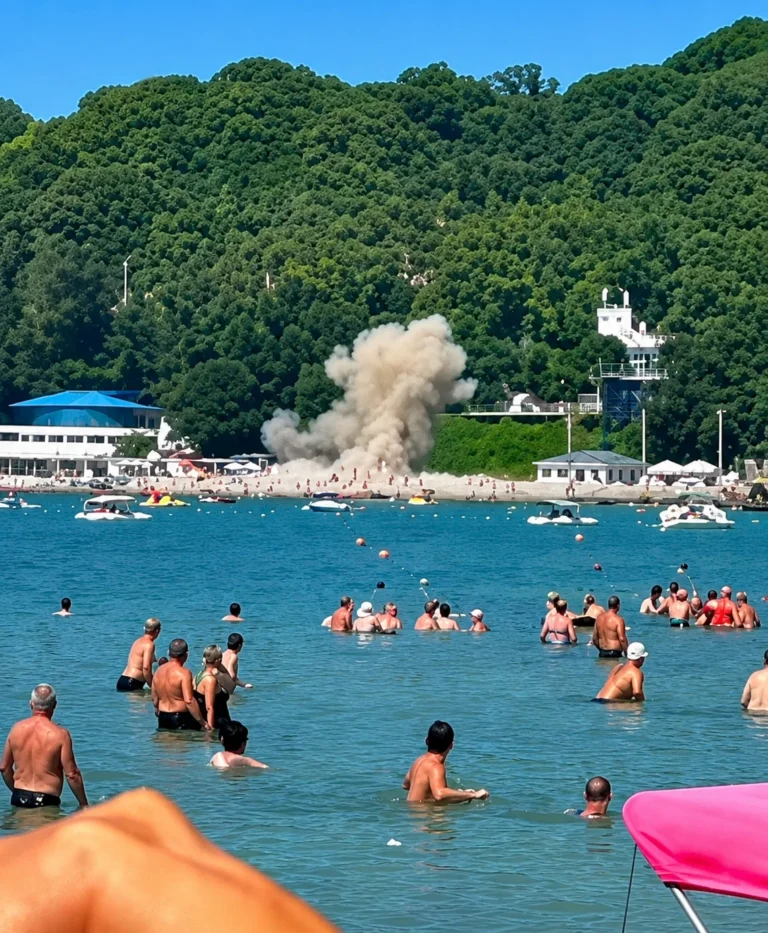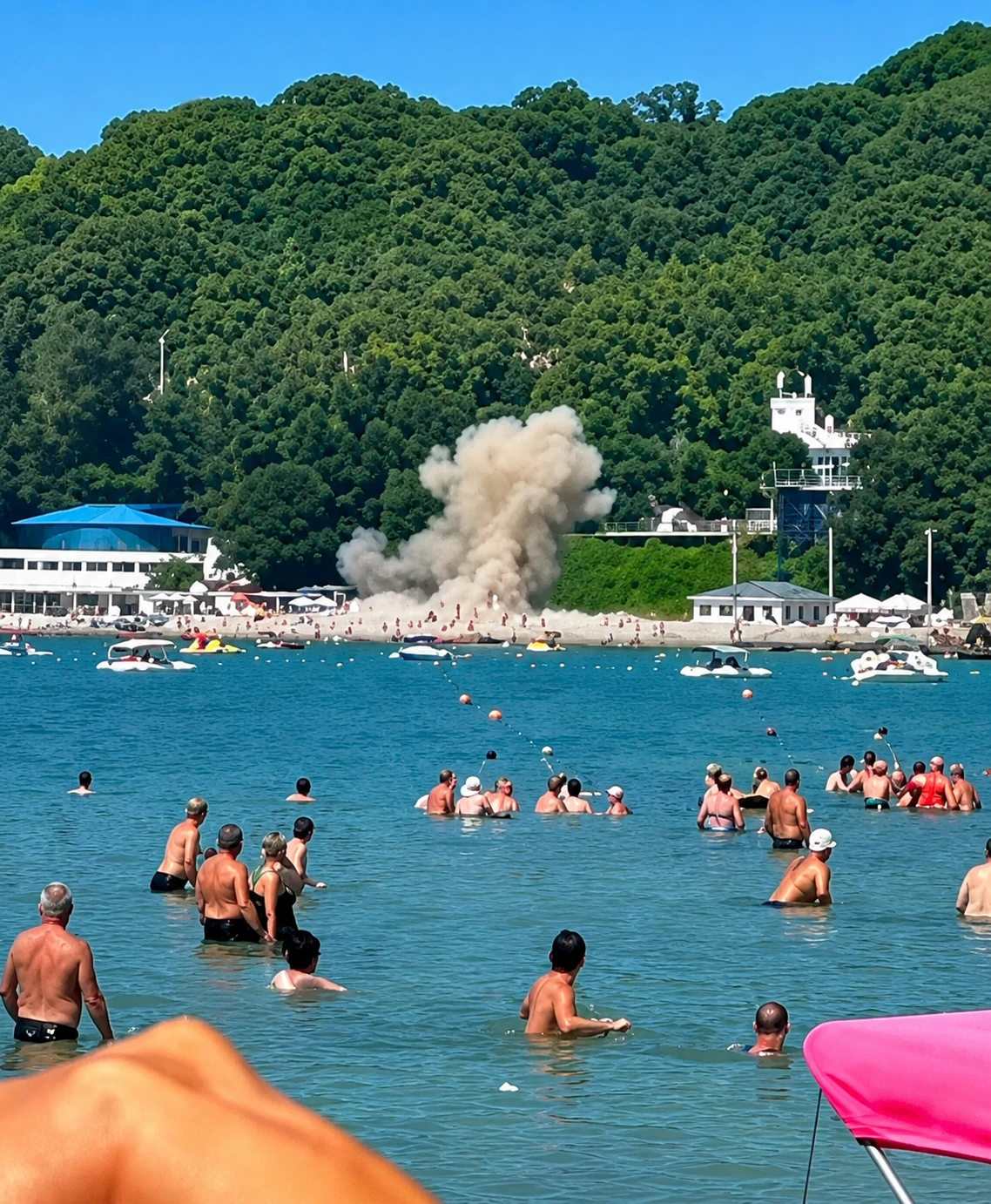
The explosion of a drone on a crowded beach along Russia’s Black Sea coast has become one of the deadliest incidents involving civilians inside Russia this summer, exposing how the war in Ukraine is increasingly reaching places once regarded as distant from the battlefield.
Russian authorities said seven people, including three children, were killed and 40 others injured when the drone crashed near the resort village of Arkhipo-Osipovka in the Krasnodar region on Monday. Seventeen people remained in hospital, according to regional governor Veniamin Kondratyev, who accused Ukraine of deliberately targeting civilians. Kyiv had not commented publicly on the incident by Tuesday.
The circumstances surrounding the strike remain contested. Russian officials have not identified the drone’s intended target, while several Ukrainian military-focused Telegram channels argued the aircraft may have been diverted after Russian electronic warfare systems interfered with its navigation.
Witnesses interviewed by Russian media also reported hearing sustained gunfire before the explosion, suggesting air-defence units may have attempted to intercept the drone over the coastline. Neither account has been independently verified.
Tourism meets the battlefield
Arkhipo-Osipovka occupies an increasingly strategic place in Russia’s domestic tourism industry. Since the invasion of Ukraine and the imposition of Western sanctions disrupted international travel and reduced direct flights abroad, millions of Russians have shifted their summer holidays to Black Sea resorts within the country.
That transformation has turned beaches once viewed primarily as economic assets into potential targets within the wider security environment created by the war. Unlike Crimea, which has frequently experienced missile and drone attacks, the Krasnodar mainland has generally remained outside the most intense strike zones despite hosting military facilities, ports and logistics infrastructure linked to Russia’s southern military operations.
Residents interviewed by local media said no air-raid sirens sounded before the explosion. Some described sheltering behind beach furniture as debris and smoke spread across the shoreline, while others said families were already in the sea when the blast occurred.
Ukraine’s drone strategy moves deeper into Russia
The attack comes amid a marked expansion of Ukraine’s long-range drone programme, which has evolved from occasional symbolic strikes into a sustained campaign against logistics, aviation, fuel storage and industrial facilities hundreds—and in some cases more than a thousand—kilometres from the Ukrainian border.
Unable to match Russia’s missile arsenal, Ukraine has increasingly relied on domestically produced drones to disrupt military supply chains and impose economic costs inside Russia. The strategy reflects a broader shift toward asymmetric warfare, allowing Kyiv to strike infrastructure beyond the range of many conventional weapons.
Among the recurring targets are warehouses operated by Wildberries, Russia’s largest e-commerce platform. Ukrainian officials have argued that some logistics centres support military procurement and transportation, allegations Moscow rejects.
Although Wildberries primarily serves civilian consumers, investigators have documented the sale of tactical equipment and dual-use products through its marketplace, illustrating how commercial supply networks have become intertwined with wartime logistics.
Hours after the beach explosion, Russian officials also reported another drone attack on a warehouse facility in the Leningrad region near St. Petersburg. Authorities did not disclose the name of the facility or assess the extent of the damage.
Electronic warfare becomes part of the battlefield
The uncertainty over why the drone landed on the beach reflects a growing feature of the conflict: electronic warfare.
Both Russia and Ukraine routinely deploy sophisticated jamming systems designed to interfere with satellite navigation and radio communications used by drones. Military analysts have increasingly noted that successful jamming can cause unmanned aircraft to lose guidance, deviate from programmed routes or crash before reaching their intended targets.
Neither military has released evidence explaining whether electronic interference or defensive fire caused Monday’s incident. Such uncertainty has become common as both sides rely heavily on electronic countermeasures whose effects are difficult to verify independently.
Civilians bear the cost of an expanding war
Civilian casualties have become an increasingly visible consequence of long-range attacks by both combatants.
Russia’s Ministry of Defence has repeatedly accused Ukraine of carrying out indiscriminate drone attacks on populated areas, while Ukrainian officials argue their operations are directed at military and logistical targets and that civilian casualties often result from interception attempts or equipment failures.
Ukraine has made similar accusations against Russia throughout the conflict. Since launching its full-scale invasion in February 2022, Russia has conducted extensive missile, drone and glide-bomb attacks on Ukrainian cities, energy infrastructure and residential districts. According to the United Nations, thousands of civilians have been killed or wounded during the war, with casualty figures continuing to rise as strikes increasingly reach urban areas.
Only days before the beach attack, Ukrainian authorities said Russian ballistic missiles struck residential areas of Kyiv, killing at least nine people and injuring dozens. Officials also reported that a separate strike in the Kryvyi Rih region killed ten members of the same family.
The changing geography of the war
The beach explosion illustrates how the conflict’s geography has evolved over more than four years of fighting.
Early phases of the war were largely confined to occupied territories and frontline regions. Advances in drone technology, domestic weapons production and electronic warfare have since enabled both Russia and Ukraine to project force far beyond the battlefield, placing industrial centres, transport hubs and civilian communities under persistent threat.

For Russian authorities, maintaining confidence in domestic security has become increasingly difficult as drone attacks reach regions previously considered relatively insulated from the conflict. For Ukraine, the campaign reflects an effort to demonstrate that military and logistical infrastructure supporting Russia’s war effort remains vulnerable regardless of distance from the front.
As both sides continue to expand the range and frequency of long-distance strikes, civilian areas increasingly occupy the same contested airspace as military targets, reducing the distinction between rear areas and active theatres of war.