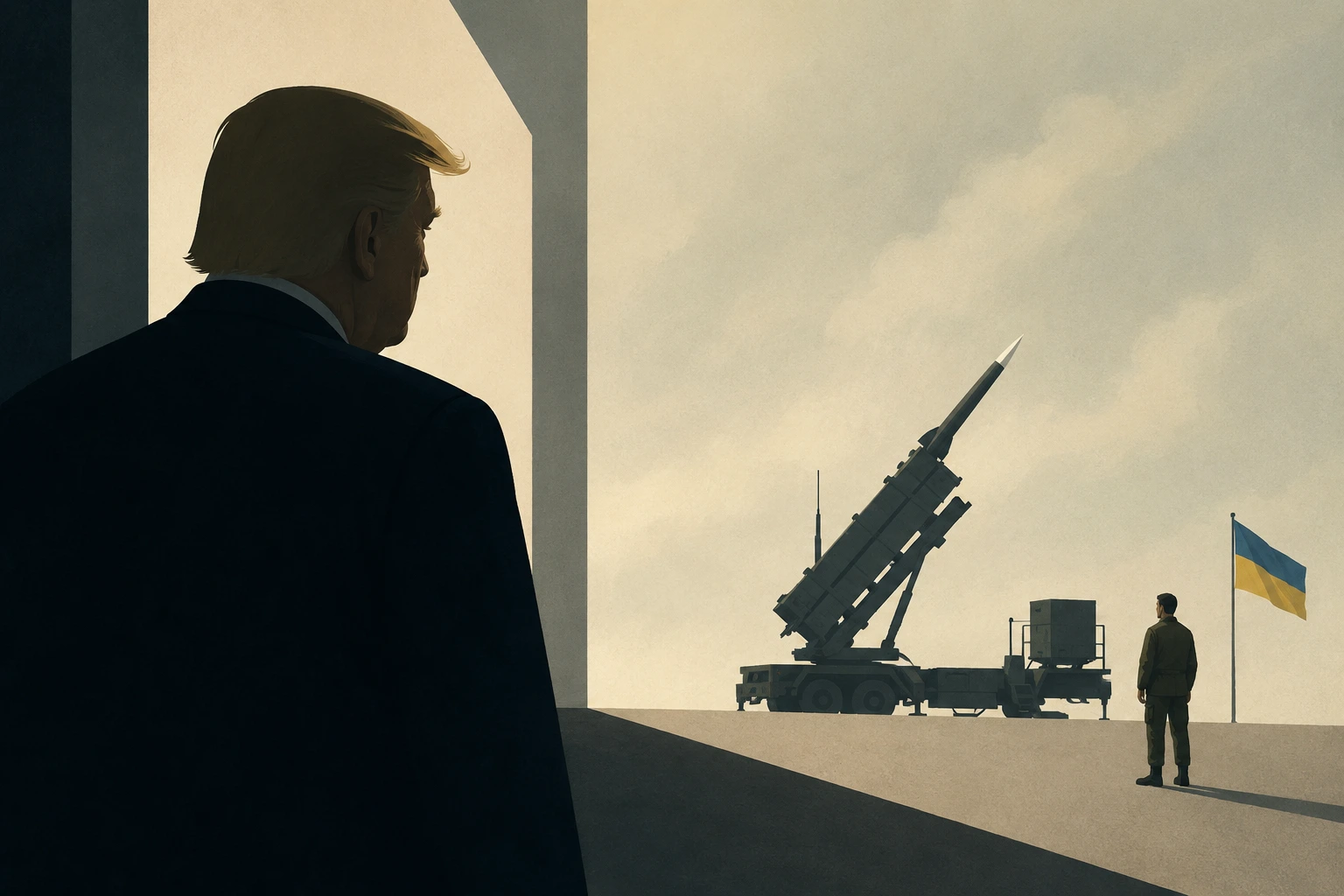
President Donald Trump has indicated that the United States has yet to decide whether it will permit Ukraine to manufacture Patriot interceptor missiles, injecting fresh uncertainty into one of Kyiv’s most strategically important defence ambitions even as Washington continues to expand military cooperation with the country.
Speaking days after hosting Ukrainian President Volodymyr Zelenskyy at the White House, Trump said his administration was still evaluating whether to grant a production licence for the missile interceptors, describing the Patriot system as exceptionally sensitive technology whose export requires careful consideration.
The comments mark a notable shift in tone from earlier statements suggesting Washington was prepared to allow licensed production. While the White House has continued to accelerate deliveries of air-defence equipment to Ukraine, authorising domestic production would represent a deeper level of technology transfer than previous military assistance packages.
Beyond Weapons, Kyiv Wants Industrial Independence
Ukraine’s push to manufacture Patriot interceptors reflects a broader wartime strategy that extends beyond receiving foreign weapons. Since Russia’s full-scale invasion in 2022, Kyiv has sought to transform itself from a recipient of military aid into a producer capable of sustaining long-term defence operations through partnerships with Western manufacturers.
The effort mirrors initiatives already under way in armoured vehicles, drones, artillery ammunition and missile maintenance, where Ukrainian factories increasingly work alongside European and American defence companies. Officials argue that local production reduces delivery times, protects supply chains from political shifts abroad and provides greater resilience as the conflict enters its fifth year.
For Kyiv, obtaining permission to produce Patriot interceptors would carry symbolic as well as military importance. It would signal a level of strategic trust rarely extended outside NATO’s closest industrial partners.
Why Patriot Matters More Than Other Air-Defence Systems
The Patriot system occupies a unique position in Ukraine’s layered air-defence network. While shorter-range systems supplied by European allies protect infrastructure against drones and cruise missiles, Patriot batteries remain among the few Western platforms capable of intercepting advanced ballistic missiles that Russia has increasingly deployed against cities including Kyiv.
Those interceptors have become particularly valuable as Russia expands production of ballistic missiles while combining them with large-scale drone attacks designed to overwhelm Ukrainian air defences. Military analysts say interceptor availability—not launcher availability—has increasingly become the limiting factor in sustaining Ukraine’s defensive shield.
That reality explains why Kyiv is seeking not merely additional batteries but the industrial capacity to replenish interceptor stocks over time.
Technology Transfer Remains Politically Sensitive
Washington has historically been cautious about allowing overseas production of advanced missile technology.
Unlike conventional weapons assembled under licence by allied nations, Patriot interceptors incorporate sensitive guidance systems, propulsion technologies and classified software that remain subject to stringent US export controls.
Any agreement would require approval under American arms export regulations and would almost certainly involve close oversight from the Departments of State and Defense alongside the manufacturers themselves.
The principal industrial partners are Lockheed Martin, which produces the PAC-3 Missile Segment Enhancement interceptor, and RTX Corporation, formerly Raytheon Technologies, which manufactures other Patriot missile variants and the overall air-defence architecture.
Europe’s Defence Industry Is Watching Closely
The debate comes as European governments attempt to expand their own defence manufacturing after years of underinvestment exposed by the war in Ukraine.
NATO members have announced multi-year plans to increase ammunition production, missile manufacturing and industrial capacity, but output continues to lag battlefield demand. European leaders have increasingly argued that Ukraine itself should become part of the continent’s defence industrial base rather than remain solely dependent on imported weapons.
Several European defence companies have already established joint ventures or announced plans to manufacture equipment inside Ukraine despite the ongoing conflict, betting that long-term security cooperation will outlast the war.
Trump’s Peace Agenda Meets Ukraine’s Security Priorities
Trump framed the licensing decision within his broader objective of negotiating an end to the conflict, saying his administration remained focused on achieving peace rather than expanding weapons programmes.
That approach illustrates the delicate balance confronting Washington. While the administration continues supplying military assistance intended to strengthen Ukraine’s negotiating position, it also seeks to preserve diplomatic leverage with Moscow as it explores avenues for ending the war.
Administration officials have indicated that senior envoys are expected to travel to Ukraine in the coming days to discuss both military cooperation and diplomatic initiatives, suggesting that defence policy and peace negotiations are becoming increasingly intertwined.
A Decision With Long-Term Consequences
Whether Ukraine ultimately receives permission to manufacture Patriot interceptors could shape the future of Western defence cooperation well beyond the current conflict.

If approved, the arrangement would establish one of the most advanced examples of wartime defence industrial integration between the United States and a non-NATO country. If delayed or rejected, Kyiv would remain reliant on foreign production lines already struggling to satisfy rising global demand for sophisticated air-defence systems.
For Ukraine, the question extends beyond acquiring another weapons capability. It concerns whether the country’s defence industry will emerge from the war as a permanent component of the Euro-Atlantic security architecture or continue to depend on decisions made abroad.