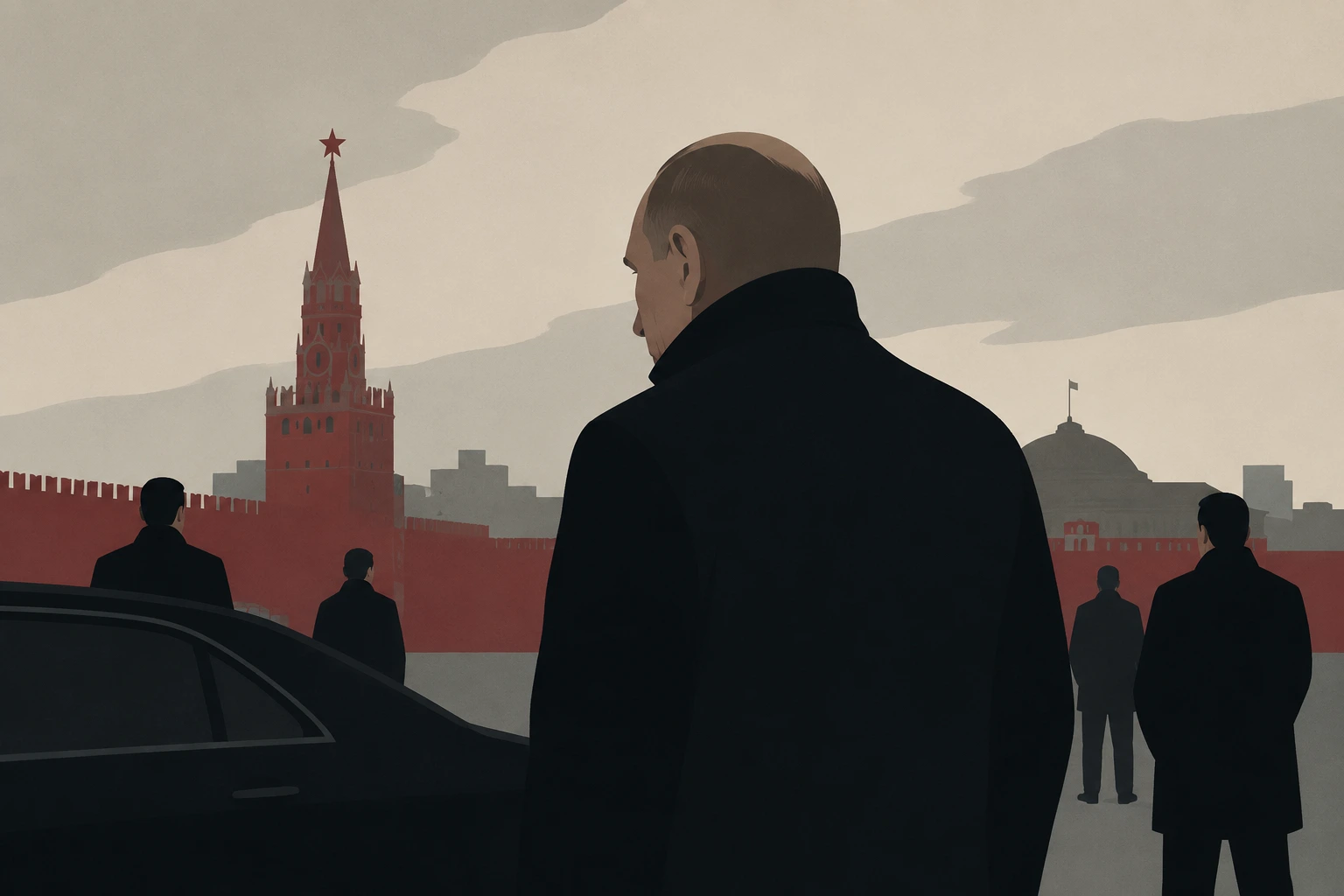
The Russian presidency has reportedly adopted some of its most extensive security precautions since the invasion of Ukraine, reflecting the increasingly complex risks confronting the Kremlin after more than four years of war.
Although the latest claims originate from a leaked European intelligence assessment that cannot be independently verified, they align with a broader trend that has seen Russia harden protection around senior officials as Ukrainian long-range strikes, sabotage operations and targeted killings have reached deeper into Russian territory.
The reported measures go beyond traditional presidential security. According to the assessment, President Vladimir Putin has curtailed travel between official residences, reduced appearances at military facilities and increasingly relied on highly secured locations for public engagements.
Members of his immediate entourage—including bodyguards, household staff and photographers—are also said to face tighter movement restrictions, while surveillance around personnel connected to the presidency has reportedly been expanded.
A Wartime Security State Reaches the Kremlin
If accurate, the precautions would represent another stage in the transformation of Russia’s wartime security architecture.
Since launching the full-scale invasion of Ukraine in February 2022, Moscow has progressively shifted resources toward defending strategic infrastructure, government institutions and senior officials against a growing spectrum of threats that now includes drones, cyberattacks, sabotage networks and covert operations inside Russia itself.
The changing security environment has become increasingly visible over the past two years. Ukrainian drones have struck military airfields hundreds of kilometres from the front, oil refineries have repeatedly suspended operations after attacks, and Moscow has experienced several high-profile drone incursions.
Russian authorities have responded by deploying additional air-defence systems around the capital, expanding electronic warfare capabilities and imposing temporary mobile internet restrictions during perceived security threats.
Assassinations Have Altered the Kremlin’s Risk Calculus
The latest intelligence assessment suggests that concerns intensified after the killing of a senior Russian military officer in a bombing that Russian investigators attributed to Ukrainian intelligence.
Moscow has repeatedly accused Kyiv of orchestrating assassinations of military commanders and officials inside Russia and Russian-controlled territory. Ukraine rarely comments on such operations, maintaining strategic ambiguity while emphasising its right to target military figures involved in the war.
Russian security planners have increasingly been forced to contend with attacks that blur the line between conventional warfare and covert operations. The expanding use of drones, intelligence networks and sabotage has brought the consequences of the war closer to Russia’s political and military leadership than at any point since the conflict began.
Elite Politics Add Another Layer of Uncertainty
Beyond external threats, the report points to growing unease within Russia’s own governing elite. It alleges that Putin has become increasingly attentive to the possibility of internal political instability, including tensions involving senior security figures. Those claims remain unverified, but they emerge against the backdrop of an unusually turbulent period within Russia’s defence establishment.
The dismissal of Defence Minister Sergei Shoigu from the ministry in 2024—while retaining him as secretary of Russia’s Security Council—was followed by sweeping corruption investigations involving several former defence officials.
Multiple senior military administrators and procurement figures have since been arrested, signalling one of the largest anti-corruption campaigns within Russia’s military bureaucracy in years.
Russian authorities have framed the prosecutions as efforts to improve accountability during wartime, while outside analysts have debated whether they also reflect shifting balances of power among competing security institutions.
The Wagner Mutiny Changed Kremlin Thinking
Those institutional rivalries have become increasingly important since the brief Wagner mutiny in June 2023, the most serious challenge to Putin’s authority during his quarter-century in power.
Although the rebellion collapsed within hours, it exposed weaknesses in Russia’s command structure and demonstrated that armed dissent could emerge from within the country’s own security apparatus rather than from external opponents.
The subsequent death of Wagner leader Yevgeny Prigozhin in a plane crash two months later removed one source of instability but did little to dispel questions about cohesion among Russia’s security elite.
For many analysts, the episode fundamentally altered the Kremlin’s understanding of internal security. Protecting the presidency now involves not only guarding against foreign adversaries but also ensuring cohesion among the institutions responsible for the state’s monopoly on force.
The Federal Protective Service Takes Centre Stage
The Federal Protective Service, known by its Russian acronym FSO, has assumed an increasingly prominent role in safeguarding the presidency. Unlike the Federal Security Service (FSB), which combines domestic intelligence, counter-intelligence and counter-terrorism functions, the FSO is responsible for protecting the president, senior state officials, sensitive government facilities and the nuclear command system.
Analysts have long regarded it as one of Russia’s most secretive institutions, with extensive technical surveillance capabilities and direct access to the Kremlin leadership.
The reported transfer of additional protective responsibilities to the FSO would be consistent with a broader trend toward centralising authority over the security of Russia’s senior leadership as wartime risks continue to evolve.
Security Measures Are Reaching Everyday Russians
Security concerns have also reshaped daily life beyond the Kremlin walls. Mobile internet disruptions—officially justified as measures against drone attacks—have become more frequent in Moscow and several other regions.
Authorities argue that restricting communications can interfere with the navigation of unmanned aerial vehicles. Businesses, logistics operators and residents, however, have increasingly complained about disruptions affecting banking services, ride-hailing applications and digital commerce, illustrating how wartime security measures are spilling into the civilian economy.
The spread of such restrictions reflects a broader shift in Russia, where domestic security considerations increasingly influence economic activity and everyday life far from the battlefield.
A Resilient Economy Under Growing Strain
Those domestic pressures coincide with broader economic challenges. Russia has avoided the severe recession predicted immediately after the invasion, largely through high levels of military expenditure, redirected trade toward Asia and extensive state intervention.
Yet economists increasingly point to structural strains, including persistent inflation, labour shortages driven by mobilisation and emigration, elevated interest rates and mounting pressure on public finances as defence spending absorbs an unprecedented share of federal resources.
Despite these headwinds, the Kremlin continues to argue that Russia has successfully adapted to Western sanctions and reoriented its economy. Independent economists, however, warn that sustaining wartime growth while preserving living standards will become increasingly difficult if the conflict continues.
An Increasingly Insulated Presidency
Despite those challenges, Putin’s political position remains stronger than that of most contemporary authoritarian leaders.
The Kremlin continues to exercise tight control over national television, electoral institutions and organised political opposition, while opinion polling conducted inside Russia consistently shows relatively high levels of public approval for the president.
Independent researchers caution, however, that polling in authoritarian systems may not fully capture private political attitudes because respondents can be reluctant to express dissent.
The leaked intelligence report’s central claims cannot be independently confirmed, and the Kremlin has not publicly addressed them.

Even so, the broader trajectory is evident: as Russia’s war with Ukraine has evolved into a prolonged conflict marked by cross-border attacks and internal security incidents, protecting the presidency has become a far more complex undertaking than it was before 2022.
Whether the latest measures reflect extraordinary concern over Putin’s personal safety or simply the realities of conducting government during wartime, they illustrate how the conflict has steadily moved from the battlefield to the very centre of Russia’s political system.