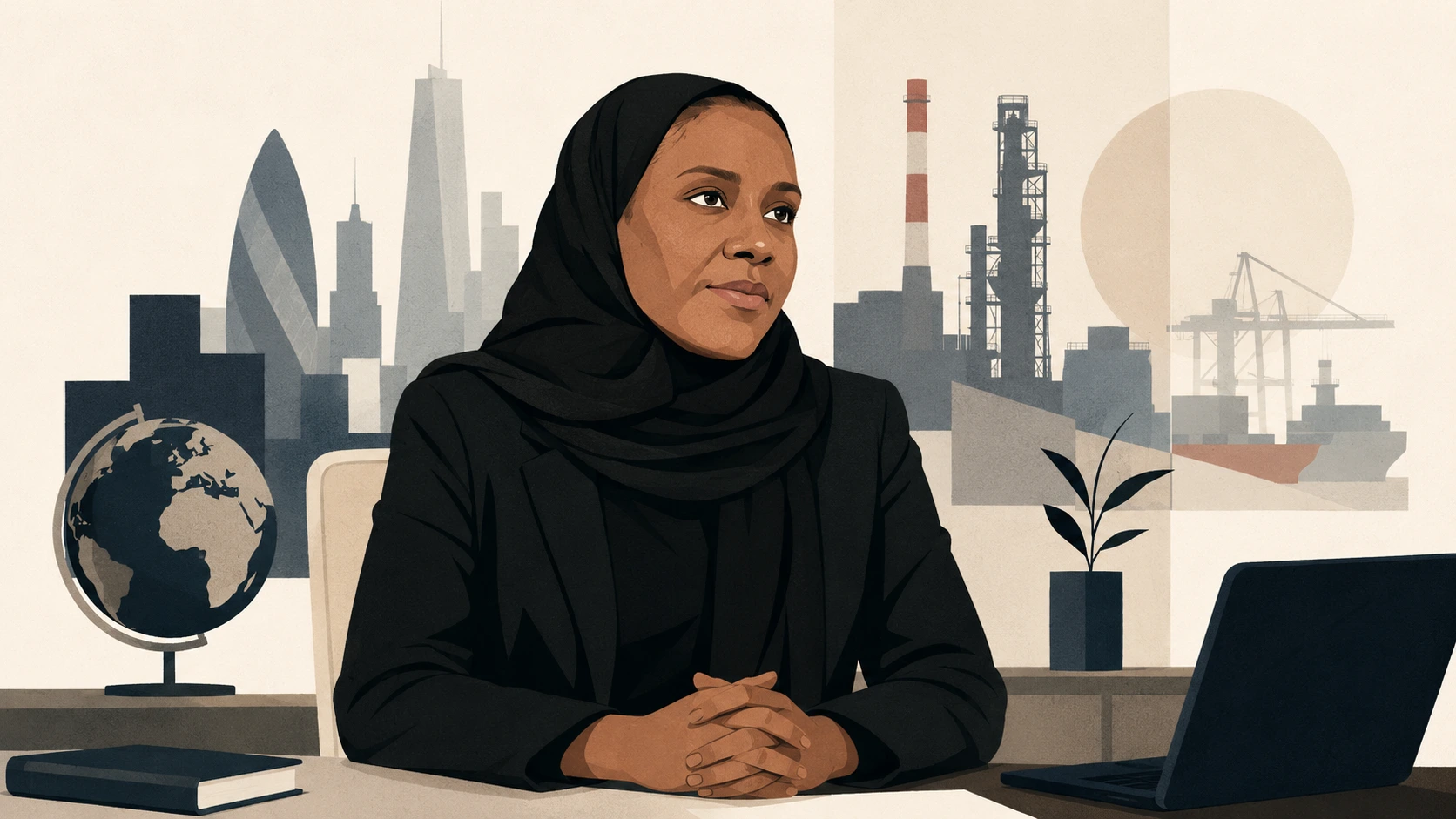
The 42-year-old executive has moved from helping turn around a flour business to managing the family office and international operations behind Aliko Dangote’s $35 billion fortune. Her hardest assignment is making sure the empire can survive its founder.
| CURRENT ROLE
Group Executive Director, Dangote Family Office and International Offices |
JOINED GROUP
2008 |
KEY EXIT
Dangote Flour Mills sale to Olam, N120 billion |
BOARD ROLES
Dangote Cement, NASCON and The Africa Center |
Late in July, Halima Dangote disclosed a decision that says almost as much about the future of Africa’s largest private industrial fortune as it does about philanthropy: her father, Aliko Dangote, intends to leave one-third of his wealth to charity. At his current Bloomberg valuation of about $35.1 billion, that would be roughly $11.7 billion – one of the largest philanthropic commitments ever contemplated by an African business family.
The announcement came from Halima, not from her father, and that detail matters. At 42, she is no longer simply one of the billionaire’s three daughters or a director inside the family conglomerate. She now occupies the junction where ownership, succession, international capital and philanthropy meet. In February, Dangote Group named her Group Executive Director for the Dangote Family Office and its international offices in Dubai and London.
It is a quieter brief than running the $20 billion refinery outside Lagos or the cement businesses that built most of the family’s fortune. It may ultimately be more consequential.
Halima’s assignment is to construct the governance framework, operating model, policies and institutional discipline that can hold together a founder-led empire when the founder is no longer directing every major decision.
That makes her, in effect, the architect of the post-Aliko Dangote era.
An apprenticeship inside the empire
Halima began her career away from the family business, as a business analyst at KPMG Professional Services in Lagos. The experience gave her exposure to performance improvement, strategy and policy work before she joined Dangote Industries Limited in 2008.
Her first role was as special assistant to the group president and chief executive – her father – supporting strategy and management decisions across a conglomerate already expanding beyond trading into large-scale manufacturing.
The route that followed was more operational than ceremonial. She served as an executive director at NASCON Allied Industries, the group’s listed salt and seasoning company, and later moved to Dangote Flour Mills, where she was responsible for sales and marketing.
Dangote Group says she helped lead the flour business from losses back to profitability before its sale to Olam in 2019.
The transaction provided an unusually measurable line on her corporate record. Olam initially valued the business at N130 billion and ultimately completed the acquisition for N120 billion. The final offer of N24 a share represented a 124% premium to Dangote Flour Mills’ last traded price before the proposal was announced.
Family-company biographies often rely on expansive claims about leadership; a completed strategic exit at a substantial premium is harder evidence to dismiss.
After the sale, Halima returned to the holding company as Group Executive Director for Commercial Operations. Her portfolio covered customer strategy, procurement, branding, communications and corporate services – the shared functions that make a collection of subsidiaries operate as a group rather than as unrelated companies carrying the same surname.
The family office as a control room
Her new role moves her closer to the ownership layer. Halima has run the Dangote Family Office in Dubai since 2023, according to the Financial Times, helping establish the family’s presence in a financial centre that has become a magnet for African, Asian and Middle Eastern capital.
The 2026 appointment widened her remit to include London and gave her explicit responsibility for governance, compliance, cost discipline and coordination across the group’s international offices.
A family office is often described as a private investment firm for the very rich. In a fortune as concentrated and industrial as Dangote’s, it is more than that. It must connect operating companies, personal wealth, estate planning, investment diversification, philanthropy and family decision-making.
It must also separate what belongs to the founder from what belongs to the businesses and establish rules before disagreements, tax pressures or succession create them under duress.
This is the problem confronting many first-generation African fortunes. The founder is frequently the principal shareholder, chief strategist, political negotiator, capital allocator and final court of appeal.
That concentration can be formidable while the founder remains active. It becomes a vulnerability during transition. Halima’s work is designed to replace personal authority with an institution capable of reproducing disciplined decisions.
The one-third charitable pledge is part of the same architecture. Halima said the plan follows Islamic inheritance principles and reflects her father’s belief that giving back is inseparable from the success of the business. The important corporate point is that the philanthropy is being embedded in succession planning rather than treated as an informal promise to be interpreted later by heirs.
Three daughters, divided responsibilities
Aliko Dangote has begun dividing major responsibilities among his three daughters. Mariya oversees commercial operations for the cement and food businesses. Fatima leads commercial operations across oil and gas, including the refinery, fertiliser and upstream assets.
Halima sits above the operating divisions in a different sense: she is building the structures through which the family will own, govern and deploy its capital internationally.
The arrangement is notable in a business culture where succession has often been improvised and where daughters are still less commonly positioned as custodians of large industrial fortunes.
It is also a test of whether the roles are genuinely matched to competence. In family businesses, surnames open doors but they do not automatically produce performance. The larger and more leveraged the group becomes, the more costly a weak transition would be.
Halima’s public record suggests deliberate preparation. She holds a bachelor’s degree in marketing from American Intercontinental University in London and an MBA from Webster Business School.
She has completed executive programmes at Harvard Business School, Kellogg School of Management and Columbia Business School. She is a non-executive director of Dangote Cement and NASCON, a trustee of the Aliko Dangote Foundation and president of the board of The Africa Center in New York.
Those posts broaden her network beyond Nigeria and beyond the group’s factories. The Africa Center role, in particular, places her at the intersection of business, policy and culture in New York – useful territory for an executive tasked with making an African industrial fortune legible to global institutions and investors.
The burden of the name
None of this removes the central problem of being an heir inside one of the world’s most founder-dominated companies. Every promotion can be read as inheritance rather than achievement. Every mistake will be treated as proof that the empire should have remained in professional hands. And every success risks being credited to the advantages of the Dangote name.
The group appears to understand the danger. Aliko Dangote has stepped back from the chairmanship of major listed companies, expanded the responsibilities of his daughters and hired senior professional managers for the refinery and the holding company.
He has said that succession planning is already under way. Halima’s portfolio is where those intentions must become enforceable rules.
Her challenge is not to become a replica of her father. Aliko Dangote built his fortune through concentration: large bets on cement, fertiliser and refining, executed with relentless attention to scale and government policy.
The next generation must manage the opposite task – diversification of authority, formal governance, international capital allocation and preservation of family unity across assets that are becoming too complex for any one person to control.
That is why Halima may emerge as the most institutionally important of the Dangote heirs even if she never becomes the public face of the conglomerate.
The refinery will attract headlines, and cement will continue to generate cash. The family office will determine how the proceeds are owned, invested, transferred and given away.
For now, her influence is easiest to see in the decisions announced through her: an international family office, a clearer division of executive responsibilities and a plan to commit a third of Africa’s largest fortune to philanthropy. These are not the moves of a family assuming that the founder will always be there. They are the early outlines of a system intended to make sure he does not have to be.