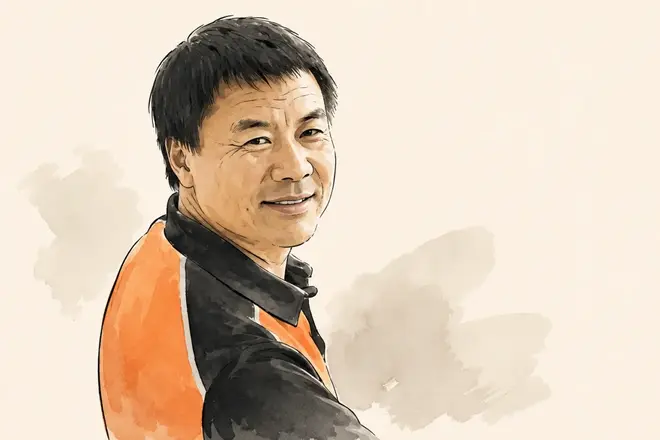
A Chinese food delivery rider whose poems chronicle the struggles, resilience and dignity of gig economy workers has won one of the country’s highest literary honours, highlighting the growing recognition of blue-collar voices in contemporary Chinese literature.
Wang Jibing, 56, received the prestigious Lu Xun Literary Prize for his poetry collection Low Flight, a work inspired by the daily experiences of food delivery riders navigating the pressures of China’s rapidly expanding platform economy.
Named after Lu Xun, widely regarded as the father of modern Chinese literature, the award recognises outstanding literary achievements in China. While the current cash prize has not been publicly disclosed, previous editions awarded winners 100,000 yuan (about $14,800).
Speaking after the announcement on July 15, Wang admitted the attention surrounding his nomination had been emotionally taxing. “I held my breath and felt extremely nervous. Once it was revealed, everything was settled,” he told China’s Global Times.
From Construction Sites to Literary Acclaim
Born in Jiangsu Province, Wang left school as a teenager because of financial hardship and spent decades taking on manual jobs, including construction work, waste collection and street vending.
Around 2019, he became a food delivery rider, a profession that would later provide the inspiration for much of his writing.
Despite the demands of the job, Wang nurtured a passion for literature, regularly posting poems and essays on Chinese social media over the past decade.
His breakthrough came in 2022 when his poem Man in a Hurry went viral online. The piece was inspired by a frustrating delivery in which a customer entered the wrong address, forcing him to spend hours completing a single order.
The following year, he published his first poetry collection, Man in a Hurry: Poems of a Food Delivery Rider, earning widespread recognition among readers.
Published in 2024, Low Flight expands on Wang’s exploration of life in China’s gig economy.
The collection draws on interviews and surveys he conducted with about 200 delivery riders, capturing the economic uncertainty, physical exhaustion and emotional resilience that define the profession.
One of the collection’s best-known lines reads: “Who says spreading your wings means flying high? Flying low is also flying.”
The work offers an intimate portrait of millions of workers whose labour underpins China’s booming food delivery and e-commerce industries but whose voices have often remained absent from mainstream literature.
Despite receiving one of China’s most prestigious literary honours, Wang says he has no intention of leaving his delivery job. He told Global Times he plans to continue working until the age of 60, saying the job offers him more than just income. “Financially I don’t need this job to make a living, but I love the vibe of the work and it keeps me fit. I want a down-to-earth life and the award will never change who I am.” He said.
Chinese Working-class Literature
Wang’s success reflects a broader trend in Chinese literature, where blue-collar workers are increasingly gaining recognition for authentic accounts of working-class life.
In 2023, former courier Hu Anyan published I Deliver Parcels in Beijing, a memoir that became a bestseller in China before being translated into English.
Earlier, migrant worker Fan Yusu captured national attention with her autobiographical essay I Am Fan Yusu, which went viral in 2017 for its candid account of hardship and perseverance.