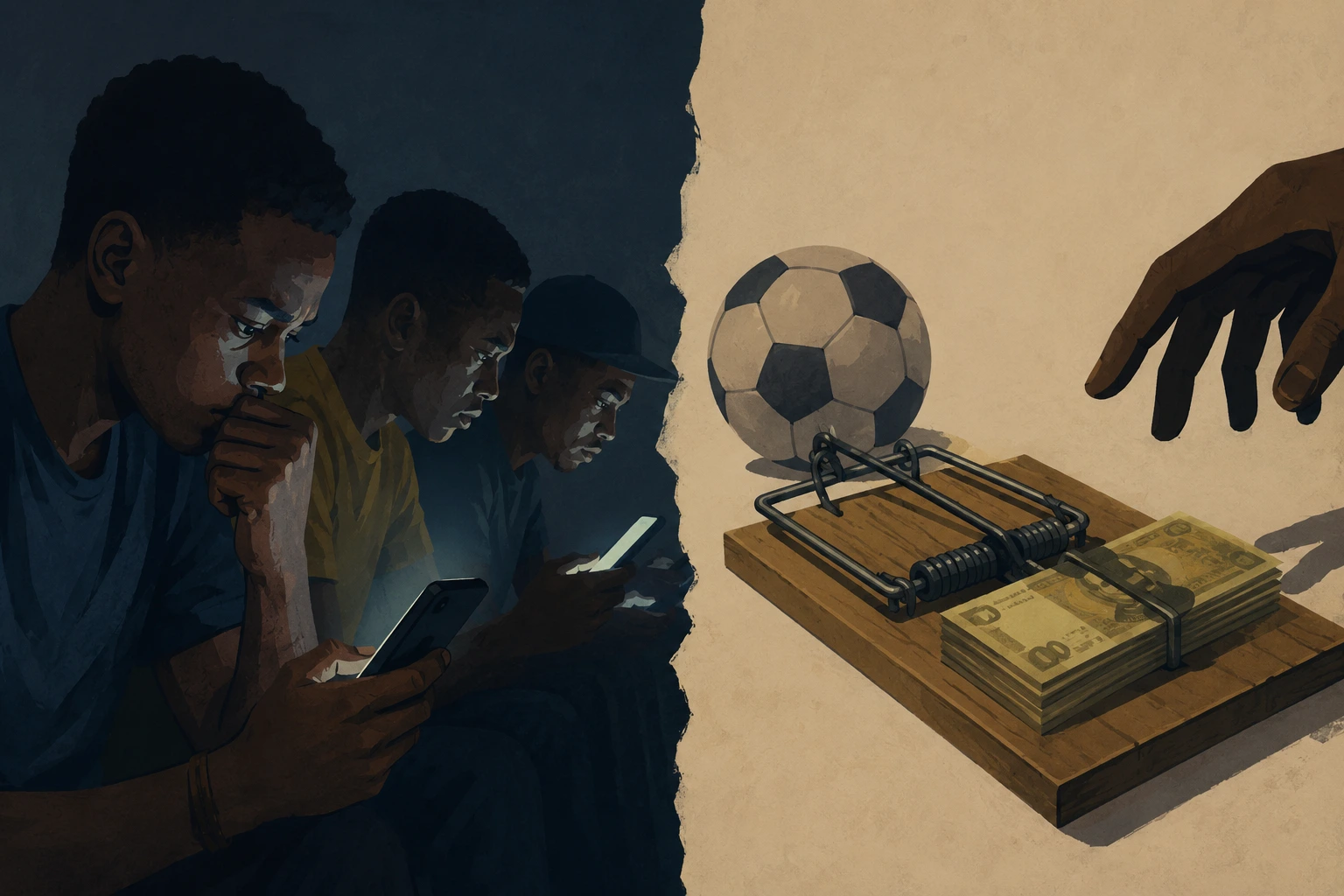
On any given weekend, millions of Africans gather around televisions and smartphones, watching football matches from England, Spain, Italy, and Saudi Arabia. But many are not simply supporting their favourite clubs—they are waiting for a wager to change their lives.
A last-minute goal. A red card. An extra-time winner.
For a growing number of young people, these moments represent something far greater than sport. They represent hope.
Across Africa, sports betting has evolved from a niche form of entertainment into a multi-billion-dollar industry woven into everyday life. Betting companies sponsor football clubs, dominate advertising during live broadcasts, partner with celebrities, and market themselves as gateways to financial freedom. In Nigeria alone, industry estimates suggest that between 50 and 60 million people actively participate in sports betting, making it one of the continent’s largest gambling markets.
Yet behind the rapid growth lies a deeper question: Is Africa building an economy driven by productivity—or by the commercialization of hope?
Betting’s New Economic Empire
Few industries have expanded as rapidly over the past decade as online betting.
Cheap smartphones, affordable mobile data, digital payment systems, and the continent’s youthful population have created ideal conditions for explosive growth. Analysts estimate that Nigeria’s betting industry alone generates more than US$2 billion annually, while similar growth is occurring across Kenya, Ghana, Uganda, South Africa, Tanzania, and other African markets.
Television viewers rarely watch a football match without seeing multiple betting advertisements. Some of the world’s largest football clubs have entered sponsorship agreements with betting companies, while retired football legends and popular influencers increasingly promote gambling platforms to millions of followers.
The result is a powerful cultural shift.
Where previous generations admired entrepreneurs, engineers, doctors, and industrialists, many young people today are repeatedly exposed to messages suggesting that wealth can arrive through prediction rather than production.
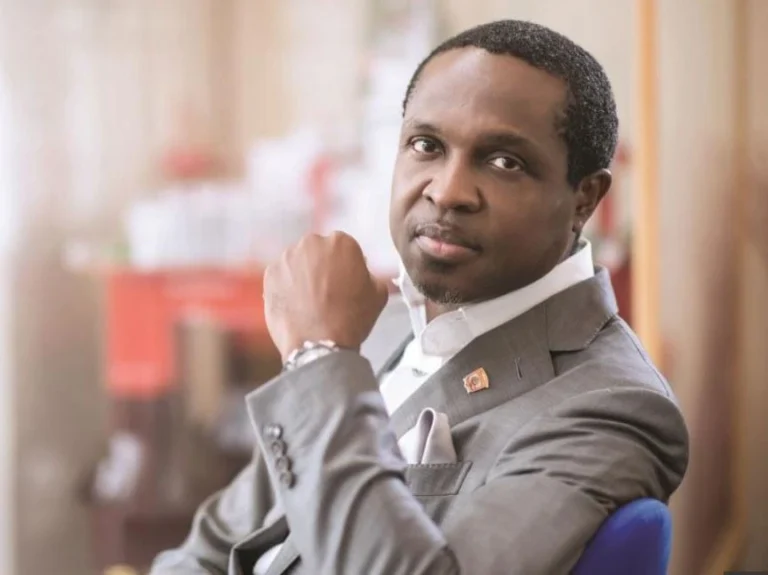
Business leader Austin Okere argues that this transformation represents more than a change in consumer behaviour. It reflects the rise of what he calls “hope-based industries”—businesses that monetize aspiration without necessarily creating lasting economic value.
Why Betting Is So Difficult to Resist
The popularity of betting cannot be explained by economics alone. Psychology plays an equally important role.
Scientists have long understood that gambling activates one of the brain’s most powerful learning systems: the variable reward schedule. First demonstrated by behavioural psychologist B.F. Skinner, this mechanism shows that rewards delivered unpredictably are far more addictive than rewards delivered consistently.
Every winning ticket reinforces the belief that another victory may be just one bet away. Modern neuroscience has added another layer to this understanding. Dopamine—the brain chemical commonly associated with pleasure—is released most strongly during anticipation rather than after receiving a reward.
For gamblers, the excitement of waiting for a match to finish, hoping for a late goal or dramatic comeback, often produces a stronger neurological response than the prize itself.
This anticipation encourages repeated betting, even after significant financial losses.
Another psychological phenomenon, known as the near-miss effect, further strengthens this cycle. A bettor who correctly predicts fourteen out of fifteen football matches experiences disappointment, but the brain interprets the result as evidence that success is close.
Instead of discouraging future gambling, near misses often increase the desire to continue.
Behavioural economists also identify optimism bias and the illusion of control as powerful influences. Most bettors believe they possess superior football knowledge or betting strategies, despite overwhelming statistical evidence that bookmakers consistently hold the long-term advantage.
The Mathematics Always Favour the House
The betting industry is frequently presented as an opportunity to make money. In reality, it is designed to make money for bookmakers.
Every betting company builds a mathematical profit margin—known as the house edge—into the odds it offers customers. Individual players occasionally win substantial prizes, but the industry’s long-term profitability depends on millions of customers collectively losing more than they gain.
The World Health Organization notes that a relatively small proportion of heavy gamblers account for a disproportionately large share of gambling revenue, highlighting the industry’s dependence on repeated participation rather than isolated winners.
The stories of jackpot winners dominate advertising campaigns and social media, while the far larger population of unsuccessful bettors remains largely invisible.
This imbalance creates the illusion that extraordinary success is common when, statistically, it is exceptional.
The Hidden Cost to Families
The consequences extend well beyond lost money.
Austin Okere points to growing reports of students using tuition fees to gamble, workers diverting business funds in hopes of replacing them with winnings, and individuals spending nights inside betting centres pursuing another opportunity to recover previous losses.
Across many communities, traders, artisans, and salary earners have watched portions of household income disappear into gambling accounts instead of paying school fees, rent, healthcare expenses, or investments.
The World Health Organization classifies gambling disorder as a behavioural addiction associated with depression, anxiety, family breakdown, financial distress, substance abuse, and an elevated risk of suicide among severe cases.
Financial institutions and researchers have also linked problem gambling to higher levels of personal debt, workplace fraud, theft, and bankruptcy.
While comprehensive African data remain limited, these patterns increasingly mirror experiences already documented in Europe, Australia, and North America.
Opportunity Cost: The Wealth Africa Never Creates
The greatest economic danger may not be the money that is lost. It is the wealth that is never created.
Economists distinguish between wealth creation and wealth transfer. When money is invested in agriculture, manufacturing, technology, education, renewable energy, healthcare, or infrastructure, it produces new goods, services, businesses, jobs, and productivity.
Betting largely transfers existing money between participants, operators, and shareholders.
It rarely builds factories., It rarely finances innovation, It rarely increases agricultural output or industrial capacity, Instead, it redistributes purchasing power while extracting commissions for operators.
As Okere asks, after billions of naira circulate through betting platforms, what has actually been produced? Have more schools been built? Have hospitals expanded? Has the economy become more productive?
Africa’s Demographic Dividend at Risk
Africa possesses one of the world’s greatest economic opportunities.
By 2050, roughly one in four people on Earth is expected to be African, according to demographic projections. If these young people acquire education, skills, employment, and entrepreneurial opportunities, the continent could become one of the world’s most powerful engines of economic growth.
But demographic advantage is not automatic.
It depends on productive investment in human capital.
When millions of young adults devote substantial time, attention, and disposable income to speculative gambling rather than education, savings, business creation, or professional development, the continent risks weakening the very workforce expected to drive future prosperity.
The issue is not that every bettor becomes addicted.
Most do not.
The concern is whether an entire generation increasingly comes to believe that financial security depends more on prediction than preparation.
The Power of Advertising and Role Models
Sports betting companies understand that trust sells.
That is why they increasingly recruit admired athletes, football legends, musicians, and influencers to promote their platforms. For many young fans, the distinction between celebrity endorsement and personal recommendation becomes blurred.
If respected sporting heroes appear to endorse betting as normal, entertaining, or profitable, the behaviour gains legitimacy. Okere argues that societies ultimately become reflections of what they celebrate.
When role models encourage shortcuts instead of entrepreneurship, persistence, and innovation, aspirations begin to shift accordingly.
Beyond Gambling: A Question About Africa’s Future
The debate over betting is ultimately about far more than gambling.
It is about the type of economy Africa wants to build.
Can sustainable prosperity emerge from industries that primarily monetize hope, or must long-term growth continue to depend on education, manufacturing, innovation, productive enterprise, and disciplined investment?
No economy has achieved lasting prosperity through speculation alone.
History shows that nations become wealthy by rewarding productivity, creating businesses that solve real problems, developing technologies, expanding industries, and investing in people.
Betting offers the possibility of extraordinary reward to a fortunate few.
Enterprise offers the possibility of sustained prosperity to entire societies.

As Africa seeks to harness the potential of its young population, the challenge may not simply be regulating gambling more effectively. It may be rebuilding confidence that hard work, innovation, and entrepreneurship remain the most reliable pathways to lasting wealth.
That is a form of hope no bookmaker can sell.