South Korea’s ambition to turn ordinary households into long-term investors has collided with the volatility of the global artificial intelligence boom, after a sharp correction in semiconductor stocks erased billions of dollars in paper wealth and prompted regulators to curb some of the market’s riskiest investment products.
A National Strategy Meets Market Reality
The sell-off, centred on semiconductor leaders Samsung Electronics and SK Hynix, has become more than a routine market correction. It is testing a broader economic strategy that sought to redirect household savings away from property speculation and into domestic capital markets, using the country’s globally competitive technology sector as the principal attraction.
For much of the past two years, that strategy appeared to be working. Demand for advanced memory chips used in AI servers transformed South Korea into one of the world’s best-performing equity markets.
Foreign institutions returned to Seoul, corporate profits surged and retail participation reached levels rarely seen outside the pandemic-era trading boom.
Why AI Turned Korea Into a Market Darling
The optimism rested on a structural shift in the semiconductor industry rather than short-term speculation alone. Generative AI applications have sharply increased demand for high-bandwidth memory (HBM), a specialised chip segment dominated by Samsung Electronics and SK Hynix. Both companies became indispensable suppliers to AI infrastructure built by major technology firms developing large language models and expanding hyperscale data centres.
That industrial success encouraged many South Koreans to view semiconductor shares less as cyclical technology investments than as long-term bets on the future of artificial intelligence itself. As valuations climbed, however, a growing number of investors sought to amplify returns through borrowed money and leveraged exchange-traded funds tied to individual stocks.
How Leverage Turned a Correction Into a Rout
The widespread use of leverage ultimately magnified the market’s decline.
When semiconductor shares began retreating after months of exceptional gains, falling prices triggered margin calls that forced investors to liquidate positions. Those sales accelerated declines, placing further pressure on leveraged funds designed to deliver multiples of daily price movements. Analysts say the resulting feedback loop temporarily overwhelmed normal market pricing as forced selling replaced fundamental valuation.
Unlike conventional ETFs, single-stock leveraged funds reset their exposure every trading day. During periods of sustained volatility, that structure can produce returns that diverge sharply from the underlying stock over longer periods—a feature that many inexperienced investors underestimate.
South Korean regulators approved a series of such products only weeks before the correction, a timing that has attracted scrutiny from market participants and policymakers alike.
Regulators Move to Contain Systemic Risks
The Financial Services Commission and other regulators have since moved to tighten access to leveraged ETFs after concluding that the products had amplified market swings. Officials have also expressed concern that rapid growth in margin lending increased vulnerabilities within household finances at a time when South Korea already carries one of the highest household debt burdens among advanced economies relative to gross domestic product.
Some lawmakers have also proposed tax relief for retail investors who realised significant losses, while financial authorities continue monitoring liquidity conditions across domestic markets to prevent further forced selling.
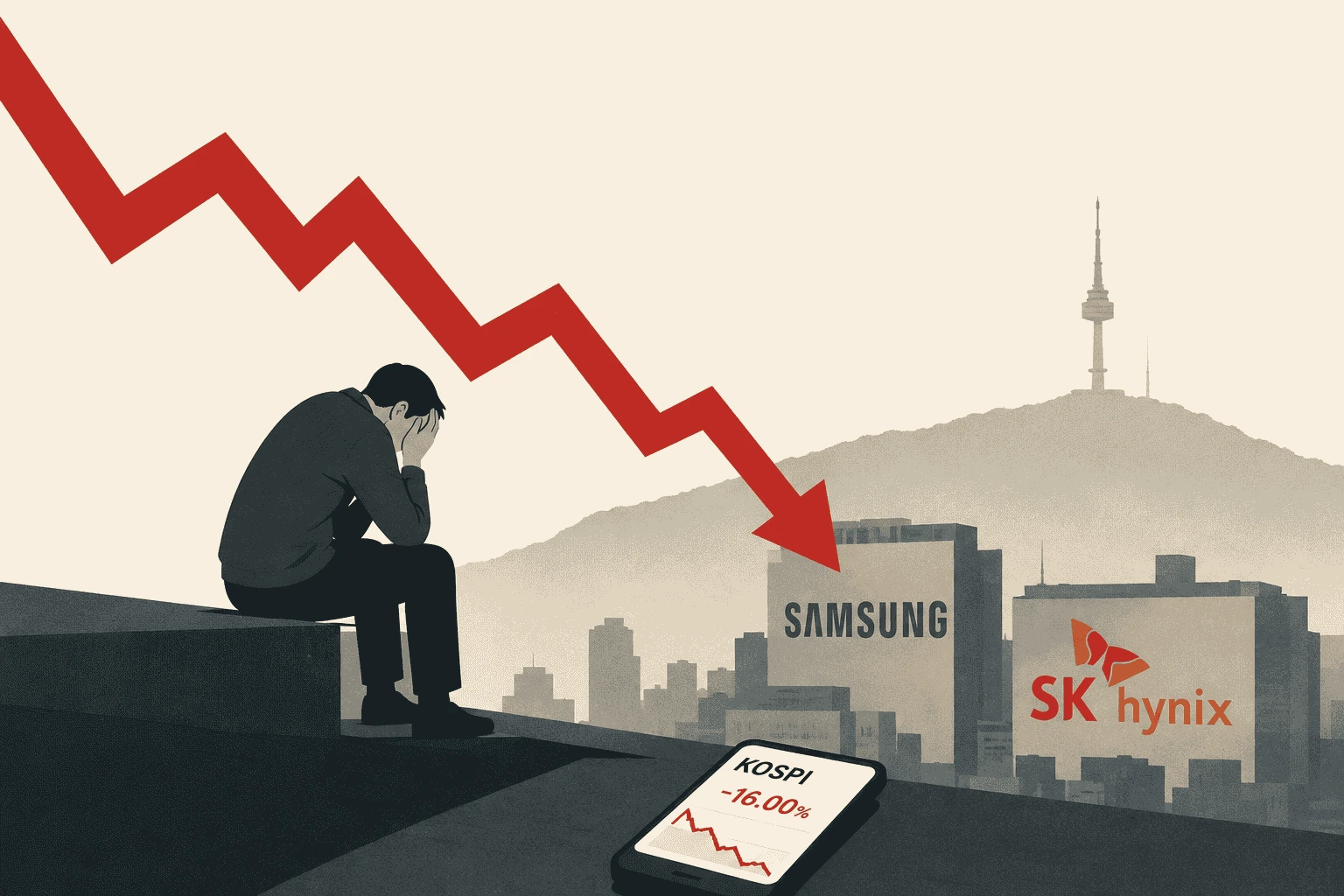
a distressed investor sitting on a rooftop as a large red downward arrow cuts across the Seoul skyline toward office buildings representing major semiconductor companies, symbolizing South Korea’s AI-driven stock market sell-off and heavy retail investor losses.
The Rise of Korea’s Retail Investor Generation
The episode illustrates how South Korea’s retail investing culture has evolved since the COVID-19 pandemic. During lockdowns, millions of first-time investors opened brokerage accounts, joining what local media dubbed the “Donghak Ant Movement”—a reference to small investors banding together to buy domestic shares in response to heavy foreign selling.
What began as a grassroots movement gradually matured into a permanent feature of Korean financial markets, giving retail investors unprecedented influence over daily trading volumes.
Successive governments sought to build on that momentum. President Lee Jae Myung has promoted a stronger equity culture as part of wider efforts to improve corporate governance, deepen domestic capital markets and reduce the country’s long-standing “Korea Discount”—the tendency for Korean companies to trade below comparable international peers because of governance concerns, opaque ownership structures and relatively low shareholder returns.
The recent correction has complicated that agenda. Investors who entered near market highs have experienced losses severe enough to erode confidence in equities just as policymakers were attempting to encourage greater participation. Brokerage data suggest hundreds of thousands of retail shareholders in Samsung Electronics and SK Hynix are now holding unrealised losses despite both companies remaining substantially above their levels at the beginning of the year.
Strong Chip Demand Has Not Disappeared
Yet the market turbulence has not reflected a deterioration in the semiconductor industry’s underlying business.
Samsung Electronics recently reported record quarterly revenue and operating profit, supported by continuing global demand for AI memory chips. The results reinforced expectations that capital expenditure by cloud computing providers and AI developers remains robust despite increasing investor concern that share prices had outrun earnings expectations.
That divergence between corporate fundamentals and market sentiment has become a defining feature of the global AI investment cycle.
Similar corrections have periodically affected semiconductor stocks in the United States, Taiwan and Japan, where investors have grappled with the distinction between genuine long-term demand growth and valuations inflated by speculative enthusiasm.
A Warning for Global AI Investors
South Korea’s experience also reflects a broader shift in global financial markets, where passive investment vehicles and leveraged products increasingly influence price movements alongside traditional institutional investors.
Daily rebalancing by leveraged ETFs can amplify volatility during periods of rapid market movement, prompting regulators in several jurisdictions to reassess how such products are marketed to retail clients.
For international investors, the Korean correction serves as a reminder that leadership in AI hardware manufacturing does not insulate equity markets from speculative excess.

Companies supplying critical technologies may continue delivering strong earnings while their share prices fluctuate sharply as investors reassess risk, liquidity and future growth expectations.
Whether confidence returns quickly will depend less on semiconductor demand—which remains supported by expanding AI infrastructure investment—than on the willingness of retail investors to re-enter a market where leverage transformed a routine correction into one of the most painful episodes many individual shareholders have experienced in years.