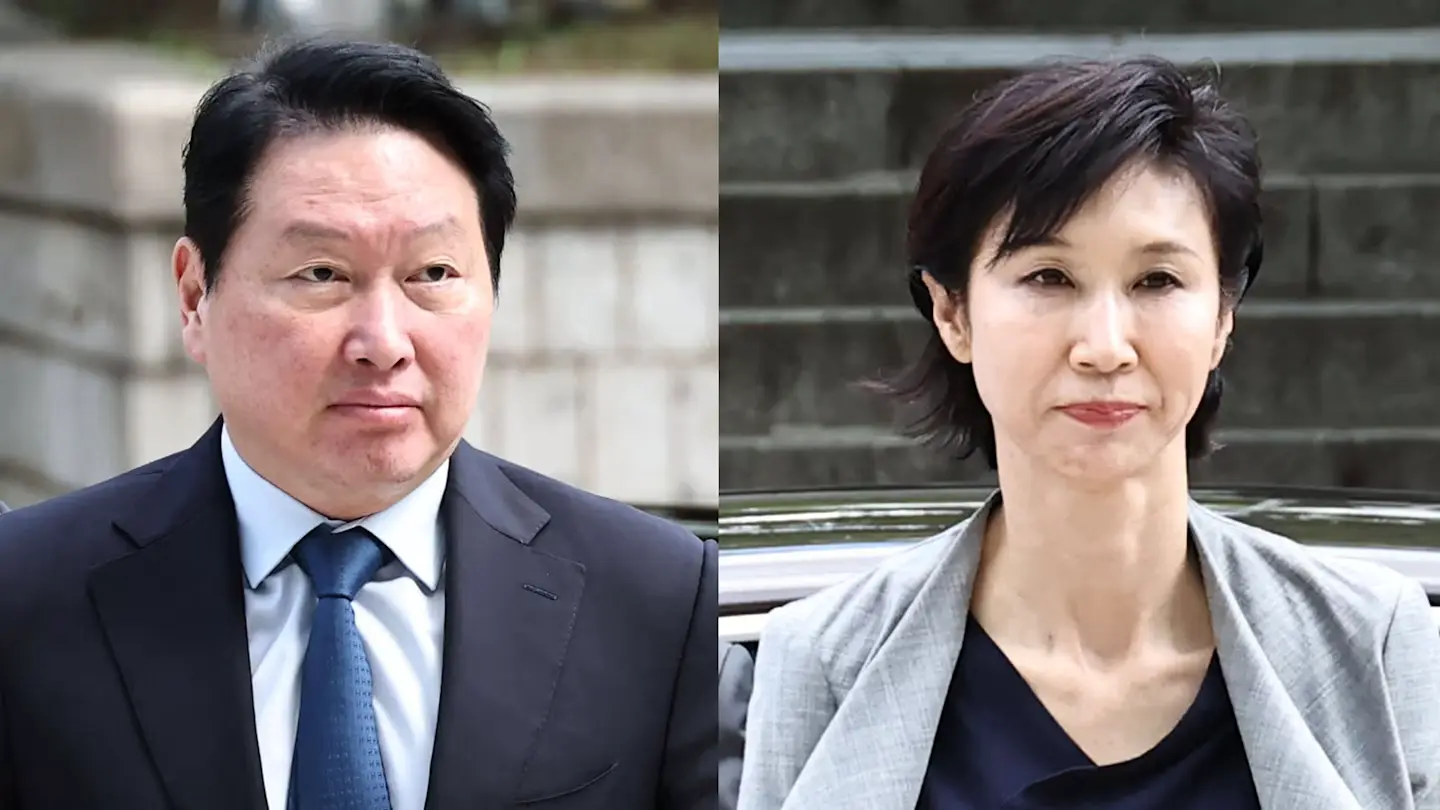
A South Korean court has ordered SK Group chairman Chey Tae-won to pay his former wife, Roh Soh-yeong, 944 billion won (about $644 million) in what is now the country’s largest divorce settlement, bringing one of the nation’s most scrutinized legal battles closer to an end after more than a decade of litigation.
The ruling by the Seoul High Court recalculates the division of marital assets following years of appeals that tracked not only the collapse of a prominent political and business marriage but also the extraordinary rise in the value of South Korea’s semiconductor industry.
While the payment represents roughly one-eighth of Chey’s estimated personal fortune, the court allowed the settlement to be made in cash, reducing the likelihood of immediate changes to the ownership structure of SK Group.
A Divorce That Became a Corporate Governance Story
The dispute has long extended beyond family law.
Chey leads SK Group, South Korea’s second-largest conglomerate by assets, whose businesses span semiconductors, telecommunications, energy, batteries and advanced materials. Its crown jewel, SK Hynix, has become one of the world’s most strategically important chipmakers as demand for artificial intelligence infrastructure has transformed the global semiconductor market.
The timing of the latest ruling reflects that transformation. Since Chey initiated divorce proceedings in 2017, SK Hynix’s market value has surged dramatically as it became Nvidia’s leading supplier of high-bandwidth memory (HBM) chips used in AI accelerators.
The court said the appreciation in Chey’s shareholdings could not be separated entirely from his role in managing the company, making those gains relevant when calculating the marital estate.
The judgment substantially increases the award from an earlier lower-court decision that had valued Roh’s entitlement at only a fraction of the current figure.
Political Legacy Meets Corporate Dynasty
The marriage joined two influential South Korean families.
Roh Soh-yeong is the daughter of former President Roh Tae-woo, who governed South Korea between 1988 and 1993 during the country’s transition toward democratic civilian rule. Chey belongs to the founding family of SK Group, one of the family-controlled conglomerates—or chaebol—that have dominated South Korea’s industrial development since the second half of the twentieth century.
The relationship deteriorated publicly in 2015 when Chey disclosed an extramarital relationship and acknowledged fathering a child outside the marriage. Divorce proceedings formally followed in 2017 after mediation efforts failed.
Legal arguments since then have centered on one of the most difficult questions in South Korean family law: how to distinguish inherited wealth from assets created through joint marital contribution when fortunes expand dramatically during a marriage.
Courts Revisited Earlier Assumptions
The litigation has already produced one significant legal reversal.
In 2024, the Seoul High Court had awarded Roh more than 1.4 trillion won after accepting arguments that funds linked to her late father’s political network indirectly contributed to SK Group’s expansion. South Korea’s Supreme Court later overturned that reasoning, concluding that the former president’s slush fund could not legally be treated as Roh’s personal contribution when dividing marital assets.
The case was sent back for reconsideration, resulting in Friday’s revised award of 944 billion won while leaving intact separate alimony previously ordered by the courts.
The decision may become an important reference point for future disputes involving ownership of family-controlled conglomerates, particularly where company valuations rise sharply during lengthy court proceedings.
Why Investors Are Watching
Despite the headline figure, analysts expect limited immediate consequences for SK Group’s governance.
Chey remains the group’s controlling figure through his holdings in SK Inc., the conglomerate’s principal holding company. Because the court permitted payment in cash rather than requiring a transfer of shares, market observers believe he has multiple financing options—including asset sales or loans secured against existing equity—that would avoid diluting his voting control.
That distinction matters for investors. SK Hynix occupies a central position in the global semiconductor supply chain, supplying advanced memory products essential for AI systems built by companies including Nvidia. Any uncertainty over governance at the parent group has implications extending beyond South Korea’s domestic market.
A Landmark in South Korean Family Law
South Korean courts have gradually moved toward recognizing the economic contributions of spouses in high-net-worth divorces, even when one partner formally owns business assets.
Earlier generations of chaebol divorces often resulted in comparatively modest settlements because controlling family shareholdings were viewed largely as inherited property. More recent rulings have adopted a broader interpretation of marital contribution, particularly where wealth increased substantially during the marriage through business expansion.

Legal specialists say the Chey-Roh case is likely to influence future disputes involving business founders, controlling shareholders and inherited corporate wealth, especially as South Korea continues to confront questions about succession, governance and transparency within its largest conglomerates.
For SK Group itself, the judgment removes one of the longest-running personal legal uncertainties surrounding its chairman. Attention is now expected to return to the company’s role in the global AI semiconductor race, where SK Hynix has become one of the industry’s most critical suppliers amid surging worldwide demand for advanced memory chips.