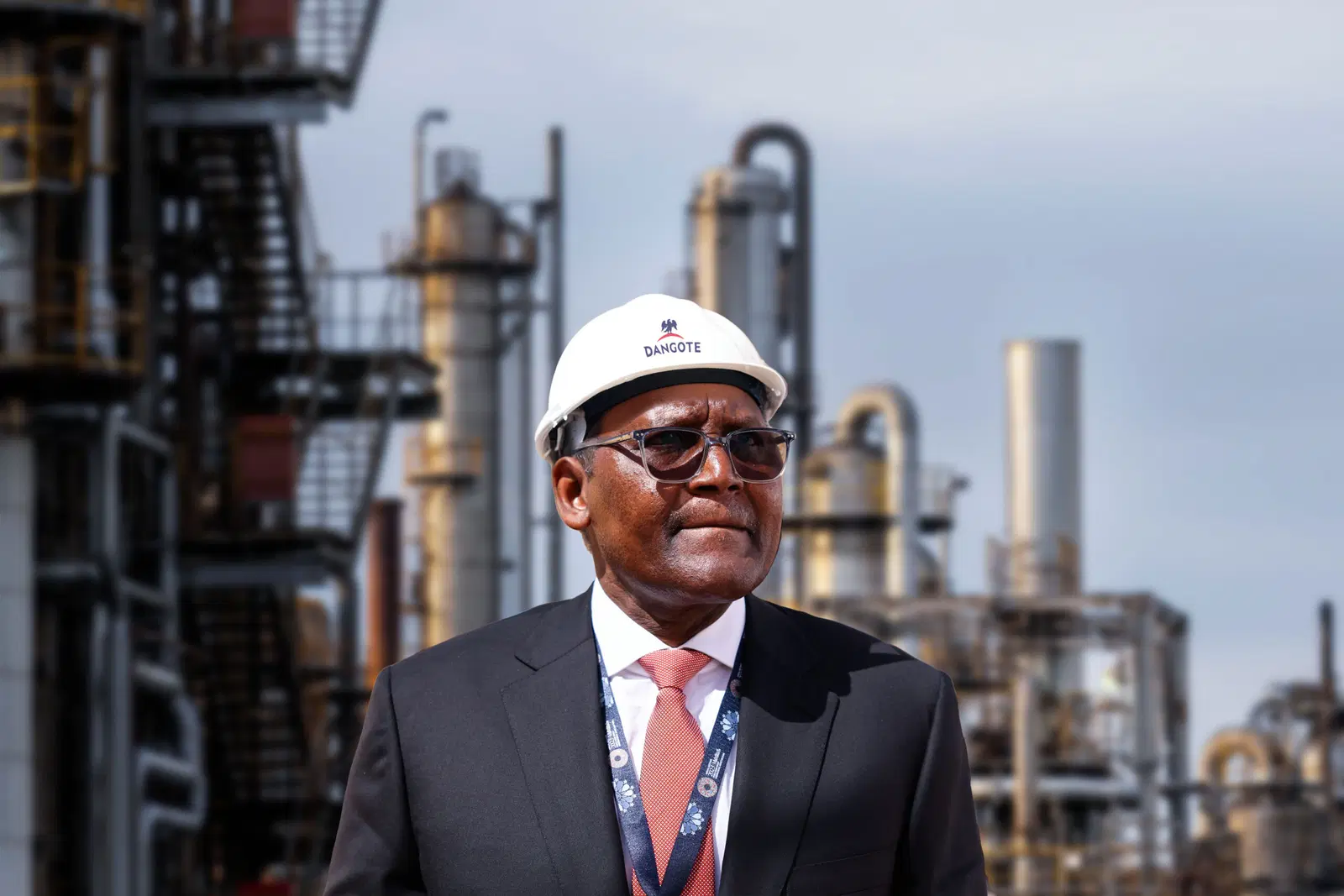
Aliko Dangote is selling more than shares in Nigeria’s biggest industrial project. With the planned public offering of his 650,000-barrel-a-day refinery, Africa’s richest man is attempting to create a mass shareholder base around an asset that he increasingly sees as the foundation of a continent-wide industrial strategy.
The Dangote Petroleum Refinery and Petrochemicals IPO will offer 4.1 billion shares at ₦525 each, potentially raising about ₦2.15 trillion ($1.6 billion). The offer is scheduled to open on September 14 and close in October, with a listing on the Nigerian Exchange expected in November.
But the fundraising target tells only part of the story.
Dangote has said the refinery is already generating enough cash that raising money is not the sole reason for taking it public. Instead, he has repeatedly framed the transaction as an attempt to broaden ownership of an industrial asset that was built with roughly $20 billion of investment and took more than a decade to complete.
The minimum subscription has been set at 10 shares, or ₦5,250. Dangote has spoken of attracting as many as 10 million investors, a scale that would make the transaction as much a financial-market experiment as a conventional corporate fundraising exercise.
From refinery to African industrial platform
Dangote’s broader argument is that refining is not an isolated business. It is part of the infrastructure required for African economies to industrialise.
In remarks accompanying the IPO, he linked the refinery to the Dangote Group’s Vision 2030 strategy, arguing that African countries cannot industrialise reliably without secure energy supplies.
The speech described the Nigerian refinery as a starting point for a wider push into other African markets, including Ethiopia, Kenya, Tanzania and Namibia.
That ambition is already moving beyond rhetoric.
Dangote has selected Kenya’s Lamu coast for a proposed second mega-refinery with capacity of about 700,000 barrels per day.
The project is expected to cost between $15 billion and $16 billion and would supply refined products to Kenya and neighbouring markets. Construction is expected to take about 30 months once the project gets under way.
The Kenyan project also exposes the difficulty of replicating the Nigerian model.
Kenya does not currently produce enough commercial crude to feed a refinery of that scale. Dangote would therefore have to rely heavily on imported crude or supplies from countries such as South Sudan and Uganda, requiring infrastructure and cross-border arrangements that do not yet exist at the necessary scale.
That is the contradiction at the centre of Dangote’s African expansion: the company wants to build integrated industrial systems across borders, but the infrastructure and policy coordination needed to make those systems work remain fragmented.
Why the refinery matters beyond Nigeria
The Nigerian refinery was conceived partly as an answer to one of the country’s most persistent economic paradoxes: Nigeria exports crude oil but has historically depended heavily on imported refined petroleum.
The plant has changed that equation.
After years of construction delays, financing challenges and technical difficulties, the refinery began operations in 2024 and subsequently ramped towards its full capacity. It has increasingly bought large volumes of Nigerian crude while also sourcing oil internationally. Reuters reported this week that Dangote had secured at least 16 million barrels for October deliveries, equivalent to roughly 520,000 barrels per day.
That growing appetite for crude has implications beyond Dangote itself.
The refinery competes with exporters for Nigeria’s domestic crude supply, while its growing output gives the country a larger source of locally produced petrol, diesel and other refined products.
It has also positioned Nigeria as a potential supplier to neighbouring African markets rather than simply a buyer of imported fuel.
Global conditions have strengthened that position.
Damage to refining infrastructure in the Middle East and disruptions linked to the Iran conflict have tightened global fuel markets.
Dangote’s refinery has benefited from that environment, with the business reporting a $1.82 billion profit in the first half of 2026 after recording a $476 million loss in the same period a year earlier.
The timing of the IPO therefore matters. Dangote is bringing outside investors into the refinery just as the asset has moved from a highly controversial construction project into a strategically important operating business.
The next bet is twice the size
Dangote does not intend to stop at 650,000 barrels per day.
The group plans to increase the Nigerian refinery’s capacity to about 1.4 million barrels per day by the end of the decade, potentially putting it in the same league as the world’s largest refining complexes. The expansion has been estimated at roughly $14.3 billion.
That changes the meaning of the IPO.
The ₦2.15 trillion being sought from investors is substantial by Nigerian capital-market standards, but it is small relative to the scale of the investment programme Dangote has described.
The refinery is therefore being opened to public investors not simply to finance a finished asset, but to give the company a broader capital base for its next phase.
Dangote’s speech made the intended ownership model unusually explicit. He said drivers, cooks, service workers and managers should have an opportunity to own stakes and eventually receive dividends from the refinery.
That is why the company has branded the transaction the “IPO for the People.”
The strategy also fits a longer evolution in Nigerian capital markets. Large Nigerian companies have historically relied heavily on banks, private investors and institutional shareholders. A transaction designed to bring millions of retail investors into a single industrial company could widen participation in equities if the target is achieved.
But mass ownership also creates a different set of expectations. Retail shareholders will ultimately judge the refinery not by its symbolism but by earnings, dividends, governance and the market value of their shares.
An African strategy, not just a Nigerian one
The refinery is increasingly becoming the centre of Dangote’s larger industrial map.
In Tanzania, the group is discussing investments spanning ports, transport infrastructure, fertiliser, power generation and special economic zones. Dangote has also discussed involving Tanzania in the planned East African refinery project.
The group has described its wider investment programme in terms of industrialisation rather than simply energy.
That distinction matters. A refinery can create demand for ports, pipelines, storage facilities, transport networks, petrochemicals and financial services. Fertiliser and cement businesses can similarly create industrial ecosystems around raw materials and infrastructure.
Dangote’s model is therefore closer to building interconnected industrial platforms than simply owning individual factories.
The wager is that Africa’s fragmented markets can gradually become large enough, and sufficiently connected, to support that scale.
The risks are moving with the ambition
The expansion also exposes Dangote to risks that did not exist when the group’s strategy was concentrated primarily in Nigeria.
Kenya’s refinery faces crude-supply questions, environmental concerns and infrastructure constraints. In Tanzania, major proposed investments require government approvals and coordination across several sectors. Across the continent, projects of this size depend on predictable regulation, currency stability, transport infrastructure and access to long-term capital.
The Nigerian refinery itself illustrates the difficulty.
The project took about 11 years to build and required an investment of around $20 billion before becoming operational. Its eventual success does not remove the risks involved in attempting to reproduce that model across countries with different energy systems, regulations and political priorities.
There is another question for investors: whether the valuation implied by the IPO leaves enough room for future growth.
The offering values the refinery business at roughly $49 billion, according to the Financial Times, making it one of Africa’s most valuable corporate assets. Analysts have already questioned how that valuation compares with established international refiners.
For Dangote, the answer lies in scale.
The refinery is no longer being presented merely as a Nigerian solution to Nigeria’s fuel-import problem. It is being positioned as the first major asset in a larger African industrial network.

The IPO will test whether ordinary African investors believe that vision is worth owning.
And if Dangote succeeds in turning millions of retail investors into shareholders, the refinery will have achieved something beyond producing fuel: it will have created a new constituency with a financial stake in one of Africa’s most ambitious industrial projects.