Ukraine’s expanding long-range drone campaign is beginning to strike at a part of the Russian economy that sits far from the traditional map of military targets: the logistics infrastructure behind everyday consumer commerce.
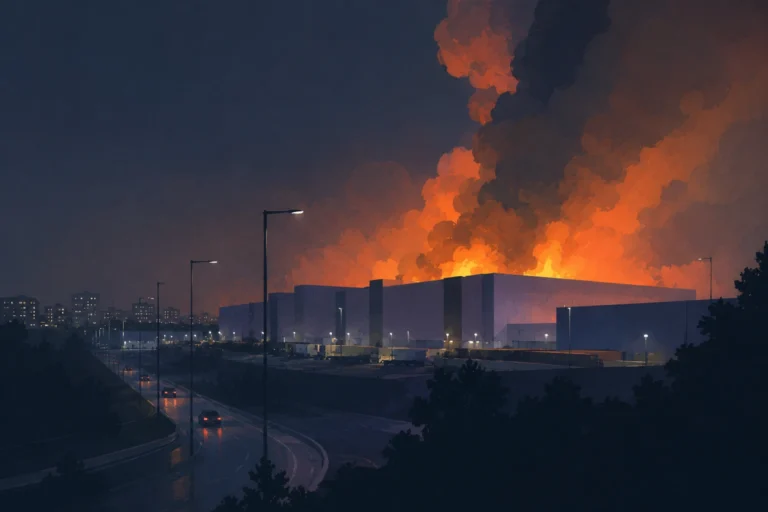
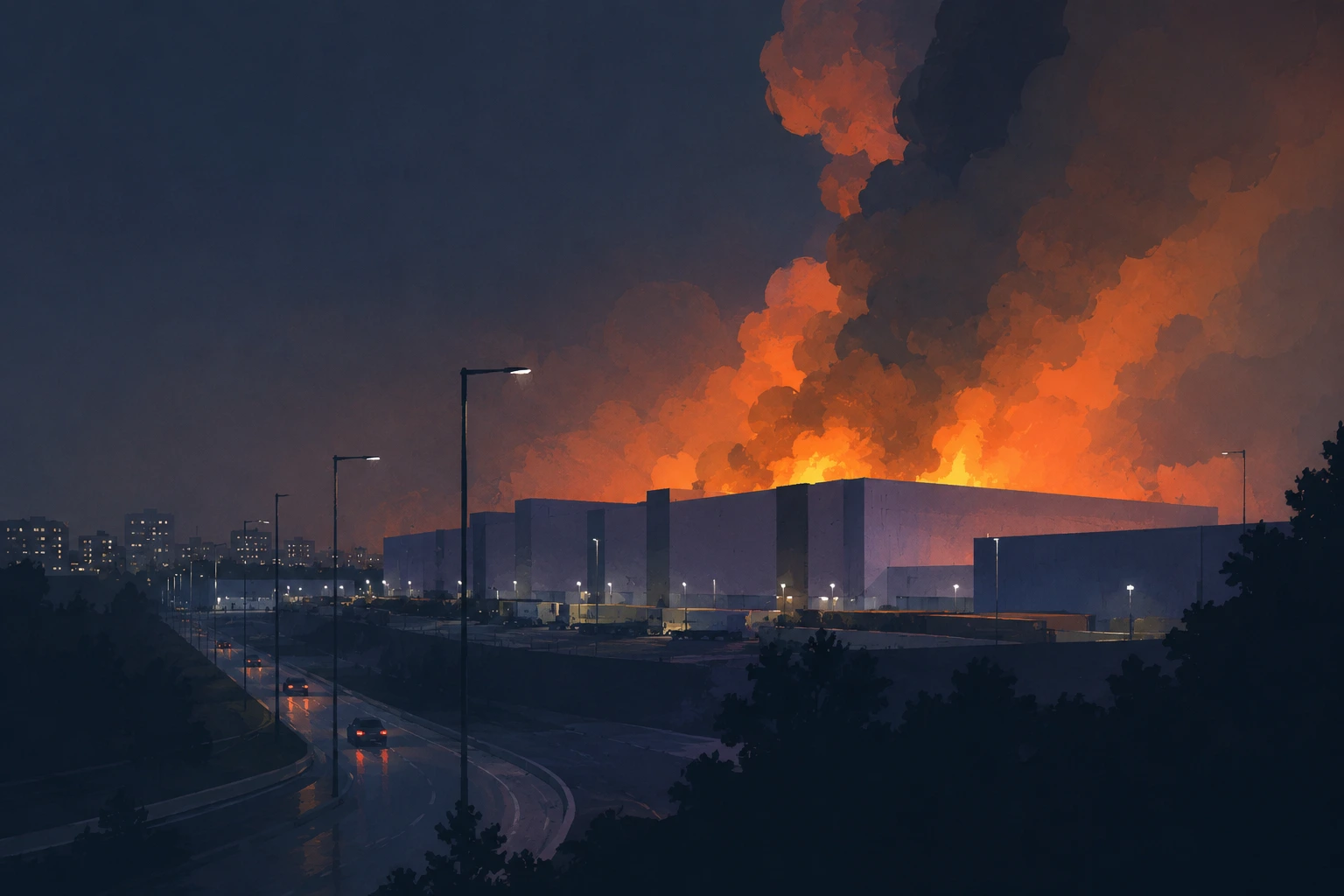
The latest example came on August 16, when Ukrainian drones struck the Moscow region in one of the largest aerial attacks reported around the Russian capital. Russian authorities said an 83-year-old man was killed in Podolsk and several people were injured. A Wildberries warehouse in Koledino, about 45 km south of Moscow, was set ablaze, while another warehouse in Domodedovo was damaged.
The Russian Defence Ministry said its air defences had intercepted or destroyed 822 Ukrainian drones across Russia. Moscow Mayor Sergei Sobyanin separately said hundreds of drones had been directed towards the capital and that 201 were destroyed over the Moscow region. The figures are Russian government claims and cannot be independently verified.
The immediate military value of hitting a shopping warehouse is less obvious than striking an oil refinery, airfield or ammunition plant. But that is precisely what makes Wildberries important to understanding Ukraine’s evolving strategy.
Why Wildberries?
Wildberries is not simply an online shop. Its own corporate description says it operates one of Russia’s largest logistics networks, with more than 1 million square metres of warehouse space, more than a dozen major distribution hubs and more than 100 smaller sorting centres. The company reported turnover of 2.5 trillion roubles.
That network makes Wildberries part of the physical infrastructure of Russia’s consumer economy.
Ukraine argues that it is also part of Russia’s wartime logistics system.
Ukrainian officials have accused Wildberries facilities of handling dual-use products, military equipment and components that can be used in Russia’s defence industry. Ukrainian President Volodymyr Zelenskiy has said some targeted warehouses were involved in supplying components for drones and navigation equipment. Those allegations have been disputed by Russia, and independent verification of the military use of individual facilities is difficult.
The distinction matters. A warehouse containing millions of ordinary consumer products is not automatically a military target. But if a logistics network is also being used to move equipment or components for military production, Ukraine’s calculation changes.
The campaign therefore appears designed to exploit the overlap between Russia’s civilian economy and its wartime production system.
The warehouse attacks are not isolated
The August 16 strike followed weeks of attacks on Wildberries facilities across Russia.
Ukraine’s Unmanned Systems Forces commander Robert Brovdi said on August 4 that Ukrainian drones had attacked 15 Wildberries logistics facilities in 18 days and claimed that 13 had been destroyed by fire. Those figures came from a Ukrainian military official and were not independently verified.
Russian authorities and Wildberries have separately confirmed fires and damage at a number of facilities.
Earlier attacks hit warehouses in Moscow, Tambov, Krasnodar and Stavropol regions. A July 18 strike on facilities in the Moscow and Tambov regions killed several people, according to Russian authorities, while attacks on July 22 injured workers at warehouses in Krasnodar and Nevinnomyssk.
The cumulative effect is more consequential than any individual warehouse fire.
Wildberries provides infrastructure for hundreds of thousands of merchants selling through its platform. Damage to distribution centres can therefore affect sellers, inventories, deliveries and consumers even when those businesses have no connection to Russia’s military.
That gives Ukraine a way to impose economic costs well beyond the immediate blast zone.
The economic pressure is becoming harder to ignore
Reuters reported earlier this month that Wildberries handled roughly $75 billion in goods in 2025, equivalent to about 3% of Russia’s gross domestic product. The attacks had destroyed or damaged a substantial portion of its warehouse capacity, with economic losses estimated in the billions of dollars.
The consequences extend through the company’s merchants.
When a warehouse burns, the loss is not limited to the building. Goods belonging to thousands of independent sellers can disappear with it. Retailers that depend on Wildberries for fulfilment can be forced to find alternative storage and distribution arrangements.
That creates a peculiar economic pressure point: Ukraine can attack the infrastructure without having to destroy a conventional military formation, while Russia has to absorb the disruption inside its civilian economy.
For Moscow, protecting such a dispersed network is also considerably more difficult than defending a small number of heavily fortified military installations.
Ukraine’s drone advantage is changing the equation
The campaign would be difficult to sustain without Ukraine’s rapidly expanding domestic weapons industry.
Ukrainian defence company Fire Point says its FP-1 and FP-2 drones are being used extensively for strikes deep inside Russia. At the Eurosatory defence exhibition in Paris in June, the company’s chief executive, Iryna Terekh, said the systems were responsible for around 60% of Ukraine’s deep-strike missions and that the company was conducting multiple strikes a day. Defence publication Janes reported that the FP-1 has a range of up to 2,700 km and can carry a payload of up to 60 kg, according to specifications provided by the company.
Fire Point has grown dramatically since its creation after Russia’s full-scale invasion. The company says it now operates dozens of production facilities in Ukraine, while reporting in July indicated it was producing hundreds of drones a day alongside long-range cruise missiles.
That production model changes the economics of the war.
Ukraine does not need every drone to reach its target. It needs to produce enough relatively inexpensive long-range weapons to saturate Russian air defences and force Moscow to spend heavily protecting an enormous territory.
Russia, meanwhile, has to defend refineries, military plants, railways, airports, warehouses and commercial logistics centres stretching thousands of kilometres from the Ukrainian border.
Moscow faces a problem that air defence alone cannot solve
The August 16 attack illustrates the scale of that challenge.
Russian air defences may intercept hundreds of drones during a single operation, but the geography remains unforgiving. Russia is the world’s largest country by land area, and critical economic infrastructure is distributed across a vast territory.
Protecting every warehouse, refinery and industrial site with expensive air-defence systems is impossible.
The alternative is to reduce the number of potential targets — but that would mean moving or dispersing infrastructure, increasing logistics costs and potentially making Russia’s economy less efficient.
This is the strategic logic behind Ukraine’s deep-strike campaign.
It is not necessarily about destroying one decisive target. It is about forcing Russia to spend resources defending hundreds of targets while gradually making the cost of operating critical infrastructure higher.
The contradiction at the centre of the strategy
The Wildberries campaign also exposes one of the most difficult contradictions in the war.
Ukraine wants to damage Russia’s ability to sustain its military while limiting the human and economic advantages enjoyed by a much larger adversary. Yet the deeper its strikes penetrate Russian territory, the more likely they are to affect facilities used simultaneously for civilian commerce and wartime supply.
That makes attribution and target classification increasingly important.
Russia can portray attacks on warehouses as attacks on ordinary Russians and civilian businesses. Ukraine can argue that commercial networks are being used to sustain military production and therefore form part of the war economy.
Both narratives can contain elements of truth.
What is becoming harder to dispute is that the boundary between Russia’s civilian and military economies has become increasingly blurred after more than four years of full-scale war.
A war increasingly fought against systems, not just soldiers
The Moscow strike therefore represents more than another night of drones.
Ukraine’s strategy is moving beyond the destruction of individual military assets toward the disruption of the systems that allow Russia to produce, transport and finance the war.
Oil refineries affect fuel supplies. Railways affect military logistics. Industrial plants affect weapons production. And warehouses affect the distribution networks connecting manufacturers, sellers and consumers.
Wildberries sits unusually close to the intersection of all three worlds.
Its warehouses are commercial facilities serving ordinary customers, but its scale also makes them strategically useful logistics infrastructure. That dual character is precisely why the company has become a recurring target.
The longer the campaign continues, the more Russia will have to decide how much of its air-defence capacity should be devoted not just to protecting military installations, but to protecting the commercial infrastructure of everyday life.

For Moscow, that is a much larger problem than stopping a single drone attack.
For Kyiv, it is the point of the strategy.