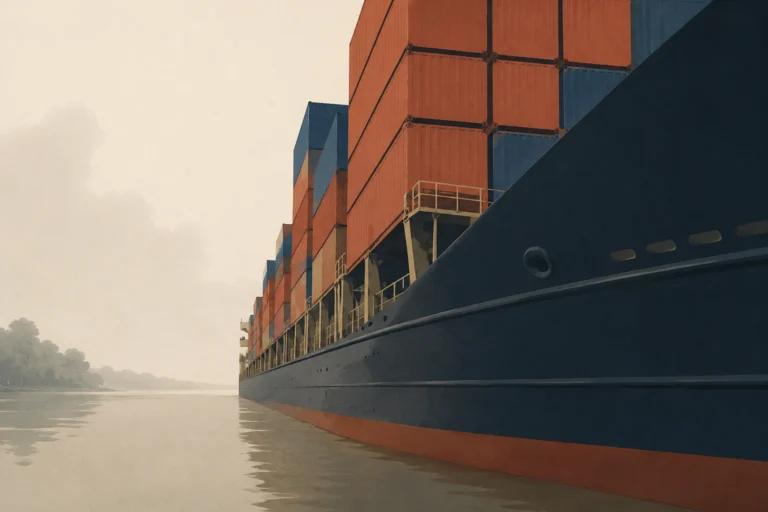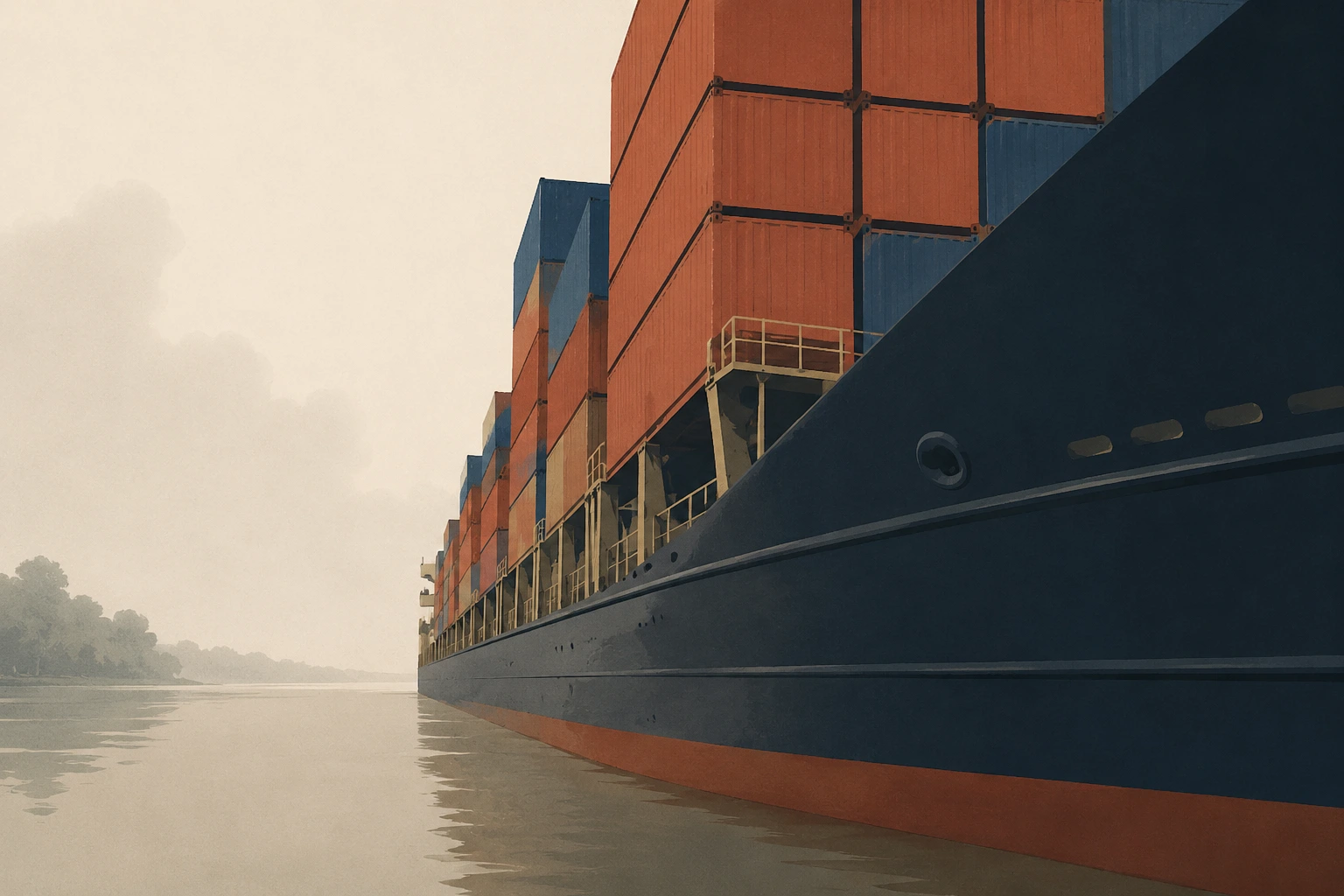
A container ship bound for Kolkata ran aground on the Hooghly River after losing steering control, forcing Indian port authorities to deploy tugboats to pull the vessel from the riverbank.
The incident involved the MTT Singapore, a Malaysian-flagged container vessel carrying 338 containers from Port Klang, Malaysia, to Kolkata’s Netaji Subhas Dock SEE VIDEO. The ship became stuck near Pukuria Point at Garchumuk in West Bengal’s Howrah district at about 11:30 a.m. on August 2, 2023. A pilot from the Syama Prasad Mookerjee Port Authority was aboard at the time.
The immediate cause reported by port authorities was steering failure. The vessel was subsequently freed with assistance from tugs dispatched from Kolkata and Haldia and anchored at Falta. No injuries or oil spill were reported.
The difficult waterway behind the accident
The grounding occurred on a stretch of river where navigation is unusually demanding because commercial vessels are operating in a shifting, tidal channel rather than a conventional deep-water approach.
The Hooghly is the maritime gateway to Kolkata, one of India’s historic river ports. The port’s own navigation system includes hydrographic surveys, river marks, buoys and tidal monitoring because the channel’s depth and navigable route are affected by sedimentation and changing river conditions.
That makes steering failures particularly consequential. A large vessel does not need to be travelling at high speed to become difficult to control once it loses the ability to maintain its intended heading in a confined channel.
The port has therefore historically relied on compulsory pilotage for large vessels. India’s Calcutta Port (Pilotage) Act, 1948 established the legal framework for transferring control of pilotage on the Hooghly to the port authorities.
The role of pilots has not diminished as shipping has modernised. In February 2026, the port authority announced what it described as its first night-time pilotage of a container vessel through the upper reaches of the Kolkata Dock System in the port’s 155-year history, illustrating how closely commercial expansion is tied to increasingly sophisticated navigation procedures.
Why one steering failure can become a grounding
The MTT Singapore incident also illustrates a basic problem of river navigation: there is less room to recover from a technical failure than there is in open water.
Contemporary accounts said the vessel veered while navigating the river and became firmly lodged in the mud. Some local reports suggested that the ship may have been attempting to pass another vessel or avoid a collision before ending up on the bank, although that detail was not established as the official cause.
That distinction matters. Steering failure was the cause reported by port authorities; the precise sequence of manoeuvres leading to the grounding required separate investigation.
Once the ship was stranded, the priority shifted from navigation to preventing a secondary accident. Authorities instructed the master to ensure that the containers remained securely lashed, reducing the risk of boxes falling into the river or shifting as the vessel was pulled free.
Kolkata’s port depends on a river that constantly changes
The episode is part of a broader challenge facing Kolkata’s maritime economy.
Unlike India’s major deep-water ports on the coast, Kolkata’s principal dock system sits far inland along the Hooghly. Ships must therefore make a lengthy river passage before reaching the docks.
The channel is affected by tides, sediment and sandbars, requiring continuous hydrographic monitoring and maintenance. Historical accounts of the port have repeatedly identified changing river depth and sedimentation as operational constraints for shipping.
The problem is not simply that the river is shallow. Its navigable geometry changes. A channel that is safe for a vessel under one set of tidal and sediment conditions may require a different approach under another.
That makes the port’s investment in navigation technology and pilotage an economic issue as much as a safety issue.
The port is trying to handle larger volumes more efficiently
Kolkata has been expanding its maritime infrastructure while simultaneously attempting to make navigation more flexible.
In 2026, the port authority highlighted advances in night navigation and described the use of navigation simulators, vessel-management systems and other digital tools as part of its effort to improve operational efficiency and safety.
The strategy reflects a tension at the heart of Kolkata’s port: the city wants greater cargo capacity and faster vessel turnaround, but the physical characteristics of the Hooghly impose limits that cannot simply be removed through investment in cranes and terminals.
The river itself remains part of the infrastructure.

For shipping companies, that means a technical problem that might be manageable offshore can become an immediate grounding risk inside the Hooghly channel. For the port authority, it means pilotage, dredging, hydrographic surveys, tides and emergency towing remain as important to cargo movement as the equipment operating on the quayside.
The MTT Singapore was ultimately freed without casualties or an oil spill. But the incident demonstrated why moving commercial ships into Kolkata is not simply a matter of bringing a vessel up a river: it requires a constantly managed interaction between ship, pilot, tide, channel and port infrastructure.