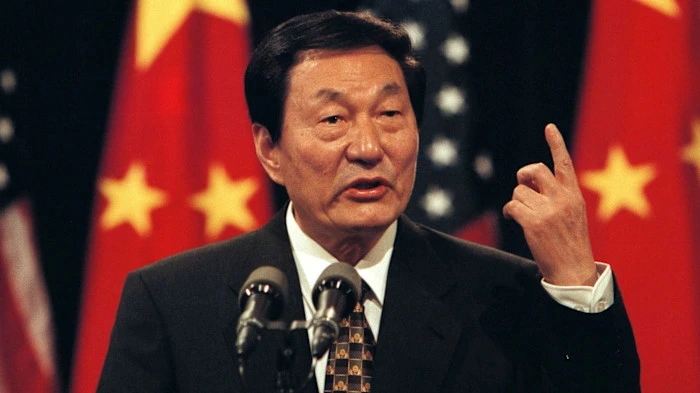
Zhu Rongji’s greatest achievement was not a single economic reform. It was the construction of a system in which China could compete with the world economy without abandoning Communist Party control over the state.
That makes his death at 97 more than the passing of a former premier. Zhu, who died on August 12, was one of the officials who converted Deng Xiaoping’s opening of China into a more disciplined, internationally integrated economic model — and whose decisions helped create the industrial giant that now sits at the centre of global trade.
He served as premier from 1998 to 2003, under President Jiang Zemin, after rising to national prominence as Shanghai’s mayor and later vice-premier. His period in power coincided with a decisive transition: China was moving from an economy still dominated by inefficient state enterprises towards one increasingly shaped by markets, private ownership and international trade.
The reforms were often brutal.
The cost of breaking the old system
When Zhu took charge of the economy, state-owned enterprises were burdened by excess workers, losses and politically protected management. For decades, the state had effectively guaranteed employment and welfare through the industrial system.
Zhu attacked that arrangement.
His strategy became known as “grasp the large, release the small”: preserve and consolidate strategically important state enterprises while allowing many smaller and weaker companies to close, merge or be sold. The programme was designed to turn the largest state companies into commercially viable organisations while reducing the economic burden of loss-making firms.
The social consequences were enormous. Employment in state-owned enterprises fell from about 77 million in 1995 to roughly 42 million by the end of Zhu’s premiership in 2003, according to research cited in the Financial Times. Other estimates put the number of workers displaced during the restructuring at tens of millions.
For workers accustomed to the Communist-era “iron rice bowl”, the reforms meant the disappearance of an economic security system that had existed for generations.
For Beijing, however, the restructuring was also preparation for something much larger.
China was about to enter the global trading system.
WTO membership was the gamble
China became the 143rd member of the World Trade Organization on December 11, 2001, after roughly 15 years of negotiations. The accession agreement required Beijing to make extensive commitments to open markets, reduce trade barriers and bring domestic rules closer to international standards.
Zhu understood that membership could do more than increase exports.
It could force China to reform itself.
That distinction mattered. China’s WTO commitments required changes in areas ranging from market access to trading rights and domestic legislation. Beijing was effectively using an international institution to lock in reforms that could be difficult to impose through domestic politics alone.
The result was one of the most consequential economic integrations of the modern era.
China’s entry into the WTO coincided with an extraordinary expansion of manufacturing, foreign investment and international trade. The WTO itself later described China’s accession as a pivotal event in the development of the global trading system.
The transformation was not simply about Chinese exports. Global companies increasingly built supply chains around Chinese factories, while consumers across Europe, North America, Africa and Asia gained access to cheaper manufactured goods.
Zhu helped create the institutional conditions for that shift.
Shanghai was his laboratory
Long before he became premier, Zhu had tested many of his ideas in Shanghai.
He served as mayor from 1988 and became the city’s Communist Party secretary in 1989. Shanghai was already China’s principal industrial and commercial centre, but Zhu pushed it towards a more modern urban and financial economy.
One of the clearest physical reminders of that period is Pudong.
What was once largely undeveloped land across the Huangpu River became the site of one of China’s most ambitious urban transformations. Zhu backed infrastructure and development plans that helped establish the foundations for Pudong’s later emergence as Shanghai’s financial district.
The skyscrapers that eventually filled Pudong became a visual representation of the economic transformation Zhu was helping to engineer: Communist political control alongside increasingly market-oriented commerce.
His handling of Shanghai’s political unrest in 1989 also helped distinguish him within the leadership. While the Tiananmen protests in Beijing ended in a military crackdown, Shanghai’s authorities brought demonstrations to an end without a comparable military confrontation. The episode enhanced Zhu’s standing within the Communist Party and helped his subsequent rise.
The reformer was never a liberal democrat
Zhu’s economic pragmatism should not be confused with political liberalism.
He remained a Communist Party loyalist and an ardent nationalist. His objective was to make China’s socialist system more effective, not to replace it with Western-style democracy. Historians Orville Schell and John Delury have described him as rejecting the relevance of liberal democracy to China’s political development.
That distinction became increasingly important as his economic reforms reshaped the country.
Zhu was willing to let markets determine prices, companies compete and foreign businesses enter China. But he did not believe those changes required the Party to surrender political control.
In that sense, his career anticipated one of the defining characteristics of modern China: economic opening without political democratisation.
The corruption fight
Zhu’s reputation was also built on his willingness to confront officials and institutions that he believed were undermining economic reform.
He was famously abrasive. At press conferences, he spoke more directly than was customary for senior Chinese leaders and cultivated an image of a technocrat willing to confront corrupt officials.
He particularly disliked what became known as “bean curd construction” — badly built infrastructure weakened by corruption and embezzlement.
His campaign against corruption was not merely moralistic. Poorly governed banks, state companies and local governments could undermine the financial discipline required for a functioning market economy.
That was why Zhu’s reforms extended beyond factories.
He worked on China’s tax system, financial regulation, banking and the structure of government itself. The objective was to give Beijing greater control over national economic policy while reducing the ability of local governments and state enterprises to operate according to their own interests.
The contradictions Zhu left behind
The economic model Zhu helped establish eventually became one of China’s greatest strengths — and one of its most difficult problems.
The reforms created globally competitive companies and helped China become deeply embedded in international supply chains. But the restructuring also produced unemployment, inequality and social dislocation.
By the end of his premiership, Zhu was increasingly concerned that China’s spectacular growth was leaving large numbers of rural and urban poor behind.
There was another contradiction.
Zhu wanted state enterprises to become commercially disciplined. Yet he never sought to eliminate the state sector. His approach was to make the state more selective and effective.
China today still wrestles with that balance.
In 2026, Beijing continues to call for deeper reform of state-owned enterprises while simultaneously insisting that the state-owned economy remain a leading force in strategic industries. Chinese officials have been pushing central SOEs to improve productivity, innovation and competitiveness as the country begins a new five-year planning period.
That is not a rejection of Zhu’s model so much as an evolution of its central dilemma: how much market discipline can the Chinese state introduce without surrendering the political control that makes the system distinctly Chinese?
Why Zhu’s legacy matters now
Zhu’s economic world has largely disappeared.
The China he inherited was still a relatively poor country trying to determine how far it could move towards a market economy. The China that emerged from his premiership had joined the WTO, restructured much of its state sector and was positioned for the manufacturing boom that would transform global commerce.
The country is now confronting the reverse problem.
It has become so successful at industrial production that excess capacity in sectors such as electric vehicles, solar technology and other manufactured goods has become a source of friction with major trading partners. Beijing is again debating how to restructure industries, improve productivity and prevent inefficient investment.
That is why Zhu’s name continues to surface in discussions of China’s economy.
His defining political skill was not simply that he favoured markets. It was that he was prepared to impose painful changes on powerful domestic constituencies when he believed the existing system had become economically unsustainable.
China’s current leadership faces a different set of problems, but the underlying question is familiar.
How do you force a giant state-directed economy to become more efficient without destabilising the political system that controls it?
Zhu spent much of his career answering that question.
The China that emerged from his reforms became a global economic superpower. The tensions produced by that transformation — between state control and markets, growth and inequality, domestic priorities and global trade — remain at the centre of China’s economic policy today.