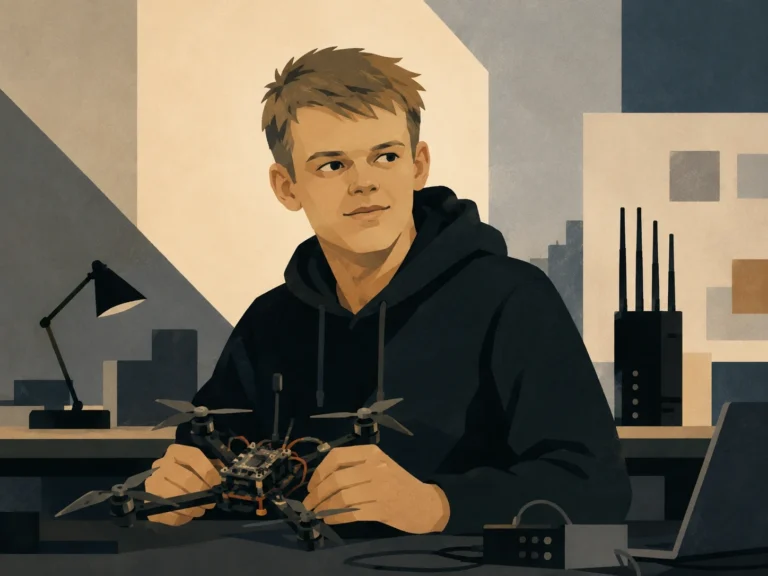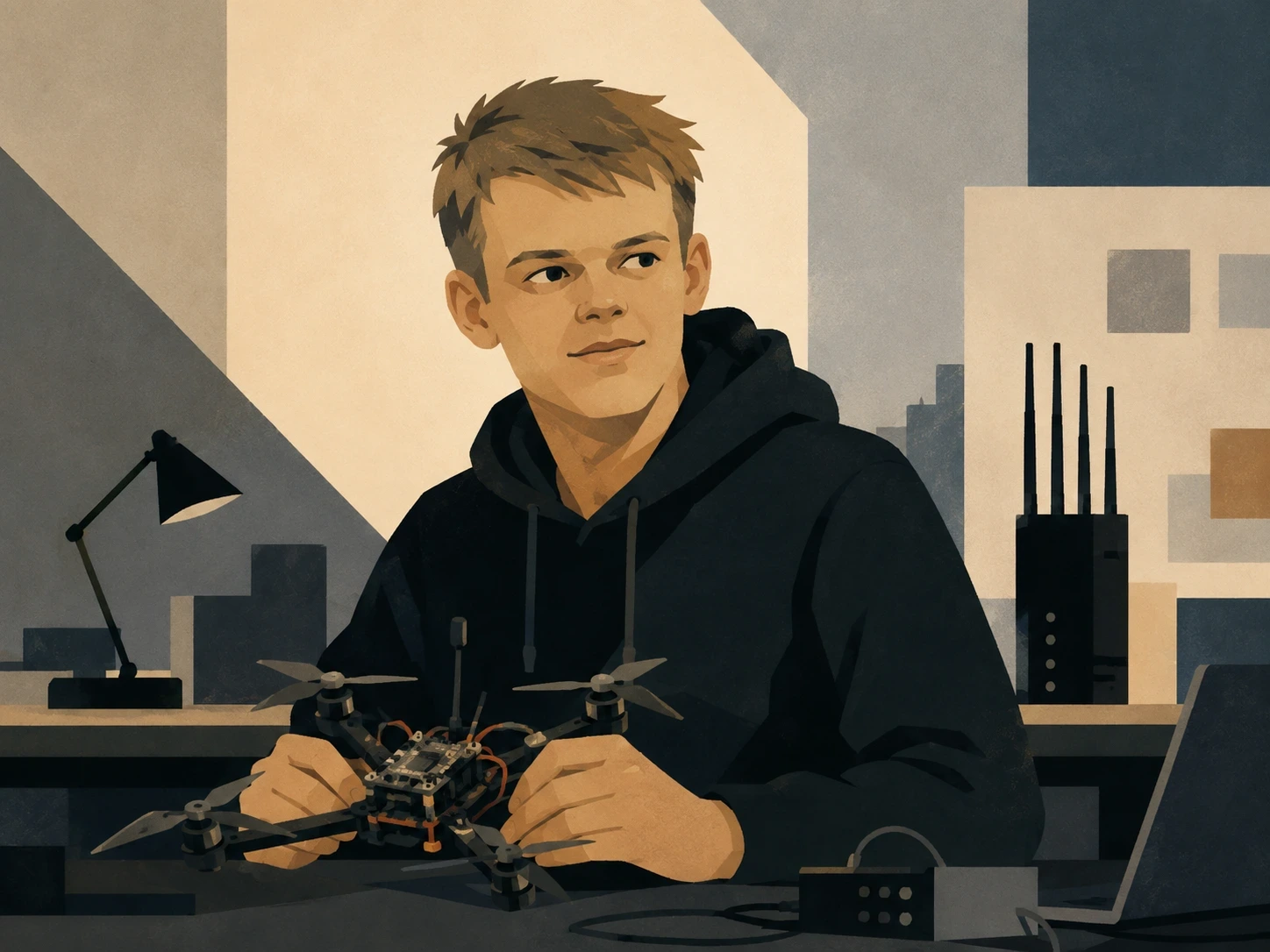
The most revealing detail about Vadym Dobrovolskyi’s invention is not its use of artificial intelligence. It is the problem that led him to build it.
Dobrovolskyi, a 16-year-old student from Skvyra in Ukraine’s Kyiv region, developed PhAInix after his father went to war as a drone operator. The teenager wanted to address one of the most persistent vulnerabilities of unmanned aircraft on the battlefield: what happens when an enemy blocks the radio link between a drone and its operator.
The result is a compact system intended to change a drone’s communication frequency when it detects that its connection has been disrupted by electronic warfare. According to descriptions of the project, PhAInix can switch among as many as seven frequencies and has a backup mode for situations in which communication is completely lost.
The invention has attracted attention beyond Ukraine’s battlefield technology community. In 2024, PhAInix placed second in Ukraine’s National Youth Entrepreneurship Challenge, earning a place alongside other Ukrainian youth startups at the World Youth Entrepreneurship Challenge in New York. The Ukrainian Junior Academy of Sciences’ Ukrainian Future incubator supported the project.
The battlefield problem is bigger than one drone
Electronic warfare has become an essential part of the war in Ukraine because drones depend heavily on radio communications and navigation systems.
Russia and Ukraine deploy systems capable of interfering with the frequencies used to control drones, transmit video and determine position. A drone that loses its connection may crash, miss its target or initiate a return-to-home procedure. In some circumstances, returning to the operator can expose the operator’s location.
That makes the electronic spectrum another battlefield alongside the physical front line.
The scale of the problem varies considerably by drone, mission and battlefield conditions, so the widely circulated claim that 70% of Ukrainian drones fail to reach their targets because of jamming should be treated as a project-associated estimate rather than an independently established statistic. The figure appears in the PhAInix project’s competition materials and in interviews with Dobrovolskyi.
Independent analysis nevertheless confirms the broader problem. Russia has deployed extensive electronic-warfare capabilities, while Ukrainian forces have increasingly turned to autonomous navigation, frequency-hopping and other methods to keep drones functioning when communications are disrupted.
One recent analysis estimated that up to 75% of drones used by both sides in 2024 were neutralised by jamming equipment, although estimates differ by type of drone and mission.
What PhAInix actually does
PhAInix is not a drone itself. It is an onboard system that sits between the aircraft’s existing flight-control architecture and its communications equipment.
Earlier descriptions of the prototype say Dobrovolskyi built versions around inexpensive single-board computers and microcontrollers, including Orange Pi and Arduino hardware, with receivers capable of monitoring different communications systems used by drones. The system was designed to be installed on different types of aircraft rather than tied to a single drone model.
When the system detects a loss of communication, it attempts to move the drone to another available communication frequency. If signals remain unavailable, the project describes a backup algorithm using onboard inertial sensors to maintain flight until communication is restored.
That approach reflects a broader shift in drone warfare: reducing the dependence of an aircraft on a continuous connection to a human operator.
Ukrainian developers are pursuing increasingly autonomous systems for precisely this reason. Recent battlefield developments include drones capable of continuing toward a target after losing contact with their operators, using pre-programmed navigation, target locking and computer vision.
PhAInix represents a somewhat different layer of the same technological race: rather than simply making the drone independent of communications, it attempts to preserve the communications link when an adversary is actively trying to destroy it.
From school project to military technology
Dobrovolskyi’s route into defence technology began before PhAInix.
He has described spending years thinking about ways to contribute to Ukraine’s war effort. The project eventually developed through Ukrainian Future, the business incubator operated by Ukraine’s Junior Academy of Sciences. By 2024, PhAInix had moved beyond a school experiment and into youth entrepreneurship competitions.
The national competition placed PhAInix second among the participating youth startups. It was then one of three Ukrainian projects sent to the World Youth Entrepreneurship Challenge in New York.
The project has also appeared at international invention competitions. The INOVA-Croatia listing identifies Dobrovolskyi and the Junior Academy of Sciences of Ukraine as the creators and describes PhAInix as a system for changing drone communication protocols during flight.
The technology has reportedly been tested with military personnel, although the identities and operational details were not disclosed for security reasons.
That distinction matters. Winning an invention competition and being tested by military users are not the same thing as demonstrating that a system is ready for widespread battlefield deployment.
The 242% claim needs context
One of the most striking numbers attached to PhAInix is a claimed 242% increase in drone effectiveness.
That figure comes from the project’s own research and has been repeated in subsequent Ukrainian reports and competition materials. It has not, from the sources available, been independently validated through a published peer-reviewed study or a publicly documented military trial.
The more defensible conclusion is therefore narrower: PhAInix is an independently developed prototype whose creator says testing showed substantial improvements in drone performance under electronic-warfare conditions.
That is still notable.
Modern military technology is increasingly being developed outside traditional defence contractors. Ukraine’s war has created an unusually direct feedback loop between engineers, soldiers, startups and battlefield requirements. Cheap components can be assembled into systems addressing problems that conventional procurement cycles may take much longer to solve.
The country’s drone industry has expanded around that model. Drones have become central to reconnaissance, artillery targeting and strike operations, while electronic warfare has evolved alongside them as both sides attempt to disrupt the other’s systems. Bloomberg has reported that drones accounted for an estimated 60% to 70% of damage and destruction to Russian equipment by early 2025, according to the Royal United Services Institute.
A teenager working inside a much larger technological race
Dobrovolskyi’s age makes the story unusual. The technology itself is part of a much broader contest.
As electronic warfare improves, simply producing more drones is no longer enough. Manufacturers and military units increasingly need aircraft that can tolerate interference, navigate without GPS, operate with limited communications and make more decisions independently.
That creates an unusual advantage for countries able to combine military experience with a large pool of engineers and entrepreneurs.
Ukraine’s youth entrepreneurship programmes are becoming one channel through which that ecosystem is developing. PhAInix was not simply a classroom invention: it moved through an incubator, competed against other startups, reached an international entrepreneurship competition and attracted military feedback.
Whether PhAInix ultimately enters large-scale production remains a separate question. Dobrovolskyi said in 2025 that he was preparing for mass production and seeking to expand the team.
For now, the more important story may be what produced the invention in the first place.

Ukraine’s war has turned electronic engineering, software development and robotics into immediate national-security skills. For a generation growing up with the conflict, the distance between a school laboratory and a battlefield problem has become unusually short.
Vadym Dobrovolskyi happens to be one of the youngest people working across that boundary.