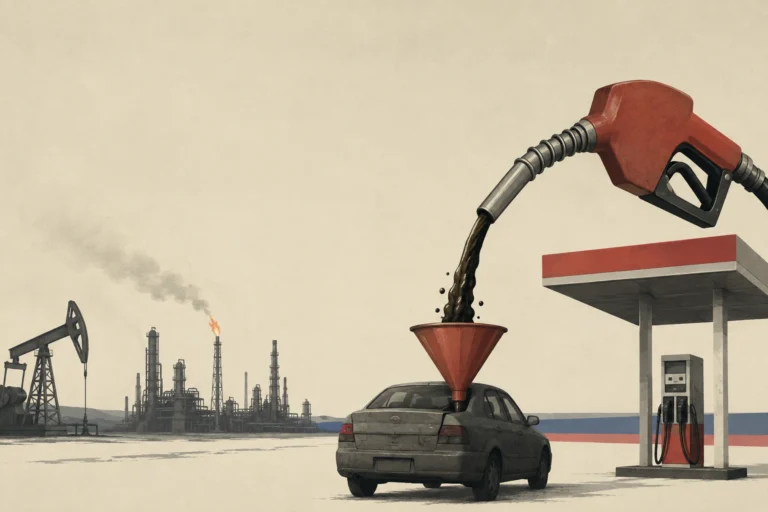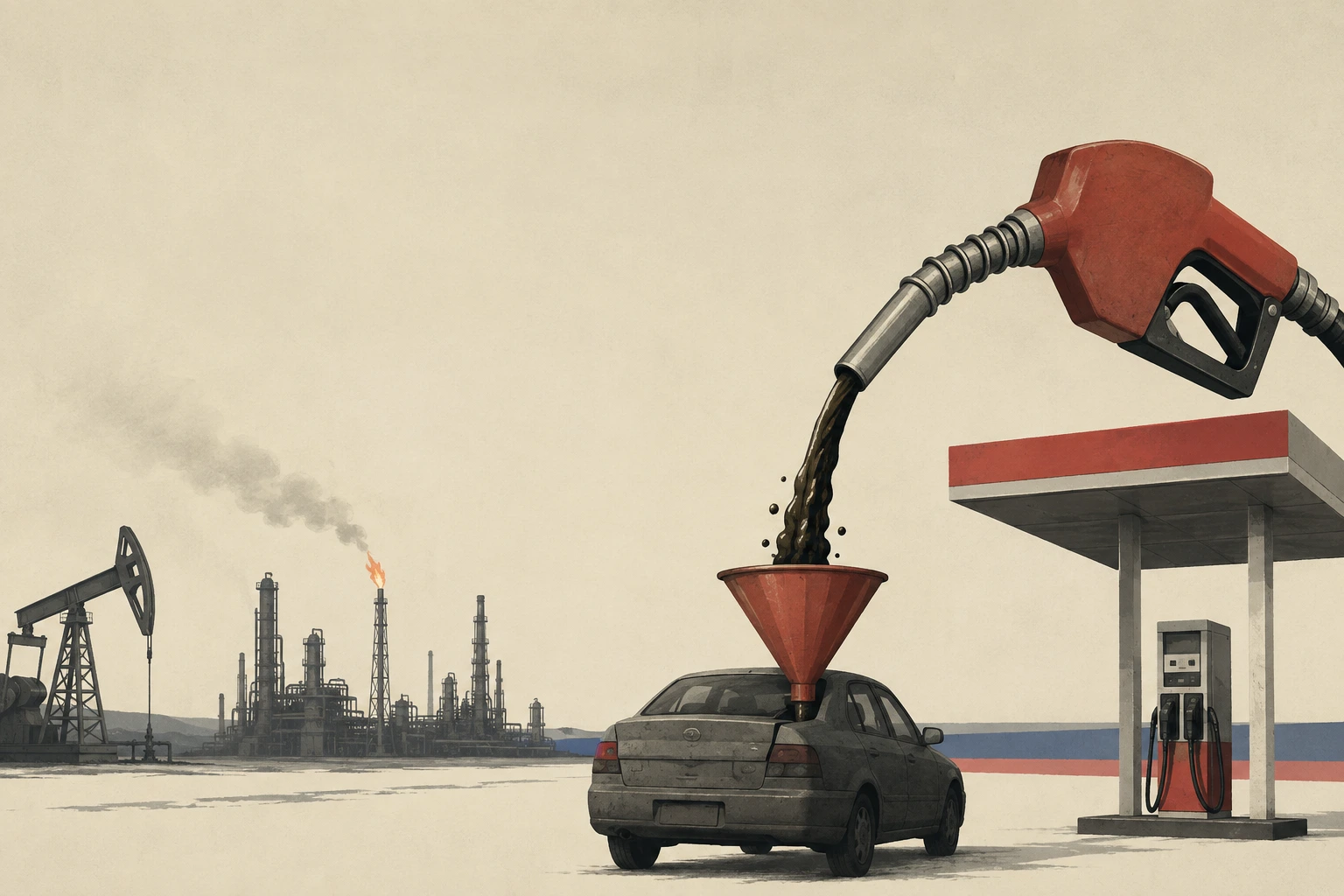
Russia has reopened a door it spent more than a decade trying to close.
The government has authorised the production, import and sale of petrol meeting Euro-2, Euro-3 and Euro-4 standards until July 1, 2027, allowing fuel grades that had progressively been removed from the Russian market as refineries were modernised and environmental requirements tightened.
The Energy Ministry has presented the decision as a temporary measure to prevent shortages amid disrupted logistics and technological constraints.
The timing points to a deeper problem than a change in fuel specifications. Russia is trying to preserve the volume of petrol reaching motorists while parts of its refining system face repeated disruption during the war with Ukraine.
Ukrainian drone attacks have increasingly targeted Russian oil infrastructure, including refineries and facilities involved in moving crude and petroleum products. The pressure has been severe enough for Moscow to introduce a succession of measures aimed at protecting domestic supplies.
Russia’s Energy Ministry said in July that it was working with regional authorities, government agencies and oil companies to ensure that regions received the volumes of fuel they required.
The latest decision effectively gives refiners another way to produce usable motor fuel when maintaining the country’s normal quality requirements becomes more difficult.
That distinction matters. Russia is not running out of crude oil. It remains one of the world’s largest oil producers. The vulnerability is further downstream: turning crude into the petrol and diesel needed by a geographically vast domestic economy, then moving those products to where motorists need them.
A return to a standard Russia had already abandoned
Euro-2 is not simply a cheaper version of the petrol normally sold at Russian filling stations. It represents a much older environmental standard.
Russia’s fuel regulations measure environmental class partly through sulphur content. Under the country’s technical classification, petrol in class 2 can contain up to 500 milligrams of sulphur per kilogram, compared with 10 milligrams for class 5. That makes the maximum permitted sulphur content of class-2 petrol 50 times higher than class 5.
The country formally stopped the circulation of Euro-2 fuel in January 2013 after years of delays to the transition toward cleaner fuels. At the time, officials had already postponed the deadlines because of concerns about the readiness of both the vehicle fleet and Russian refineries.
The next stage came in 2016, when Russia and other members of the Customs Union moved to prohibit the production of automotive petrol below the fifth environmental class, with a temporary extension for Euro-4 because some refineries still needed time to complete modernisation.
The new policy therefore represents more than a routine regulatory adjustment. It is a temporary reversal of a long-running industrial-modernisation programme.
Why refiners need the flexibility
Petrol production involves considerably more than separating crude oil into different fractions. Refineries use additional processing units to remove sulphur and produce fuels that meet increasingly demanding specifications.
When those units are damaged, unavailable or constrained by maintenance and supply problems, producing the same quantity of high-grade fuel becomes harder.
Allowing lower environmental classes reduces the processing requirements for some batches of petrol. In a shortage, that can make it possible to get more product into the domestic market without waiting for every part of the refining system to return to full capability.
That is why Moscow’s wording matters. The Energy Ministry has described the relaxation as an “anti-crisis” measure and linked it to changing logistics chains and technological restrictions rather than presenting it as a permanent change in environmental policy.
The government has also made clear that the measure is temporary, setting July 1, 2027 as its current end date.
The war is reaching the petrol pump
Russia’s fuel problem illustrates a recurring feature of modern industrial warfare: infrastructure can become a strategic target even when it is far from the battlefield.
Refineries are particularly attractive because they sit between Russia’s enormous crude-oil production system and the domestic economy that depends on refined products. Damaging a refinery does not necessarily remove oil from the ground, but it can interrupt the conversion of that oil into transport fuel.
The effects can then spread through the distribution network.
Reuters reported on Aug. 7 that drone attacks in the Black Sea region had also disrupted crude exports through the Caspian Pipeline Consortium, reducing July loadings by more than a fifth to roughly 1.2 million-1.3 million barrels per day. The disruptions illustrate how attacks on energy infrastructure can affect several parts of the petroleum system simultaneously.
For Moscow, the domestic fuel market is particularly sensitive because shortages can quickly become a political problem. Petrol is used by households, freight companies, agricultural producers and businesses across a country where distances between production centres and consumers can be enormous.
A refinery outage in one region cannot necessarily be solved simply by moving fuel from somewhere else.
The environmental trade-off
For motorists, the immediate concern is availability. For the government, the calculation is whether maintaining supply is worth relaxing environmental safeguards.
Lower-grade petrol contains substantially more sulphur than modern fuel. Higher sulphur levels contribute to emissions and can interfere with the operation and durability of emissions-control systems designed around cleaner fuel.
The consequences are not identical for every vehicle. Older cars designed around less demanding fuel standards are better suited to lower-grade petrol than newer vehicles whose emissions-control systems depend on cleaner fuel.
That helps explain why the Russian government can frame the measure as a supply intervention rather than a wholesale abandonment of environmental standards. The policy does not require every motorist to use Euro-2 petrol; it allows such fuel to enter the market.
Russia has also said information about fuel’s environmental class will be made available to consumers, giving motorists the possibility of choosing what they put into their vehicles.
A problem that predates the latest strikes
The current crisis should not be understood as the product of a single attack or a single damaged refinery.
Russia’s refining sector has been under pressure from several directions: refinery maintenance, logistical constraints, domestic demand, export restrictions and the continuing demands of a wartime economy.
The government was already using measures to increase domestic fuel availability before the latest decision. In July, the Energy Ministry said it was coordinating with regional governments and oil companies to determine how much fuel individual regions needed.
There is also a revealing historical parallel. When Russia first postponed the transition away from Euro-2 more than a decade ago, the concern was that the country’s refineries were not ready to produce enough higher-quality fuel. The government eventually invested heavily in refinery modernisation to make the transition possible.
In 2026, the problem is different. Russia has already built a much more sophisticated refining system, but wartime disruption is testing how much resilience that investment provides.

The decision to bring back lower-grade petrol suggests that Moscow’s priority, at least for now, is not preserving the trajectory of fuel-quality regulation at all costs. It is keeping the domestic market supplied.
That is the real meaning of Russia’s “anti-crisis petrol”: not that the country has suddenly lost access to oil, but that a state with vast crude reserves is having to loosen rules governing what comes out the other end of its refineries.