President Donald Trump has moved quickly to turn Abdul El-Sayed’s upset victory in Michigan’s Democratic Senate primary into a national ideological fight, accusing the progressive candidate of hating Israel and Jewish people and warning that Democrats are moving from socialism toward communism.
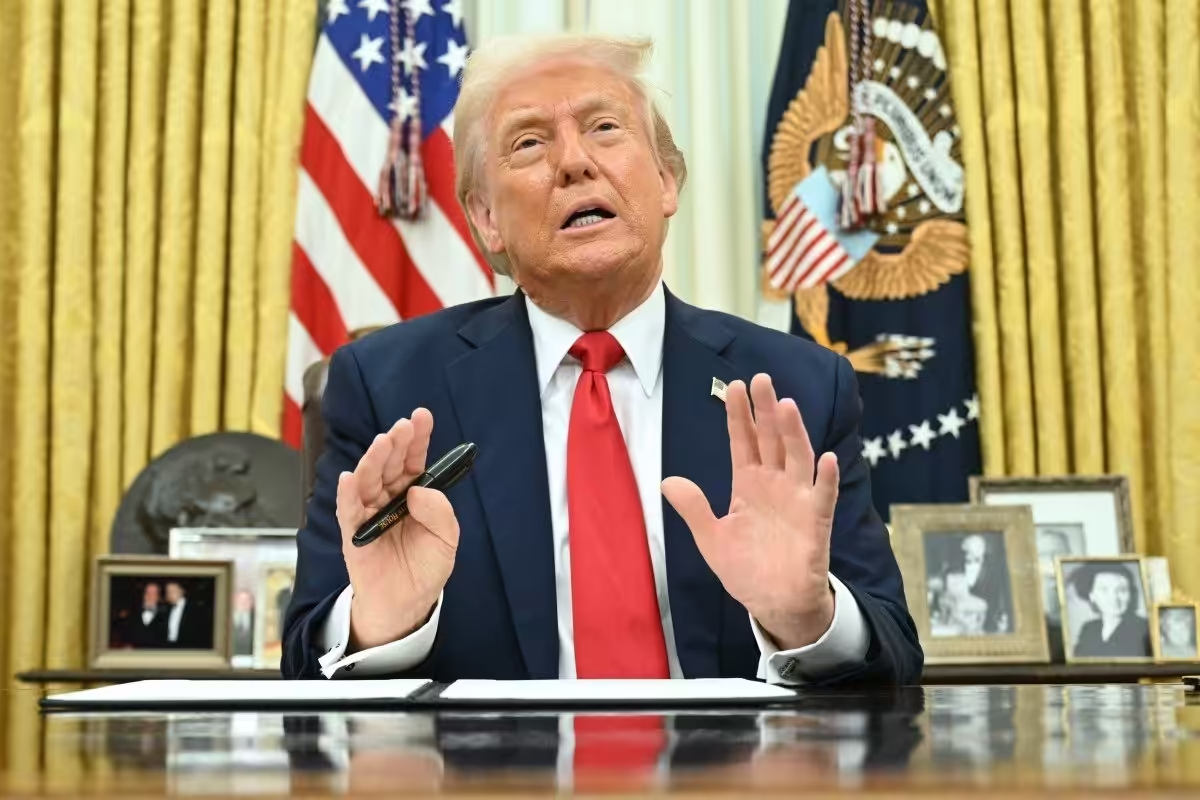
Speaking in Las Vegas after El-Sayed defeated U.S. Rep. Haley Stevens in Tuesday’s primary, Trump portrayed the Michigan Democrat as emblematic of what he described as an increasingly radical Democratic Party.
“He doesn’t love Israel, he doesn’t love Jewish people, he hates them,” Trump said, according to a video of his remarks. He also dismissed El-Sayed as “full of” expletives and argued that his political movement represented a shift beyond socialism.
The remarks came less than 48 hours after El-Sayed secured one of the most closely watched Democratic primary victories of the 2026 midterm cycle. His win was not simply a defeat for Stevens. It overturned the expectations of much of the Democratic establishment, which had rallied behind a candidate viewed as more conventionally electable in a state that could help determine control of the Senate.
A primary that exposed a Democratic fault line
El-Sayed, a former Detroit-area public health official, defeated Stevens by less than one percentage point after a campaign in which the Democratic establishment invested heavily in stopping his candidacy.
Stevens had support from figures including Senate Democratic Leader Chuck Schumer and Michigan Gov. Gretchen Whitmer. Pro-Israel political groups also spent tens of millions of dollars in the race, making the contest one of the most expensive Democratic Senate primaries of the cycle.
El-Sayed instead built his campaign around a grassroots coalition and an explicitly progressive platform. He campaigned on Medicare for All, campaign-finance reform and a sharp reduction in U.S. military assistance to Israel. His campaign also sought to make the Democratic primary a referendum on whether the party’s traditional strategy of choosing moderate candidates remains viable in battleground states.
That strategy produced a result that Democratic leaders had spent months trying to prevent.
The victory also gives El-Sayed a difficult task: translating a narrow primary coalition into a statewide electorate that includes voters who did not participate in the Democratic contest and Republicans who are likely to oppose him in November.
Israel becomes central to the race
Trump’s attack focused heavily on El-Sayed’s position on Israel, an issue that had already made the Michigan primary unusually contentious.
El-Sayed has been among the Democratic candidates most critical of Israeli policy during the Gaza war. He has called for an end to offensive and defensive U.S. military assistance to Israel and described Israeli actions in Gaza as genocide. He has also questioned whether the concept of Israel as a specifically Jewish state is compatible with the liberal principles he says he supports.
Those positions have generated opposition among some Michigan Jewish voters, including voters who traditionally support Democrats. Before the primary, some Jewish community leaders said they would consider withholding their support from El-Sayed or backing Republican Mike Rogers if he won the nomination.
But Trump’s claim that El-Sayed “hates” Jewish people is a political accusation, not an established fact. El-Sayed has publicly courted Jewish voters and has spoken about his connection to Michigan’s Jewish community. Following the March attack on Temple Israel in West Bloomfield, his campaign condemned the assault and expressed solidarity with those affected.
The distinction matters because criticism of Israeli government policy, opposition to U.S. military aid or disagreement over the political definition of Israel are not, by themselves, evidence that a candidate hates Jewish people.
From Michigan to a national Democratic argument
El-Sayed’s emergence is part of a broader struggle over what Democrats believe can win elections after years of Republican advances among working-class voters.
The Michigan result followed progressive primary victories elsewhere, strengthening the argument among the party’s left that voters are increasingly willing to reject candidates promoted by Washington’s political establishment. Reuters has described the trend as a progressive wave testing the Democratic Party’s direction ahead of the midterms.
Michigan is a particularly important test because Democrats cannot treat it as a reliably liberal state. Donald Trump carried Michigan in the 2024 presidential election after Democrats had won it in 2020, making the state a closely contested political battleground.
El-Sayed himself has embraced that contradiction. During the campaign, he argued that Michigan voters had demonstrated an appetite for politicians outside the traditional ideological mould, pointing to Bernie Sanders’ success in the state as well as Trump’s victory.
That gives Republicans a straightforward line of attack: present El-Sayed not as a Michigan-specific progressive but as evidence that the Democratic Party has moved too far left.
Trump’s Las Vegas remarks fit directly into that strategy.
The November test
El-Sayed will now face Republican Mike Rogers, a former congressman, in November. The contest could have national consequences because Democrats are seeking to regain control of the Senate, while Michigan’s open seat is one of the party’s opportunities to make that effort.
The seat is being vacated by Democratic Sen. Gary Peters, who has represented Michigan in the Senate since 2015. The challenge for El-Sayed is therefore different from the one he faced in the primary.
He no longer needs to convince Democratic voters that he is sufficiently progressive. He needs to persuade a much larger electorate that his politics can work in a state where voters have repeatedly moved between Democrats and Republicans.
For Republicans, meanwhile, El-Sayed’s nomination offers an opportunity to nationalise the race around issues such as Israel, socialism, communism and the Democratic Party’s relationship with its progressive wing.
The danger for Democrats is that the same nationalisation could obscure the economic issues that helped El-Sayed win the primary.
His campaign was built not only around foreign policy but also around healthcare, economic inequality, corporate influence and dissatisfaction with Washington. His victory demonstrated that those issues could overcome a substantial financial and institutional disadvantage.
The November election will determine whether that coalition was large enough to win a general election—or whether it was primarily a product of an unusually polarised Democratic primary.

For Trump, the answer is already clear. His decision to attack El-Sayed before the general-election campaign has fully begun suggests Republicans intend to make the Michigan Democrat a symbol of the Democratic left, not merely an opponent competing for one Senate seat.
The broader question is whether Michigan voters will accept that framing.