A salmonella outbreak that has sickened 207 people across the UK and killed one has exposed a potential weakness in the country’s food supply chain, with investigators focusing on eggs imported from outside Britain.
The UK Health Security Agency (UKHSA) says the cases involve the same strain of salmonella, suggesting a common source rather than the unrelated infections that occur routinely across the country. The investigation covers cases identified between August 2025 and August 2026, with most of the illnesses occurring in recent weeks.
The geographical spread is national but uneven. Of the 207 cases recorded by Aug. 13, 199 were in England, including 47 in London and 38 in Yorkshire and the Humber. Scotland recorded six cases, while Wales and Northern Ireland each recorded one.
More than a third of those infected required hospital treatment. Two people developed bloodstream infections, which can be a serious complication of salmonella infection, particularly among vulnerable patients.
Why investigators are looking at eggs
The strongest clue has come not from patients eating the same branded product, but from what they ate outside their homes.
UKHSA interviews found that 95 of 114 people who had completed questionnaires had eaten food prepared outside the home during the week before becoming ill. Investigators identified five food businesses associated with two or more independent cases, collectively accounting for 24 infections.
Eleven of those cases involved dishes containing eggs.
That does not establish that a particular egg producer caused the outbreak. The businesses were supplied by eggs from multiple sources, including importers, meaning investigators are still trying to determine whether the contamination occurred before the eggs reached Britain or later in the food-preparation chain.
UKHSA says there is currently no identified link to eggs or poultry produced in the UK.
The distinction matters. Egg consumption is the strongest epidemiological signal so far, but investigators have not yet identified a specific supplier, country of origin or contaminated batch.
Britain already has a salmonella problem
The outbreak comes against a backdrop of elevated salmonella activity in England.
UKHSA recorded 10,406 laboratory-reported salmonella cases in England in 2025, the highest annual figure in a decade, although the total was only slightly above the 10,389 recorded in 2024.
That broader increase does not mean all of those infections are connected to the current outbreak. Salmonella encompasses numerous strains and transmission routes, and UK surveillance treats genetically linked clusters differently from the general burden of disease.
The current investigation became possible because modern surveillance can distinguish strains at a much finer level.
UKHSA uses whole-genome sequencing to compare the genetic fingerprints of salmonella isolated from patients. When apparently unrelated patients carry highly similar organisms, epidemiologists can identify a possible common source and investigate what the patients have in common.
The agency has used the same approach in previous UK outbreaks involving imported food.
In January 2026, for example, UKHSA identified a genetically linked outbreak of monophasic Salmonella Typhimurium. Investigators eventually found epidemiological and supermarket loyalty-card evidence pointing to an imported ready-to-eat cured pork product. The product was withdrawn and later recalled after salmonella was detected in a batch.
Imported food is becoming a bigger surveillance challenge
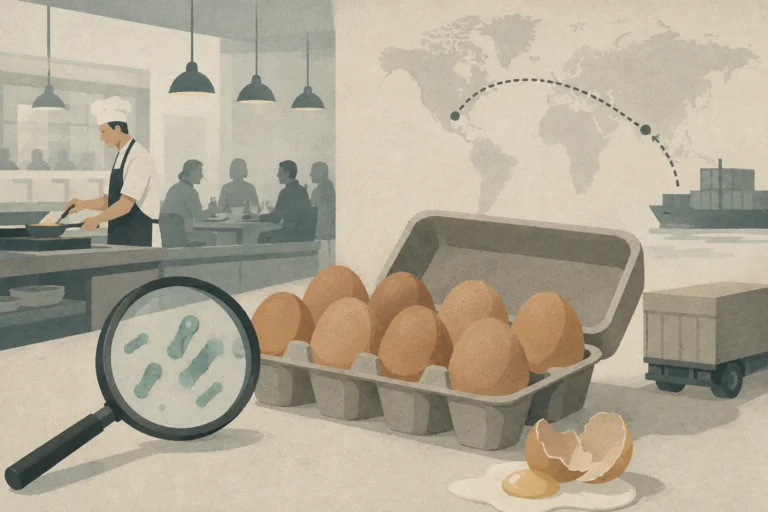
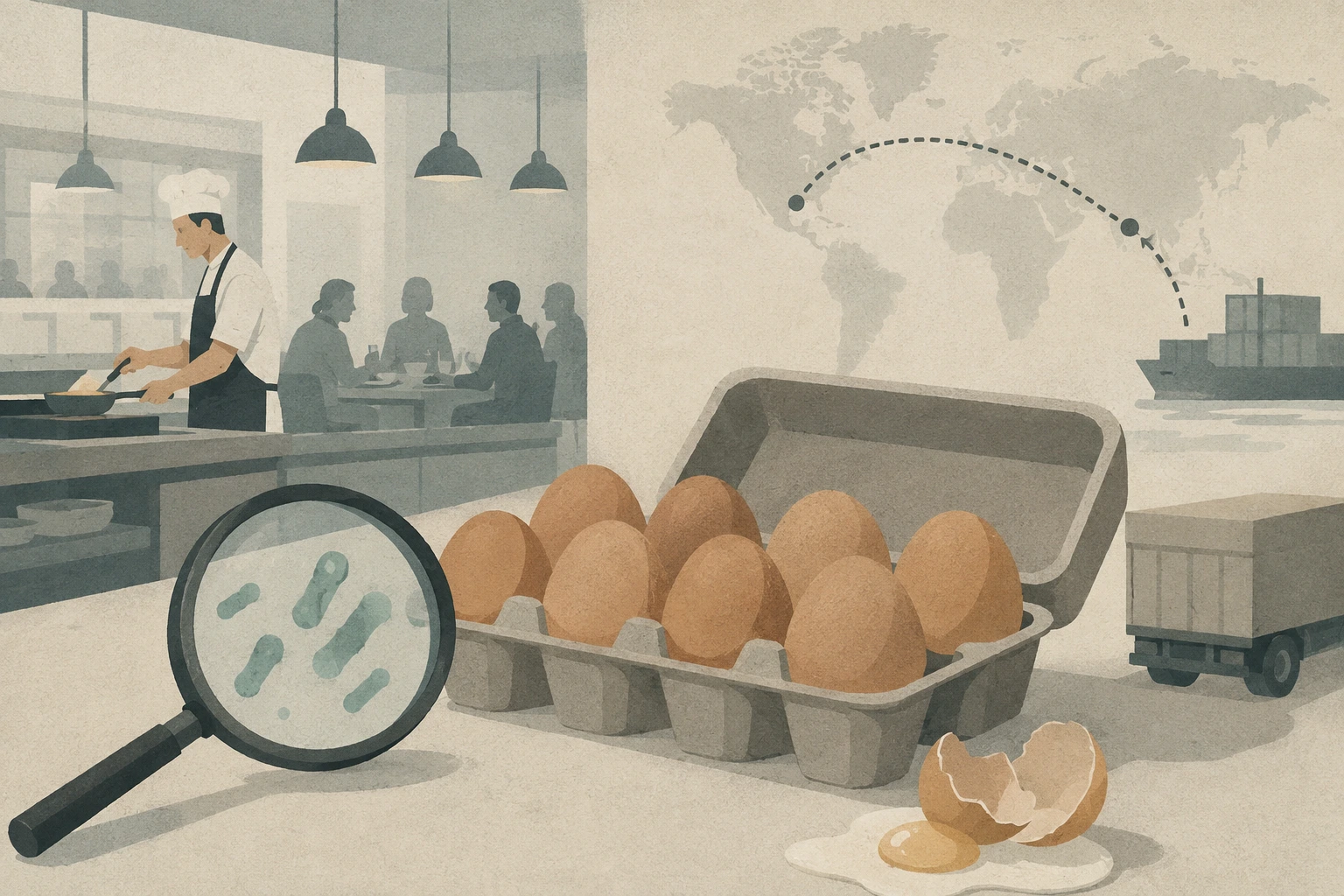
The egg investigation also fits a wider problem confronting food-safety authorities: food can cross several borders before reaching a restaurant kitchen.
The UK has systems for testing imported food at ports and other points of entry, but contamination is not necessarily detected in every consignment. UKHSA says its laboratories work with port health authorities to test imported foods and use genomic sequencing to link contaminated food with human infections.
The Food Standards Agency’s current national monitoring plan specifically lists salmonella testing for ready-to-eat foods and egg products containing raw egg among its surveillance priorities.
That reflects a practical difficulty: identifying the source of an outbreak is not the same as identifying the precise point at which contamination occurred.
An egg may leave a farm, pass through a distributor, enter a catering business and then become an ingredient in a meal. By the time a customer becomes ill, the original product may no longer be available for testing.
The British egg industry’s warning
The investigation has also revived a long-running debate within Britain’s egg industry over imported eggs.
Nick Allen, chief executive of the British Egg Industry Council, has pointed to what he described as increasing imports produced under less stringent rules. British commercial hens are subject to mandatory salmonella vaccination, a measure the industry says helps reduce the risk of contamination.
But those industry claims should not be confused with the findings of the current investigation. UKHSA has not identified the source of the outbreak and has specifically said there is no identified link to UK-produced eggs.
The distinction is particularly important because imported food is not automatically unsafe. The question for investigators is whether a particular supply chain, product or handling practice allowed the outbreak strain to enter food consumed by the affected people.
For most people, the authorities say the risk to the general public remains low.
Salmonella commonly causes diarrhoea, abdominal cramps, vomiting and fever. Symptoms typically begin between 12 and 72 hours after infection. Most people recover without specific treatment, although infection can become severe in some patients.
The risk is greater for vulnerable groups, including infants, young children and older adults.
The Food Standards Agency recommends that infants, young children, pregnant people and older adults eat runny or raw eggs only when they carry the British Lion mark or have been produced under the Laid in Britain assurance scheme.
Thorough cooking remains one of the simplest ways to reduce the risk of salmonella, while careful handwashing and avoiding cross-contamination are important when handling eggs and their packaging.
The investigation is not over
Authorities have not issued a blanket warning against eating eggs, nor have they identified a particular imported egg supplier as responsible.
Instead, UKHSA, the Food Standards Agency and other public-health bodies are continuing epidemiological and food-chain investigations. The fact that affected restaurants received eggs from multiple sources makes tracing the outbreak more difficult.
The episode illustrates why a foodborne outbreak can become a supply-chain investigation as much as a medical one. Doctors may identify the infection in a patient, but determining where that infection originated can require reconstructing what a person ate, where the ingredients came from and how they were handled days or weeks earlier.
For now, the central finding is narrower than some of the headlines suggest: investigators have identified a genetically linked salmonella outbreak, eggs are the strongest suspected food vehicle, and imported eggs are part of the supply-chain investigation.

They have not yet established which eggs caused the outbreak.
That distinction will remain crucial until laboratory and food-chain evidence identifies the source.