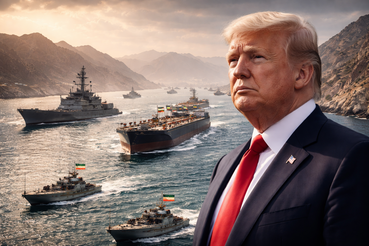
President Donald Trump has threatened military action against Oman as Muscat and Tehran move closer to an agreement intended to restore maritime traffic through the Strait of Hormuz, turning a dispute over one of the world’s most important shipping routes into a confrontation involving a longtime US security partner.
Trump made the threat in an interview with Fox News journalist Trey Yingst on Monday, saying the United States would bomb Oman if it interfered with Washington’s efforts over the strait. He also called on Iran to surrender and said he was in no hurry to reach a broader settlement with Tehran.
The timing is critical. Iran and Oman have been conducting negotiations on how ships could move through the waterway after months of conflict and severely reduced traffic. Iranian officials said Monday that the two countries were working toward a joint declaration, while other reports said they were close to finalising an interim framework for shipping.
Oman is not simply an intermediary
Oman’s involvement is rooted in its geography as much as its diplomacy.
The Strait of Hormuz lies between Iran and Oman, connecting the Persian Gulf with the Gulf of Oman and the wider Indian Ocean. Its narrow geography means that both countries have territorial waters around the waterway, making any attempt to determine how shipping resumes inseparable from questions of sovereignty, maritime law and security.
Muscat has spent years cultivating a position as a go-between in disputes involving Iran and Western governments. That role became particularly important during the current conflict because Oman could communicate with Tehran while maintaining relations with Washington and other Gulf states.
Rather than attempting to replace US diplomacy, Oman’s current effort appears aimed at establishing a practical mechanism through which commercial vessels can move safely.
Oman and Iran had already agreed in June to continue negotiations through a joint working group on the future administration of navigation in the strait. Their governments said any arrangement should respect international law while recognising the sovereign rights of the two coastal states.
The dispute is about who controls the reopening
That distinction matters because Washington and Tehran are approaching the same problem from very different positions.
The United States has sought the reopening of Hormuz as part of its pressure campaign against Iran. Tehran, meanwhile, has used control over the waterway as leverage in negotiations over the war, sanctions and its nuclear programme.
Oman’s approach has been to work on navigation arrangements rather than accept either side’s broader claims.
In June, Muscat said it was working with the International Maritime Organization to establish a temporary maritime corridor through which vessels could transit without fees. The arrangement was explicitly presented as being consistent with international maritime law.
That makes Trump’s latest threat particularly consequential for Oman’s diplomacy: the country is attempting to create a technical mechanism for shipping at precisely the moment Washington is treating control over the waterway as a strategic bargaining instrument.
Hormuz is an energy problem far beyond the Middle East
The stakes extend well beyond the three countries.
Before the conflict, roughly 20 million barrels of petroleum liquids per day moved through the Strait of Hormuz in 2024, equivalent to about one-fifth of global petroleum consumption. Around one-fifth of global liquefied natural gas trade also passed through the waterway, much of it originating in Qatar.
The International Energy Agency estimates that nearly 20 million barrels per day of oil moved through Hormuz in 2025. About 80% of those flows were destined for Asia, making China, India, Japan and other Asian economies especially exposed to prolonged disruption.
There are alternative pipelines, but they cannot fully replace the strait. The IEA estimates that only about 3.5 million to 5.5 million barrels per day of additional crude-export capacity can potentially bypass Hormuz.
That imbalance is why every additional day of disruption has consequences for refiners, shipping companies, airlines, manufacturers and consumers far beyond the Gulf.
International law complicates the American claim
The argument over Hormuz is also becoming a legal dispute.
The waterway is not simply an international sea lane that one country can declare its own. Its waters fall within the maritime jurisdictions of the coastal states, while international law provides rules governing navigation through international straits.
The International Maritime Organization has said its emergency framework for vessels trapped in the Gulf is based on the navigation rights recognised by the United Nations Convention on the Law of the Sea and customary international law.
Oman is a party to UNCLOS. Iran and the United States are not, although legal experts note that the rules governing transit through international straits have also acquired importance through customary international law.
That makes Washington’s increasingly forceful claims over Hormuz politically and legally sensitive. The immediate question is not simply who can move naval vessels through the waterway, but how commercial shipping can operate without turning every transit into a military confrontation.
Oman’s balancing act is becoming harder
Muscat has repeatedly described its position as neutral.
In July, its foreign ministry said Oman was cooperating with all parties to restore freedom of navigation and would continue doing so in accordance with international law.
That neutrality has allowed Oman to maintain channels to both Washington and Tehran. It has also made the country useful when direct communication between the two governments becomes politically difficult.
But the latest confrontation exposes the limits of that model.
If Oman accepts Washington’s preferred framework, it risks undermining its relationship with Tehran and its credibility as a mediator. If it proceeds with an Iranian-backed navigation arrangement that Washington regards as obstructing its objectives, Muscat risks a much more serious rupture with the United States.
The threat from Trump therefore places pressure on the very diplomatic role that has made Oman valuable to the United States in the first place.
A wider diplomatic window is closing
The confrontation comes as a 60-day negotiating period between Washington and Tehran expires without a comprehensive settlement.
The interim understanding had been intended to create space for diplomacy, including efforts to reopen Hormuz and address the broader dispute over Iran’s nuclear programme. But the negotiations have stalled, while military and economic pressure has continued.
Iran has warned that it could escalate if Washington fails to honour the interim arrangement, while the United States has continued to threaten additional economic pressure. Reuters reported Monday that an Iranian official warned of further military measures if diplomacy fails.
Against that backdrop, the emerging Iran-Oman shipping arrangement offers one of the few avenues for restoring movement through Hormuz without first resolving every element of the wider war.
Trump’s threat risks making that narrower agreement part of the larger confrontation.

For Oman, the immediate challenge is to keep ships moving without becoming a party to the war. For Iran, reopening the waterway could provide economic relief while preserving leverage over Washington. For the United States, accepting an arrangement negotiated by Tehran and Muscat could mean surrendering some of the leverage it has sought to establish through its blockade.
And for the global economy, the calculation is simpler: the longer the world’s most important energy chokepoint remains caught between competing military and diplomatic claims, the greater the risk that a regional conflict becomes a global energy shock.