The unveiling of electric vehicles by Christ Embassy electric cars founder Chris Oyakhilome places one of Nigeria’s most technologically ambitious churches in an unusual part of the country’s emerging industrial economy: electric mobility.
Oyakhilome presented vehicles carrying the Tsion brand at The New Economy Unveiling 2026 with Pastor Chris, an economic and innovation-focused programme organised by the church. Videos from the event circulated online on Tuesday, showing several vehicle designs, including the Tsion Passion, Tsion Falcon, Vision series, Vision Coupe and OG series.
The presentation marks a departure from the more familiar ways in which Christ Embassy has used technology — broadcasting, digital media, television and online platforms — to extend its religious reach. The ministry has for years invested heavily in digital distribution and technology as part of its global operations.
But the vehicles also arrive at a moment when Nigeria itself is attempting to move beyond petrol-dependent transportation.
Nigeria is beginning an electric-vehicle experiment
In March, President Bola Tinubu expanded the government’s Presidential Initiative on Compressed Natural Gas to include electric vehicles, giving the programme responsibility for EV deployment and charging infrastructure as well as CNG.
The government has since moved to encourage electric mobility through tax and industrial policies. Electric vehicles and some related equipment have been granted preferential treatment under the country’s evolving import regime, while the government has also begun deploying electric buses and plans to introduce thousands of electric tricycles.
That creates a potentially important opening for private investors and local manufacturers. Nigeria’s automotive policy has long sought to increase domestic vehicle production, with the Nigerian Automotive Industry Development Plan targeting greater local content and a substantial share of locally produced electric vehicles by 2032.
The government is also pushing regulators to catch up with the technology. The National Automotive Design and Development Council and the Nigerian Electricity Management Services Agency agreed in April to work on standards and safety requirements for electric mobility infrastructure.
The difficult part is not unveiling the car
For the Tsion project, the harder questions begin after the unveiling.
Electric vehicles require considerably more than a finished-looking vehicle. A commercially viable automotive operation needs battery supply, charging infrastructure, software, maintenance networks, spare parts, safety certification, financing, manufacturing capacity and a reliable source of electricity.
Nigeria’s electricity system remains one of the biggest constraints on the country’s EV ambitions. Reuters reported this month that the country was accelerating EV adoption even as its power system supplied only around 4,000 megawatts for a population of more than 200 million, leaving many EV owners dependent on home charging or hybrid arrangements.
That makes the distinction between unveiling a vehicle and building an automotive industry particularly important.
The material released around the Christ Embassy event does not establish how many Tsion vehicles have been produced, whether they are commercially available, where they are manufactured, their battery specifications, range, price, charging requirements or whether they have received the necessary regulatory approvals for mass-market sales.
Oyakhilome himself indicated during the presentation that aspects of the vehicles were still being refined, including the steering-wheel design, according to the footage cited by Punch.
For now, therefore, the unveiling is better understood as an introduction of a vehicle concept and an expression of technological ambition than evidence of a fully operational Nigerian electric-car manufacturer.
A church increasingly comfortable in the marketplace
The broader development is nevertheless notable.
Christ Embassy has built a global religious organisation that has made unusually extensive use of television, internet broadcasting, social media and digital products. Its technology strategy has historically been tied to evangelism: technology is a mechanism for taking religious content across borders.
The move into vehicles suggests a different proposition — that the church’s influence can extend into products and commercial ventures outside its traditional media ecosystem.
Pastor Bolaji Idowu, founder of Harvesters International Christian Centre, framed the development in precisely those terms during the unveiling. He described it as evidence of the church demonstrating its capacity in the marketplace and argued that religious institutions should not merely wait for others to provide solutions.
That is an important distinction. The event was not presented simply as another technological tool for preaching. It was framed around the new economy, innovation and economic participation.
The underlying idea is part of a wider trend among African religious organisations, which have increasingly developed media companies, schools, hospitals, publishing operations, technology platforms and other commercial ventures around their institutional networks.
Christ Embassy’s scale gives such experimentation a potentially large built-in audience, although an audience for religious content is not automatically a market for electric vehicles.
Technology does not remove the economics of manufacturing
The central test for Tsion will therefore be economic rather than theological.
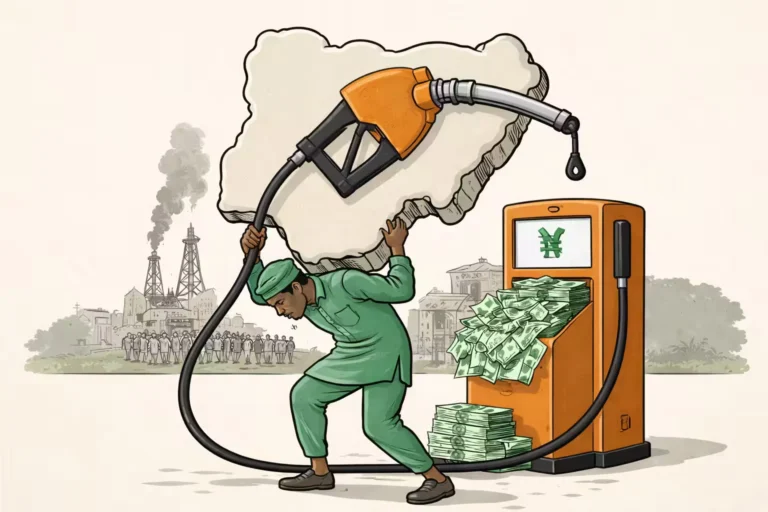
Electric vehicles are becoming more attractive in Nigeria partly because petrol prices and transportation costs have risen sharply since the removal of the fuel subsidy. Lower running costs can make electrification attractive, particularly for high-mileage commercial vehicles.
But the economics depend heavily on battery costs, access to finance, electricity prices, charging infrastructure and the ability to maintain vehicles locally.
Nigeria is attempting to build that ecosystem. Government agencies are working on charging networks, technical standards and local automotive capacity, while private companies are experimenting with electric motorcycles, tricycles, buses and passenger vehicles.
The country’s strategy is therefore moving in two directions at once: reducing dependence on petrol through CNG and electrification while trying to create a domestic industrial base around the technologies.
Tsion’s appearance comes into that transition at an early stage.
From religious influence to industrial influence
There is a larger question behind the unveiling: whether Nigeria’s influential religious institutions can become meaningful economic actors in sectors traditionally dominated by governments, foreign manufacturers and established private companies.
Oyakhilome’s presentation does not yet demonstrate that Christ Embassy has solved the technical and commercial problems of electric-vehicle manufacturing. Nor does the available information establish the scale at which Tsion intends to operate.
It does, however, show an institution accustomed to using technology as a vehicle for global influence attempting to apply that same appetite for innovation to a physical industry.

For Nigeria’s emerging EV market, that could become more interesting if the project progresses from prototypes and presentations to certified production, local assembly, charging infrastructure and vehicles that ordinary Nigerians can actually buy.
Until then, the most consequential part of the unveiling may not be the cars themselves, but the ambition behind them: a Nigerian religious organisation positioning itself not only as a producer of ideas and media, but as a participant in the country’s technology and industrial future.