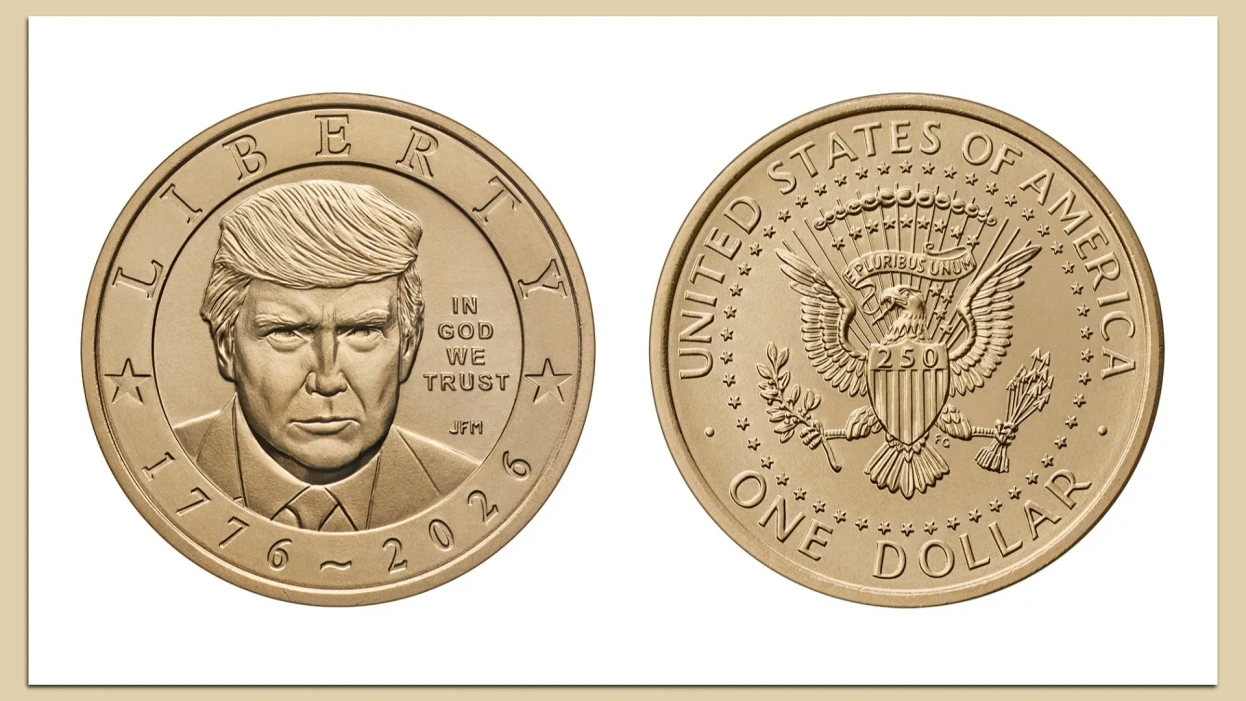
The U.S. Treasury has officially begun production of a commemorative $1 coin bearing President Donald Trump’s likeness to mark the United States’ 250th anniversary, reviving a constitutional and political debate over whether a living president should appear on American currency.
Treasury Secretary Scott Bessent announced that the coin, scheduled for release later this year, is intended to commemorate the nation’s Semiquincentennial and “honor the enduring legacy of liberty” while celebrating “the strength of American values.”
The coin features Trump’s portrait on the obverse alongside the inscriptions “LIBERTY,” “IN GOD WE TRUST,” and “1776–2026,” while the reverse depicts the Great Seal of the United States with a bald eagle, a shield, the denomination “ONE DOLLAR,” and the national motto E Pluribus Unum.
The announcement has drawn intense scrutiny because it appears to break with a longstanding American tradition that has generally kept living individuals—particularly sitting presidents—off U.S. currency.
Yet the Trump administration insists the commemorative issue is entirely lawful.
The legal loophole the administration believes it found
At the heart of the controversy is the Circulating Collectible Coin Redesign Act of 2020, bipartisan legislation signed into law by President Trump during the final weeks of his first administration.
The law authorized the Treasury Secretary to redesign circulating U.S. coins between 2022 and 2030, including a special one-dollar coin celebrating America’s 250th anniversary in 2026. It also created the American Women Quarters Program and authorized commemorative designs for the Semiquincentennial.
What has attracted attention is one specific provision.
Rather than imposing a blanket prohibition on depicting living people, the legislation explicitly states that no head-and-shoulders portrait or bust of any person, living or dead, and no portrait of a living person may appear on the reverse side of the commemorative coins. Critics argue this language was intended to preserve symbolic national imagery, but the administration says it leaves the obverse unrestricted.
That interpretation forms the legal foundation for placing Trump’s portrait on the front of the commemorative $1 coin.
Supporters describe the wording as a lawful exception built into the statute. Critics contend it is an exploitation of a drafting gap rather than the law’s intended purpose.
Breaking with more than a century of tradition
The legal argument has been amplified by a long-established Treasury practice of avoiding portraits of living individuals on U.S. currency.
That convention emerged after the Civil War and has generally been observed to prevent American currency from resembling the personality cults or monarchies from which the United States sought to distinguish itself.
The administration argues that tradition is not the same as statutory prohibition.
Treasury officials have also pointed to historical precedents. President Calvin Coolidge appeared on the 1926 Sesquicentennial half-dollar while still serving in office, and Eunice Kennedy Shriver appeared on the 1995 Special Olympics commemorative silver dollar during her lifetime. Those examples demonstrate that living individuals have appeared on certain commemorative issues under limited circumstances, although never on a circulating one-dollar coin of this nature.
Ironically, the legislation now being used to justify Trump’s appearance on the coin was enacted during his own first presidency.
When Trump signed the Circulating Collectible Coin Redesign Act into law in early 2021, its principal objective was to modernize circulating coin designs over several years while preparing commemorative issues for America’s 250th anniversary.
At the time, the legislation attracted bipartisan support and was not widely viewed as a pathway for placing a sitting president on circulating currency.
That changed after Treasury lawyers concluded that the wording governing the reverse side did not impose a corresponding restriction on the obverse, opening what critics now describe as a legal loophole.
Does the coin strengthen the U.S. dollar?
Economists say the answer is almost certainly no.
The purchasing power and international standing of the U.S. dollar are determined by monetary policy, inflation, interest rates, productivity, fiscal stability and global demand for U.S. Treasury securities—not by commemorative coin designs. A new dollar coin, regardless of whose portrait appears on it, does not alter those underlying economic fundamentals.
At most, analysts say, the commemorative issue could generate modest additional revenue for the U.S. Mint if collectors purchase the coins at premiums above face value. Such income would be insignificant compared with the scale of the U.S. economy.
For investors, the coin carries symbolic rather than financial significance.
A political statement more than an economic policy
The Treasury has described the coin as a celebration of American liberty and patriotism. Trump himself welcomed the announcement, saying he was “very honoured” by the commemorative issue during a television interview, calling it “very unusual.”
Critics, however, argue that placing a sitting president on U.S. currency shifts the focus from commemorating the nation to elevating an individual political leader.
Some legal observers also question whether bypassing traditional review processes could invite court challenges, although Treasury maintains the design complies with existing law.
The debate extends well beyond a single commemorative coin. While the Treasury Secretary has statutory authority over coin designs authorized by Congress, that authority is not unlimited.
Congress retains the power to amend coinage laws, appropriate funding and revise the statutory framework governing future commemorative issues. Courts could also be asked to determine whether the Treasury’s interpretation of the 2020 Act reflects congressional intent or stretches the legislation beyond its original purpose.
In other words, the administration’s authority exists only within the boundaries of laws enacted by Congress.
More symbolism than economics
The Trump commemorative dollar is unlikely to influence inflation, reduce America’s national debt, alter Federal Reserve policy or strengthen the dollar’s position as the world’s leading reserve currency.
Its greatest significance lies elsewhere.

The coin has become a test case for how executive administrations interpret legislation, how longstanding governmental traditions evolve and how national symbols can become part of broader political debates.
As America approaches its 250th anniversary, the discussion surrounding the coin is no longer simply about currency. It is about presidential power, institutional norms and whether a law signed years earlier inadvertently created a pathway for a sitting president to place himself on one of the country’s most enduring national symbols.