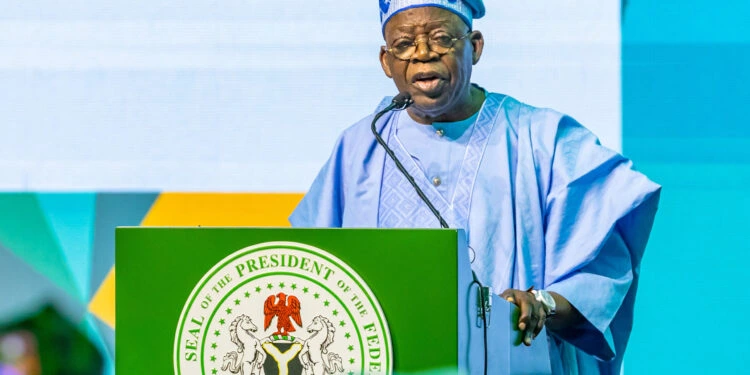
President Bola Tinubu has approved the immediate dissolution of the Presidential Implementation Committee (PIC) on the Alienation of Federal Government Properties, ending the operations of a body established 25 years ago under former President Olusegun Obasanjo to oversee the disposal of federal government assets.
The Presidency announced on Thursday that all functions previously performed by the committee have been transferred to the Attorney-General of the Federation and Minister of Justice, Lateef Fagbemi.
According to a statement issued by the President’s Special Adviser on Information and Strategy, Bayo Onanuga, the dissolution took effect from November 5, 2025. The committee’s Secretary, B. S. Dutsin-Ma, has also been directed to immediately cease acting on behalf of both the committee and the Federal Government on all matters relating to the alienation of federal properties.
The Presidency said the decision followed a review which found that the committee had exceeded its original mandate, with its activities contributing to multiple legal disputes across the country.
“After careful consideration, the government has noted that the activities of the PIC had extended beyond its original mandate, resulting in multiple litigations across the country, and the continued existence of the committee is no longer justified,” the statement said.
Presidential Implementation Committee
The Presidential Implementation Committee was created in 2000 during the administration of former President Olusegun Obasanjo to implement the government’s monetisation policy by supervising the sale and lease of federal government residential properties and other landed assets. The policy sought to reduce the cost of governance by replacing non-cash benefits such as official residences and government vehicles with monetary allowances.
The committee comprised representatives from key ministries, including Housing, Justice, Transportation, Health and Agriculture, alongside the Nigeria Police Force. It was supported by a Panel of Inquiry established by the Federal Executive Council in 2001 to produce a White Paper guiding implementation of its recommendations.
While the monetisation policy is widely regarded as one of the most significant public sector reforms of the Obasanjo administration, its implementation became increasingly contentious. Thousands of disputes emerged over the valuation and sale of government properties, with allegations of undervaluation, preferential allocations to politically connected individuals and prolonged court battles over ownership and transaction processes.

By transferring the committee’s responsibilities to the Office of the Attorney-General, the Tinubu administration appears to be centralising the management of outstanding legal and administrative issues arising from the disposal of federal government properties. T
The dissolution effectively closes a chapter in Nigeria’s long-running monetisation programme and places unresolved property-related matters under the country’s chief law officer.