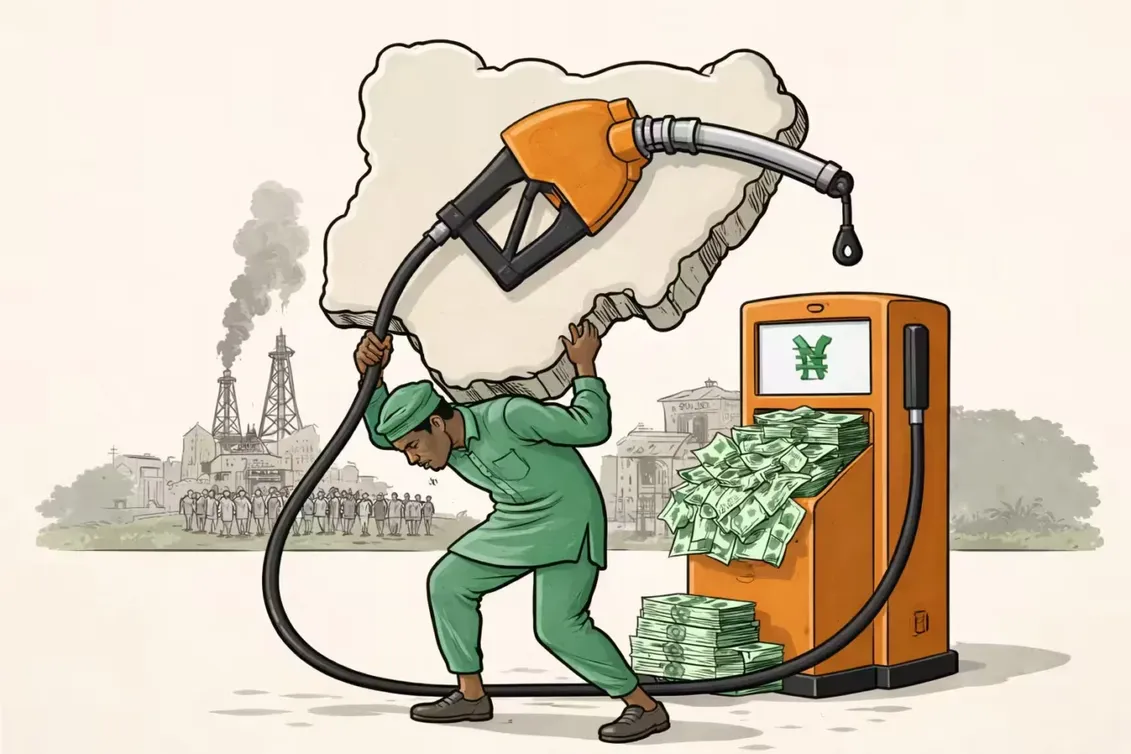
Nigeria’s petrol market is producing an unusual combination for motorists: petrol prices are rising while crude oil prices are falling.
MRS increased its petrol price in Lagos from ₦1,205 to about ₦1,310 per litre, a rise of roughly 9%. Some other fuel marketers moved above ₦1,315 per litre, while prices in some locations reached about ₦1,400.
The increases came as Brent crude was trading around $88 a barrel, below the levels recorded earlier in August.
The development raises a simple question: if crude oil is getting cheaper, why is petrol becoming more expensive in Nigeria?
The answer is that the price of petrol is determined by considerably more than the international price of crude.
As Nigeria’s domestic refining industry expands, the economics of crude acquisition, refining, depot supply, transportation, storage and competition between fuel suppliers are becoming increasingly important.
Why is petrol getting more expensive when crude oil is falling?
Crude oil is the raw material. Petrol is the finished product. Between the two are a series of costs that can move independently of the Brent crude oil price.
A refinery has to obtain crude, process it, finance its inventory and transport the resulting petrol to the market. Once the product leaves the refinery, it may also pass through depots and distribution networks before reaching a filling station.
The final price therefore reflects several factors, including:
- crude oil acquisition costs;
- refinery operating costs;
- refining margins;
- financing and inventory costs;
- depot charges;
- transportation and logistics;
- product availability;
- exchange-rate movements; and
- fuel marketer and retailer margins.
This is why a fall in Brent crude oil prices does not automatically produce an equivalent fall in the petrol price in Nigeria.
And the change is becoming more important as domestic refineries take a larger role in supplying the Nigerian market.
Nigeria’s petrol price is increasingly shaped by domestic refinery economics
For years, Nigeria’s petrol market was heavily exposed to imported refined petroleum products.
That made international refined-product prices, foreign exchange and import logistics particularly important to the price motorists paid.
The growth of domestic refining is changing that structure.
Nigeria can now increasingly obtain petrol from domestic refineries, meaning the price story is no longer simply about how much crude oil costs on the international market.
It is also about how much Nigerian refiners pay for crude, how much it costs to process that crude and how efficiently the finished petrol can be moved around the country.
The latest depot prices illustrate this.
On August 28, depot prices were around ₦1,217 per litre in Warri, ₦1,214 in Port Harcourt and ₦1,202 in Lagos.
The differences show that the price of petrol can vary significantly even within Nigeria.
The crude oil used to make the product is only one part of the equation. The economics of supplying each market also matter.
Dangote Refinery is becoming central to Nigeria’s petrol price
The rise in petrol prices is particularly significant because it comes as the Dangote Petroleum Refinery becomes an increasingly important supplier of refined petroleum products.
The refinery cut its petrol ex-depot price to ₦1,165 per litre at the beginning of August, down from ₦1,215.
But the reduction was short-lived.
Dangote subsequently raised its PMS gantry price to ₦1,185 per litre and then to ₦1,200 per litre, with the latest increase taking effect on August 26.
The timing is significant.
The increases occurred while international crude oil prices were moving lower.
That does not mean the refinery is unaffected by crude prices.
Instead, it highlights the difference between the international benchmark price of crude and the actual economics of securing and processing crude for a refinery.
This is increasingly important for understanding Nigeria’s petrol market.
Dangote Refinery still has to secure crude
Nigeria produces crude oil, but domestic crude production does not automatically mean Nigerian refineries can obtain all the feedstock they need at low cost.
Reuters reported this week that Dangote Refinery is operating near a test-production level of about 700,000 barrels per day and plans to double capacity within three years.
However, around 30% to 40% of its crude supply is imported, according to Reuters, partly because domestic crude can be difficult and expensive to secure.
That creates an important distinction for the Nigerian petroleum industry.
Nigeria can be a crude-oil-producing country while a Nigerian refinery still faces significant costs in obtaining crude.
For motorists, that means watching Brent crude alone gives an incomplete picture of where the petrol price may go next.
The more relevant question is:
What does it actually cost the refinery to obtain the crude it needs?
Nigeria’s refining boom has changed the fuel market—but not eliminated costs
The expansion of domestic refining was expected to reduce Nigeria’s dependence on imported petrol.
That transition is underway.
The US Energy Information Administration says Nigeria’s seaborne petroleum-product exports have increased sevenfold since 2023, driven largely by the growth of the Dangote refinery.
This represents a significant change in Nigeria’s petroleum trade.
But domestic refining does not mean petrol is produced without market costs.
A refinery still has to:
Buy crude.
Operate the refinery.
Finance crude and product inventories.
Maintain production.
Transport refined products.
Compete for customers.
Those costs ultimately feed into the price of petrol.
So Nigeria’s refining transition should not be understood simply as:
more domestic refining = automatically cheaper petrol.
A better way to understand it is:
more domestic refining = a different set of supply, pricing and competitive forces.
Why petrol prices differ across Nigeria
Another reason motorists should not expect one uniform petrol price in Nigeria is the country’s distribution network.
Petrol has to move from refineries and depots to filling stations, often across significant distances.
Transportation costs, depot availability and regional supply conditions can therefore affect prices.
The August 28 depot prices provide a clear example.
Lagos was around ₦1,202 per litre, compared with approximately ₦1,214 in Port Harcourt and ₦1,217 in Warri.
The differences may appear small, but they demonstrate an important feature of Nigeria’s fuel market:
where the petrol is supplied matters.
That makes the Nigerian petrol market increasingly regional and commercial.
The current rise in petrol prices does not necessarily mean the expansion of domestic refining has failed.
In fact, greater competition between suppliers could eventually benefit motorists.
Earlier in August, competition among suppliers helped push PMS prices lower in several markets, with Dangote offering petrol at around ₦1,166 per litre in Lagos at one point.
That shows how supply and competition can influence the market even when the global crude price has not changed dramatically.
If multiple refiners and suppliers have enough product, they have greater incentive to compete for customers.
A refinery that obtains cheaper crude, operates more efficiently or has lower distribution costs could potentially sell petrol at a lower price than a competitor.
But competition only works when suppliers can secure crude and maintain sustainable production.
That is why the future of petrol prices in Nigeria will depend not only on refinery capacity, but also on crude supply and the efficiency of the wider petroleum supply chain.
What should Nigerians watch to understand petrol prices?
For motorists trying to understand the next move in the Nigeria petrol price, Brent crude remains important.
But it should not be the only indicator.
Brent crude oil price
Brent remains a major global benchmark and provides an important signal about the broader oil market.
But changes in Brent do not necessarily translate immediately into changes in Nigerian petrol prices.
Refinery gate and gantry prices
The price charged by domestic refineries provides a much more direct indication of the economics of petrol supplied into Nigeria.
The pricing decisions of major suppliers such as Dangote Refinery can therefore have a significant effect on the market.
Crude acquisition costs
A refinery’s actual cost of obtaining crude may be more important than the headline international benchmark.
This is particularly relevant when domestic crude is difficult or expensive to secure.
Depot prices
Depot prices show how much petrol costs before it reaches many filling stations.
Differences between Lagos, Warri, Port Harcourt and other markets can reveal regional supply and logistics pressures.
Exchange rate
The naira exchange rate can affect imported crude, equipment, financing and other costs associated with the petroleum supply chain.
Product availability
When petrol is readily available, suppliers face greater competitive pressure.
When supply is constrained, prices can come under upward pressure.
Logistics
The cost of transporting petrol from refineries and depots to filling stations also contributes to the final pump price.
Why higher petrol prices matter to Nigeria’s economy
Petrol prices affect far more than motorists.
Fuel is an important input into transportation, logistics, commerce and household activity.
When petrol prices rise, transport operators may face higher operating costs. Logistics companies may increase delivery charges. Businesses that rely on vehicles and petrol-powered equipment can also face higher expenses.
Those costs can eventually be passed through the economy to consumers.
This makes the petrol price in Nigeria an important economic issue, not simply a filling-station issue.
At the same time, a more competitive domestic refining industry could provide long-term benefits.
If Nigerian refineries can maintain stable production, secure competitively priced crude and compete effectively, the country could become less exposed to disruptions in imported refined-fuel supply.
That is one of the potential economic benefits of Nigeria’s refining expansion.
The bigger story behind Nigeria’s petrol price increase
The latest increase is therefore about more than a jump in the amount motorists pay at the pump.
It is evidence that Nigeria’s fuel market is entering a different phase.
The traditional question was:
What is happening to the global price of crude oil?
Increasingly, Nigerians need to ask:
What are domestic refineries paying for crude?
How much does it cost to refine the crude?
What are refinery gantry prices?
What are depot prices in different markets?
How much does logistics add to the cost?
How much petrol is available?
And how strongly are suppliers competing?
Those questions are becoming more important as Nigeria moves from a market dominated by imported refined fuel towards one in which domestic refineries are major suppliers.

The result is a more complicated petrol market—not necessarily one that is permanently cheaper.
Falling crude oil prices can therefore coexist with rising petrol prices in Nigeria because the cost of crude is only one part of the journey from the oil field to the filling station.