The Joint Admissions and Matriculation Board has remained the most consistent education body in Nigeria when it comes to the provision of data and statistics on its operations.
Every year for the last six years, through livestreaming of its annual policy meeting and/or publication of its annual UTME report, JAMB has become the most important source of primary data on the health of Nigeria’s education system.
Unfortunately, that consistency has not produced the kind of systemic response one would expect from how dire some of the numbers are. What we get instead is ministers lauding some milestones, while the press reports screaming headlines, but no changes happen.
This year’s JAMB policy meeting, held on 11 May is sadly not different from the previous editions. The figures released this year, like the ones before it, tell a frightening story that deserves more than a cursory look or outrage confined to social media.
A Million Admissions, And The Question Nobody is Asking
The headline from the 2025 admission cycle, that total admissions exceeded one million for the first time, reaching 1,012,616 from a pool of over 2.05 million applicants, was received with understandable satisfaction. The Minister of Education described it as historic. It is worth pausing, however, to ask what exactly has been achieved.
Of those one million admitted candidates, more than 60 per cent scored below 200 in the UTME. Some 494,544 scored between 160 and 199, while another 113,049 scored between 140 and 159. Not long ago, anything below 200 would have been considered mediocre, while anything below 180 was the kind of result candidates and their parents would be reluctant to mention. We are now at a point where 7,821 candidates who scored between 120 and 139 were admitted into tertiary institutions, and a further 305 who scored between 100 and 119 out of 400, meaning they answered correctly, at best, roughly one in four questions, also secured places.
When the majority of the celebrated one million admissions scored less than half marks on the examination that is supposed to rank them, a direct question presents itself: is the goal tertiary access at any cost, regardless of the academic readiness of the students being mass-promoted into higher education?
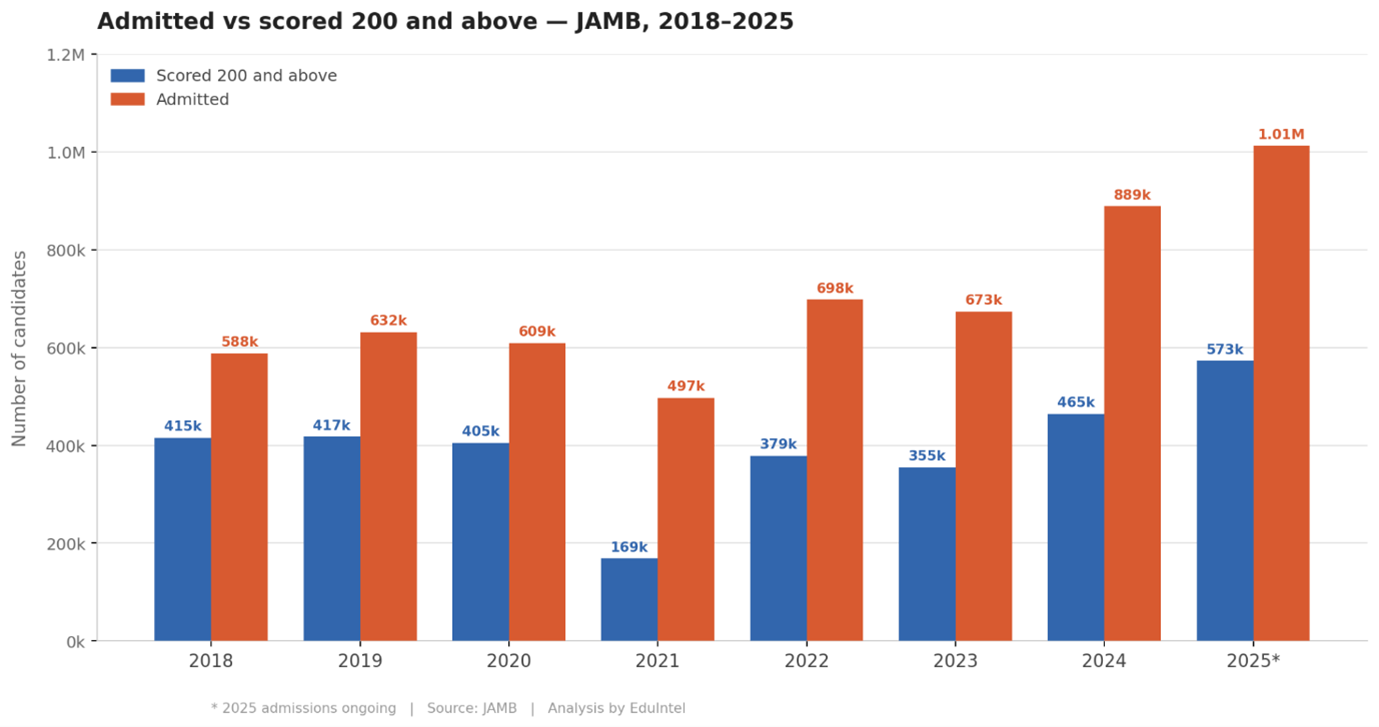
Far more students are being admitted than can clear score 50% in the entrance exams.
Ranking Examination, or Rubber Stamp?
Writing in 2022, I raised the question of what an examination system means when it sets 25% as a functional pass mark. JAMB’s defence at the time was that the UTME is not an achievement test but a ranking examination. Four years on, that position remains hard to sustain. A ranking system implies that the ranks are respected, that a score of 250 reliably opens more doors than a score of 180. The data shows this is not consistently the case. Many candidates in the lower score bands (less than 200) are being admitted into various programmes, while thousands of brilliant candidates who scored 300 and above remain without places, largely because they applied for Medicine or Law where capacity, not academic merit, is the binding constraint.
More than 433,000 candidates applied for Medicine, Health Science and Pharmacy against a national quota of 148,486. Over 58,000 applied for Law against fewer than 11,000 available spaces. While there are insufficient spaces for our brilliant students to enrol in their programme of choice, the system has continued to maintain and sustain courses for poorly prepared students with subpar UTME scores. Why are we not doing more to expand programmes that high scorers are actually competing for?
The question of what made lowering standards the path of least resistance is one that vice chancellors, rectors, and policymakers who approved these low cut-off marks owe the public an answer to. A plausible explanation is institutional pressure to produce admission numbers large enough to announce as progress, in the absence of the investment in capacity and foundational education quality that would make those numbers genuinely meaningful. When you add together everyone admitted below the 200 mark, you are describing the academic foundation of the majority of Nigeria’s new tertiary intake. Lectures will be delivered to these students. Degrees will eventually be awarded to them. Employers will inherit them. The consequences of this gradual standards compression do not stop at the admissions gate.
The Education Profession Nobody Wants
The figures on teacher training deserve far more policy attention than they typically receive. The combined NCE quota across Colleges of Education stands at 234,981. Admissions so far this cycle: 24,736, a ten per cent uptake rate. The federal government noted that many Colleges of Education are underutilised. Its response to that underutilisation is instructive.
Rather than addressing what has made the teaching profession unattractive, including poor pay, weakened professional status, and decades of institutional neglect, the policy direction has been to progressively dismantle the barriers to entry. Cut-off marks for Colleges of Education were already set at a symbolic 100 out of 400, a threshold so low it was difficult to describe as selective in any meaningful sense. The announcement at this year’s meeting that NCE programmes will no longer require candidates to sit the UTME at all is the logical conclusion of that trajectory.
This matters beyond the Colleges of Education themselves. The education sector (universities and colleges of education combined) has nearly 433,642 available places, but less than 165,000 applicants in 2026. Even if all candidates are admitted, more than 60% of available spaces would remain vacant in faculties and colleges of education around the country.
A profession that cannot attract candidates even when the examination bar is set at 25 per cent cannot solve its attractiveness problem by simply removing the low bar entirely. What we have done with the new policy change is to make it easier for unprepared candidates to enter the profession without making the profession worth entering for anyone else.
Nigeria is simultaneously struggling to fill its tertiary seats with adequately prepared candidates and abandoning the last pretence of academic selectivity for the specific seats that matter most to the country’s long-term human capital development. Strange, is it not?
Where we go Now
In a previous article, I asked whether the UTME was still worth the hassle. The structural problems I identified then, inflexible scheduling, inadequate examination centres, and a tendency to place the burden of institutional failures onto candidates, have not been fully resolved. But the more fundamental issue, sharpened by this year’s data, is that the UTME cannot perform beyond what the pipeline feeding it will allow. Nigeria’s nearly 2,000 tertiary institutions cannot admit well-educated candidates if the primary and secondary schools producing those candidates are themselves under-resourced, under-staffed, and under-performing. The UTME does not create the pool it draws from. It simply reflects it.
If the admissions system is drawing from a shallow pool today, the answer is not primarily to adjust the examination or lower the cut-off marks, and it is certainly not to exempt entire categories of candidates from the examination altogether. It is to invest seriously in the years of schooling that precede the examination, so that the pool itself is deeper, broader, and better prepared. Reforming basic education, strengthening primary and secondary school quality, and restoring the professional standing of the teaching vocation are not background conditions for fixing the admissions system. They are the fix.
Our policymakers must be reminded that an aspiring teacher who enters a College of Education with only four o’level credits and zero attempt at passing the UTME, and goes on to be trained in a system that has progressively deprioritised selectivity, will eventually stand in front of a primary school classroom. The children in that classroom will, in time, sit the UTME. And the vicious cycle continues >70% of candidates scoring below 50% in UTME (and of 73% of children not being able to read and write) will continue.

Everything else, including whatever new milestone JAMB announces at next year’s policy meeting, is downstream of that foundational choice. We must choose better.
Sodiq Alabi is the programme lead at EduIntel and writes a regular column for Arbiterz.