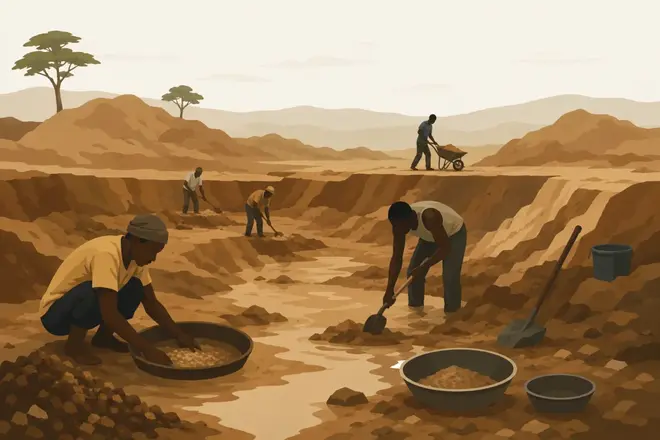
Nigeria’s illegal mining industry has evolved far beyond villagers using rudimentary tools to dig for gold or other minerals. It has become a growing informal economy connecting artisanal miners with local buyers, financiers, mineral aggregators, processors, exporters and international markets.
The trade involves some of Nigeria’s most valuable mineral resources, including gold, lithium, tin, columbite, tantalite, lead-zinc and gemstones. In parts of the North-West, mining also intersects with insecurity, with illegal extraction and mineral trading providing revenue streams for criminal networks.
In October 2025, the House of Representatives said Nigeria was estimated to lose approximately $9 billion annually to illegal mining through lost royalties, taxes, export earnings and industrial opportunities. Communities, meanwhile, bear the environmental costs through degraded farmland, polluted water, abandoned mine pits and toxic exposure. An earlier NEITI estimate placed the annual losses at between $2 billion and $3 billion, highlighting the substantial variation between estimates.
What Is Fueling Nigeria’s Illegal Mining Trade?
Nigeria has significant deposits of gold, lithium, tin, columbite, tantalite, lead-zinc and gemstones. Rising international demand for critical minerals has increased the commercial attraction of deposits that were previously considered marginal.
Gold is particularly attractive to illicit traders because it is highly valuable relative to its weight, relatively easy to transport and can be melted or refined into forms that make its original source difficult to establish.
Growing global demand for battery materials has also increased interest in lithium-bearing deposits. At the same time, Nigeria’s relatively underdeveloped mining sector creates opportunities for traders willing to operate outside formal regulatory channels. Poverty, unemployment and limited alternative livelihoods in rural communities further contribute to the expansion of artisanal and small-scale mining.
The United Nations Development Programme says artisanal and small-scale miners dominate more than 70% of Nigeria’s mining landscape. While the sector provides livelihoods for large numbers of Nigerians, particularly in rural communities, a significant informal component operates outside effective regulatory, tax and environmental systems.
NEITI has warned that illegal mining, smuggling, tax evasion, corruption, money laundering and illicit financial flows are interconnected problems in Nigeria’s solid-minerals sector. The agency has also raised concerns about opaque corporate structures and weak verification of beneficial ownership.
Despite the country’s geological potential, the official economic contribution of solid minerals remains relatively small. NEITI’s 2023 solid-minerals audit showed that the sector contributed ₦1.691 trillion, or 0.72% of Nigeria’s GDP, while solid-mineral exports amounted to ₦35.87 billion, representing just 0.28% of total exports.
How Nigeria’s Illegal Mining Chain Works
At the bottom of the chain are artisanal miners and labourers who physically extract minerals. Some deliberately operate without licences, while others work informally because they lack access to finance, formal mining titles, equipment or straightforward routes into the regulated market.
Local buyers and aggregators purchase ore at mining sites and move it to larger trading centres. Mineral dealers, financiers and operators may provide cash, excavators, processing equipment, transportation and other logistical support.
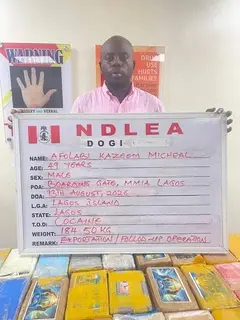
Foreign participants are also present in parts of the industry. Nigerian authorities have repeatedly arrested foreign nationals over alleged illegal mining. In March 2025, the Ministry of Solid Minerals Development said two foreign illegal miners, Yang Chao and Wu Shan Chuan, had been convicted in Kwara State.
In May 2025, the EFCC announced the arrest of two Chinese nationals and six Nigerians in Ogun State over alleged illegal mining involving suspected lithium powder and other solid minerals.
Local actors remain critical to the network because they can provide access to communities, mineral deposits, transport routes, licences, companies and political or commercial connections.
The basic structure is: Miner → Local Buyer → Aggregator → Processor/Dealer → Exporter → Foreign Buyer → International Market
The Cover-Up Behind Illegal Mineral Trade
One of the major challenges facing Nigeria is identifying the people who ultimately control mining operations and profit from them.
NEITI has warned that mining licences are sometimes held through special-purpose vehicles, shell companies and layered corporate structures, making it difficult to identify the natural persons who ultimately own or control extractive assets. The agency has consequently called for stronger beneficial-ownership disclosure and verification.
The financial incentive is straightforward. When minerals are extracted and exported outside the formal system, the government can lose royalties, taxes, fees and other legitimate economic benefits.
The problem becomes particularly significant when a mineral appears in another country’s import statistics but is absent or substantially understated in Nigeria’s export records.
An investigation using UN Comtrade data found that the United Arab Emirates reported importing 135.6 tonnes of gold from Nigeria between 2013 and 2023, with an estimated value of about $19.7 billion based on the gold price used in the investigation.
Nigeria’s official export data for the same period recorded only 0.49 tonnes, valued at approximately $71 million. More than 99% of the UAE-reported gold imports therefore did not appear in Nigeria’s official export figures.
Illegal Mining and Banditry
Where armed groups control territory, they can impose levies on miners, control access to mining areas, provide protection for operators or participate directly or indirectly in mineral extraction and trade. The proceeds can subsequently support weapons purchases, recruitment and other criminal operations.
This means mineral-rich areas affected by insecurity require a combined economic and security response rather than treating mining enforcement as a stand-alone regulatory issue.
Nigeria has intensified enforcement through the Mining Marshals, a specialised enforcement unit established in March 2024.
According to the Federal Government, the Mining Marshals arrested 327 suspected illegal miners, recovered 98 mining sites and identified 457 suspected illegal mining sites during their first year of operations.
The government has also said the unit will deploy technologies including satellite imagery, drones and other surveillance tools to improve detection and monitoring.
Environmental Effects of Illegal Mining
Illegal mining can result in vegetation clearance, excavation, erosion, diversion of waterways and the abandonment of open pits. Its environmental consequences can extend directly into agriculture and other rural livelihoods.
Research from Nigerian mining communities has documented soil degradation and heavy-metal contamination associated with artisanal gold mining. A 2024 study in Ibodi-Ijesa, Osun State, found elevated concentrations of several heavy metals around mining areas and identified potential health risks for nearby populations.
Research from Uke, Nigeria, has also demonstrated the dangers associated with mercury use in artisanal gold processing. A 2024 study found that approximately 42% of mercury added during the examined processing operations was lost, with some released through tailings and some through evaporation.
Mercury does not simply disappear after gold processing. It can contaminate soil, air and water, exposing miners, processors and nearby communities.
The effects extend beyond mining sites. When farmland is excavated, farmers lose productive land. When streams become contaminated or filled with sediment, fishing and domestic water supplies can be affected. Abandoned pits can also become hazards for people and livestock.
In 2010, an outbreak of lead poisoning was detected in Zamfara State after villagers processed lead-rich ore associated with gold mining. The World Health Organisation reported that the outbreak was linked to the processing of lead-rich ore for gold extraction.
UNEP subsequently documented extensive environmental contamination from artisanal gold mining and processing, including the dispersal of lead dust through affected communities.
What Nigeria Needs to Do
Nigeria needs to move beyond a strategy focused primarily on people physically found at mining sites and instead follow the money.
Investigators need to establish who finances extraction, who owns the equipment, who purchases the minerals, who provides transportation, which companies process and export the products, and where the proceeds eventually go.
The country also needs stronger financial intelligence covering mining licences, company ownership records, bank transactions, customs declarations, export records, tax filings and mineral-production data.
A company exporting large quantities of minerals while declaring minimal production from its Nigerian operations should automatically attract scrutiny. Beneficial-ownership information should also be independently verified because registering a company in Nigeria does not necessarily reveal who ultimately controls or profits from a mining operation.
At the same time, legitimate artisanal and small-scale miners need a realistic pathway into the formal economy. This includes simpler licensing, access to finance, geological information, safer equipment, cooperatives, mineral-buying centres and transparent pricing, making the legal market more attractive than the black market.
Nigeria also needs end-to-end mineral traceability. Production records, mine coordinates, electronic weighing, laboratory certification and export documentation can help establish where minerals originated and who handled them before they left the country.
Arresting labourers at mining sites may remove one group of workers, but it does little to disrupt the wider economic system if financiers, buyers and exporters remain active.
The Mining Marshals’ operations should therefore be complemented by the EFCC, Customs, the Nigeria Financial Intelligence Unit, tax authorities and other agencies capable of following money and corporate ownership.

Nigeria must also strengthen cooperation with destination countries. The UAE gold data demonstrates why this is necessary. Nigeria should routinely compare its export declarations with the import records of major destination countries and investigate significant discrepancies.
Finally, in areas where mining is directly linked to armed groups, security operations may be required before regulators can effectively formalise the industry.