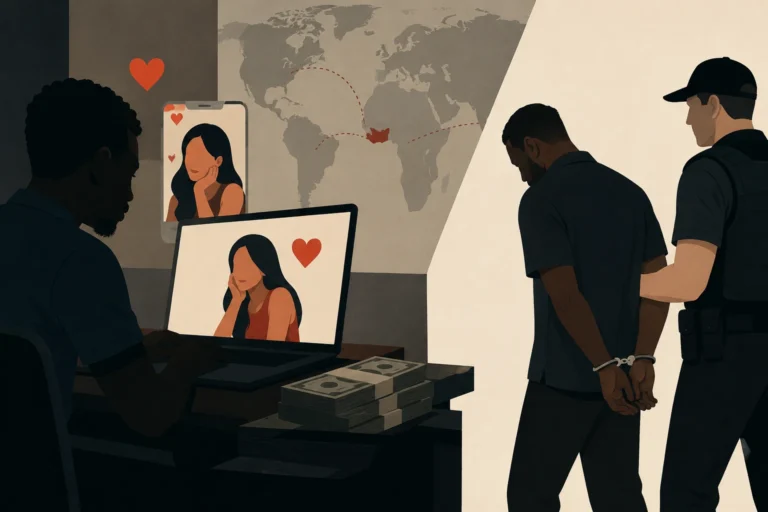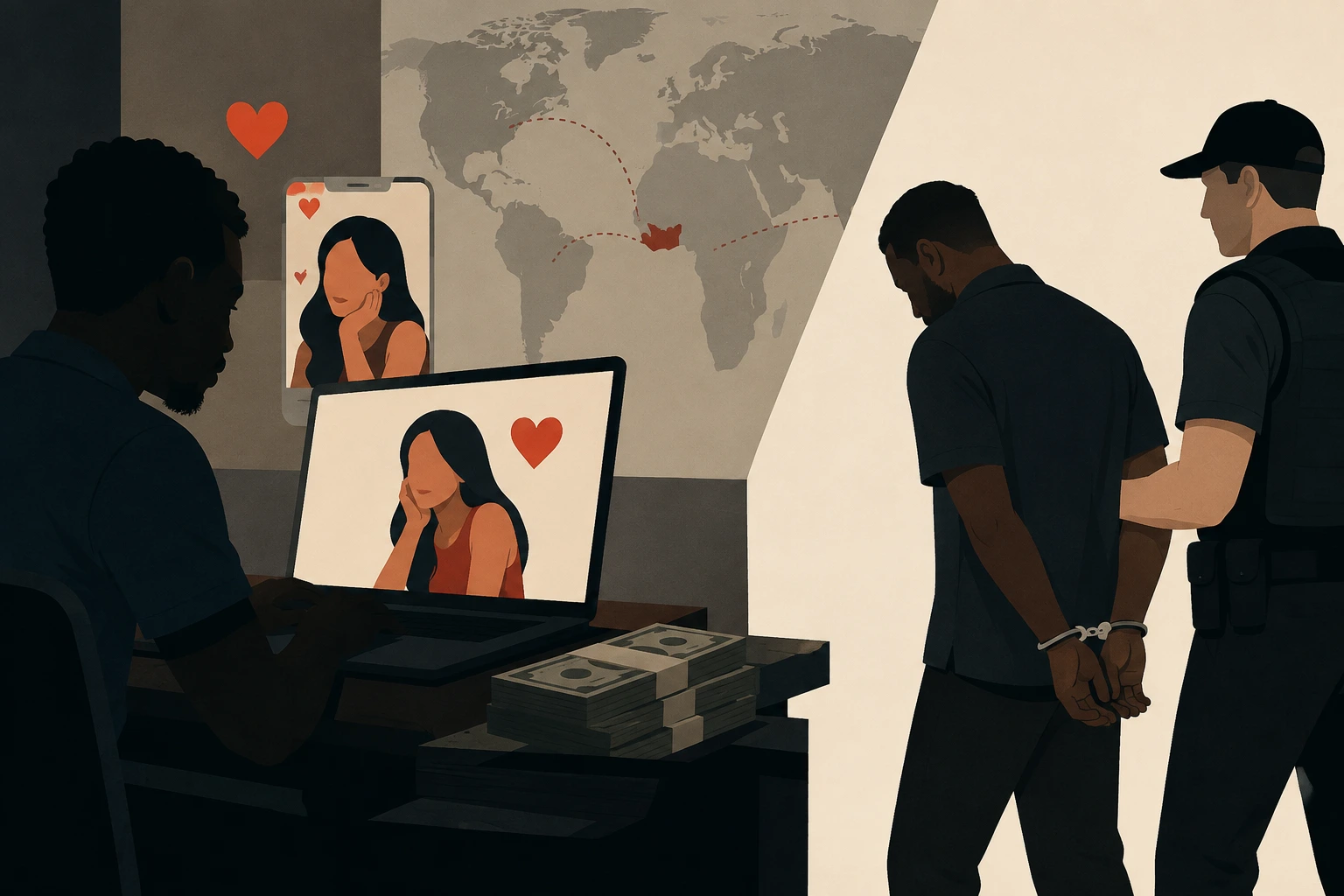
Former US prosecutor Erin West and cybercrime investigator Paul Raffile travelled to Lagos, Nigeria, in July 2026 to track down Nigerian scammers accused of running financial sextortion schemes targeting teenage boys in the United States.
Their investigation, documented by Sumsub, involved creating a decoy teenage social media account to lure suspected scammers, tracing their digital footprints and ultimately confronting one of the alleged perpetrators on a video call. The investigators said they were pursuing a form of cybercrime that has been linked to the deaths of more than 60 teenage boys.
“We know that more than 60 teenage boys have lost their lives as a result of this scam,” West said in the investigation. “We thought we’d find monsters but we were wrong. And that’s the part we still can’t shake.”
Financial sextortion has emerged as a particularly damaging form of online exploitation in which criminals deceive victims into sending sexually explicit photographs or videos and then threaten to distribute the material unless money is paid.
How ‘Yahoo Boys’ Target Teenage Victims
The scammers commonly approach teenage boys on platforms including Instagram and Snapchat, posing as girls or peers. After establishing contact, the scammer may send an explicit image and encourage the victim to reciprocate. Once the victim sends an intimate photograph or video, the scammer threatens to send it to the victim’s parents, friends, classmates or school unless money is transferred.
In one interaction recorded by the investigators, a suspected Nigerian scammer threatened to release a victim’s images while counting down from 10. “If I count to 10 and you don’t make the deal, then it’s going viral,” the scammer said.
The speed with which the schemes are executed is one of their most dangerous features. Investigators said victims can move from an ordinary social-media conversation to being threatened with public exposure in a matter of hours.
Suspected Scammer Traced to Lagos
West and Raffile created a realistic decoy account designed to attract the type of teenage boys targeted by the scammers, the account quickly began receiving suspicious requests. The investigators were subsequently contacted on WhatsApp by a suspected scammer using a Nigerian telephone number beginning with the country code +234.
With assistance from scam-baiter Kitboga, the investigators obtained information that helped identify and locate one of the suspects. The suspect’s face was captured and an IP address traced to Lagos, where West and Raffile were conducting their investigation.
Further assistance from a Nigerian academic helped connect telephone numbers to bank accounts and real identities before the investigators then travelled to an address associated with one suspect, but nobody was home.
They later managed to contact a man known by the nickname “Big Doll” through a video call. During the call, West confronted the alleged scammer and accused him of posing as a teenage girl, obtaining explicit images from a minor and subsequently blackmailing the victim.
“You were pretending to be a teenage girl. You got him to send explicit images, and then you blackmailed him, The work you are doing is killing teenage boys. We’ve had 60 suicides that we know about from the bad work that you do. I know who you are and you’re going to jail.”
The investigators, with guidance from Professor Oye Nuga, a specialist on Nigerian cybercrime met young men involved in online fraud and discussed their methods.
Evidence Handed to Nigerian Authorities
West and Raffile said they handed evidence gathered during their investigation including names, telephone numbers and locations to Nigerian authorities, including the Economic and Financial Crimes Commission and the Ministry of Justice. However, no arrest had been made in connection with the specific scammer confronted by the investigators as of the release of the film.
Some participants acknowledged using stolen photographs of adult-film performers to create fake online identities and target users on platforms such as Snapchat and Instagram and use prepared scripts or “blackmailing formats” to pressure victims into paying.
The investigation also documented a practice known as “Yahoo Plus”, in which some scammers combine cyber fraud with traditional ritual practices. In one case, investigators witnessed a scammer paying a ritualist to “bless” an ongoing scam against an American victim. The victim’s name was reportedly placed on a voodoo doll as part of the ritual.
For West, the investigation demonstrated that tackling financial sextortion cannot rest solely on arrests in Nigeria as the investigators left Nigeria with a more complicated view of the people behind the scams.

The schemes depend on a wider ecosystem involving social-media platforms, payment companies, gift-card systems and cryptocurrency services, creating multiple points where the crime could potentially be detected or prevented.
West said the team had expected to encounter obvious villains but instead found young men who appeared outwardly ordinary, as such the contrast between their everyday appearance and the consequences of their activities including the deaths of vulnerable teenage victims was one of the most disturbing aspects of the investigation.