The International Mathematical Union unveiled the 2026 Fields Medal laureates on Thursday at the opening of the International Congress of Mathematicians, held at the Pennsylvania Convention Center through July 30. Among the four recipients is Hong Wang, 35, whose career spans China, France and the United States, and whose award drew an unusual response: a personal phone call from French President Emmanuel Macron.
A call from the Élysée to salute “a wonderful role model”
According to several Chinese and French media outlets, the French president called the mathematician directly to congratulate her, describing her as someone who embodies the excellence of French research and education. He stressed the symbolic weight of the honour for the standing and appeal of the French school of mathematics, and highlighted the example she sets for young women that France is seeking to draw into scientific careers.
Macron also marked the honour on social media, calling it a source of national pride. The gesture fits into the broader science-outreach push the French government has pursued in recent years under the “Choose France” banner, which presents the country as a destination for top international researchers — a case Hong Wang’s own career makes almost point for point.
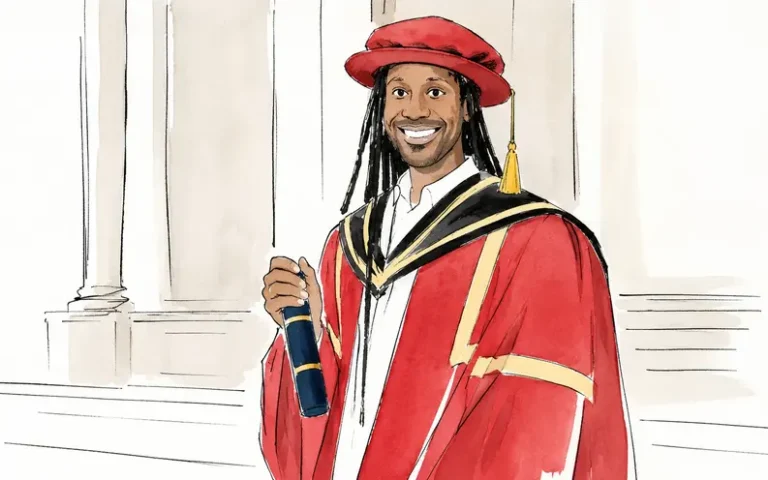
Hong Wang’s academic path crosses three continents. After an undergraduate degree at Peking University, she joined the engineering track at the École Polytechnique, graduating in 2010, before earning a master’s degree at Université Paris-Saclay and a PhD at the Massachusetts Institute of Technology. In recognition of that lasting tie, the École Polytechnique awarded her an honorary doctorate in 2026.
Since September 2025 she has held a permanent professorship at IHÉS, where she is affiliated with the Alexander Grothendieck Laboratory, a joint CNRS-IHÉS unit. She is also a Silver Professor of Mathematics at the Courant Institute of New York University.
Her award brings to nine the number of Fields Medals won by researchers who have passed through IHÉS, and to twelve the number won by scientists linked to Université Paris-Saclay.
The Kakeya conjecture, a century-old problem
The committee honoured Hong Wang for her work in harmonic analysis and geometric measure theory, and in particular for resolving, together with Canadian mathematician Joshua Zahl, the three-dimensional Kakeya conjecture — a result posted as a preprint in February 2025.
The problem, popularised by mathematician Sōichi Kakeya in the early twentieth century, is deceptively simple: what is the smallest area in which a needle of unit length can be rotated so that it points in every possible direction?
Its three-dimensional version asked whether a set containing a line segment in every direction of space must necessarily fill the whole of that space. Wang and Zahl’s proof answers yes, closing out a search that had occupied the mathematical community for half a century.
Mathematician Terence Tao has previously described the general Kakeya conjecture as one of the most sought-after open problems in geometric measure theory. Its resolution opens up new lines of inquiry in several neighbouring fields of mathematics, including partial differential equations.
A historic first for China
Hong Wang shares this year’s Fields Medal with Chinese mathematician Deng Yu, a professor at the University of Chicago, honoured for his work on partial differential equations. The two other laureates this year are John Pardon of Stony Brook University and Jacob Tsimerman of the University of Toronto.
It is the first time two mathematicians of Chinese nationality have received the award in the same year, a milestone widely discussed on Chinese social media. Hong Wang also becomes only the third woman to win the Fields Medal since its creation in 1936, after Maryam Mirzakhani in 2014 and Maryna Viazovska in 2022.

A symbol for women in science
Beyond the mathematics itself, the presidential call emphasised the symbolic significance of the win for young women considering scientific careers. Macron said he hoped the achievement would be widely publicised, at a time when France, like many countries, is working to close the persistent gender gap in scientific fields and research careers.
Asked about the award, Hong Wang credited part of her success to her colleagues, pointing to collaborations that proved decisive at every stage of her career.