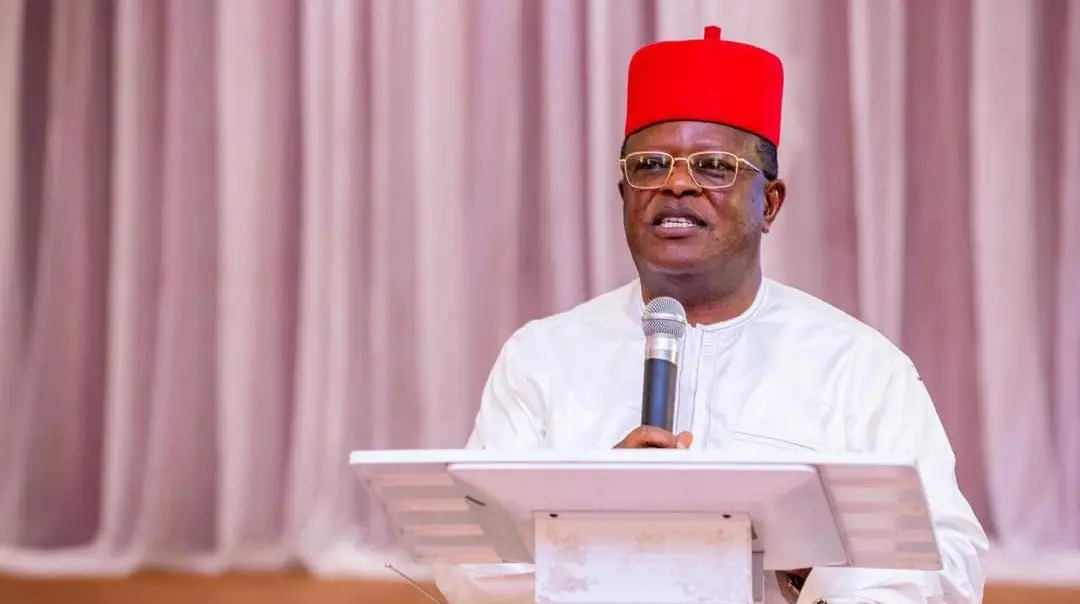
Governor Siminalayi Fubara of Rivers State has announced his withdrawal from the All Progressives Congress (APC) gubernatorial primaries, in a dramatic political development that could reshape the political landscape of the oil-rich state ahead of the 2027 elections.
In a statement issued on Tuesday, the governor said his decision followed “deep reflection and extensive consultations” with family, friends, and political associates.
“I have taken the difficult but necessary decision to withdraw from the APC gubernatorial primaries,” Fubara said. “I do so with a full heart and with a firm commitment to support whoever emerges as the candidate of our great party.”
Also Read:
- Tinubu Declares State of Emergency in Rivers State, Suspends Governor Fubara and Legislators
- Peace in Sight for Rivers as Tinubu Brokers Truce Between Wike, Fubara
- Gov. Fubara Approves New N85,000 Minimum Wage for Rivers Workers: Examining New Minimum Wage…
- Suspension of Fubara Well - Oiled Plot by APC to Take Over Rivers State - PDP
The announcement immediately intensified debate over the state of internal democracy within Nigeria’s major political parties, with analysts arguing that the withdrawal appears consistent with a broader pattern in which powerful political blocs increasingly shape or predetermine primary outcomes behind closed doors.
The development also comes after months of intense political tensions in Rivers State, where a prolonged power struggle between Fubara and his predecessor, Nyesom Wike, has divided the state’s political establishment and triggered repeated interventions from the presidency and party leaders.
“Peace and Unity Must Come First”
In the statement, Fubara framed his withdrawal as a sacrifice aimed at preserving political stability in the state.
“Rivers State is bigger than any individual, and at this critical moment, the peace, stability, and unity of our dear state must take precedence over every personal interest,” he said.
The governor acknowledged the disappointment many supporters would feel, noting that “much has indeed been invested and much sacrificed along the way.”
He also hinted at behind-the-scenes pressures that influenced his decision.
“As our elders say, not everything a hunter sees in the forest is spoken of in the marketplace,” Fubara stated. “Some truths are best borne quietly, not out of fear, but out of wisdom and restraint for the sake of peace and a greater purpose.”
Without providing details, he added that he had faced “immense pressures and difficult choices.”
Renewed Debate Over Internal Democracy
Fubara’s withdrawal is already fueling wider concerns about the growing use of elite political negotiations, consensus arrangements, and power-broker interventions in determining candidates within Nigeria’s major parties.
Critics have increasingly argued that governorship and presidential primaries are becoming less competitive and more controlled by entrenched political interests, weakening internal democracy and reducing the influence of ordinary party members.
The Rivers crisis has become one of the clearest examples of how struggles over party structures and political succession can evolve into broader institutional conflicts involving legislatures, party executives, security agencies, and the presidency.
Analysts say Fubara’s decision may reduce immediate tensions within Rivers State, but could also reinforce perceptions that political outcomes in Nigeria are often determined through elite accommodation rather than transparent party competition.
Background to the Rivers Political Crisis
The political crisis in Rivers State began shortly after Fubara assumed office in 2023, following disagreements with Wike, who had played a central role in his emergence as governor.
The dispute quickly escalated into a wider battle for control of the state’s political structure, including the state assembly, local government administration, and party machinery.
At various points, the crisis led to impeachment threats, parallel political alignments, legal disputes, defections, and concerns over governance stability in one of Nigeria’s most economically strategic states.
Rivers State remains critical to Nigeria’s economy because of its central role in the country’s oil and gas industry. Political instability in the Niger Delta has historically affected oil production, government revenues, and investor confidence.
The tensions in Rivers have therefore attracted sustained national attention, particularly from the administration of Bola Ahmed Tinubu, which has repeatedly sought political reconciliation between rival camps.
APC Dynamics and Political Implications
Fubara used the statement to reaffirm his loyalty to the APC and thanked President Tinubu for his “support and encouragement.”
“The APC remains our collective home,” he said, urging party supporters to remain committed to the party.
His withdrawal is expected to intensify speculation over who may now emerge as the dominant contender within the APC in Rivers State and whether the move signals a broader political settlement between rival factions.
Fubara insisted his decision should not be interpreted as political weakness.

“Let it be clearly understood that I stepped aside… not out of weakness, fear, or surrender, but out of conviction and sacrifice so that Rivers State may move forward in peace and unity,” he said.
The governor added that he remained committed to serving the people of Rivers State until the end of his tenure.