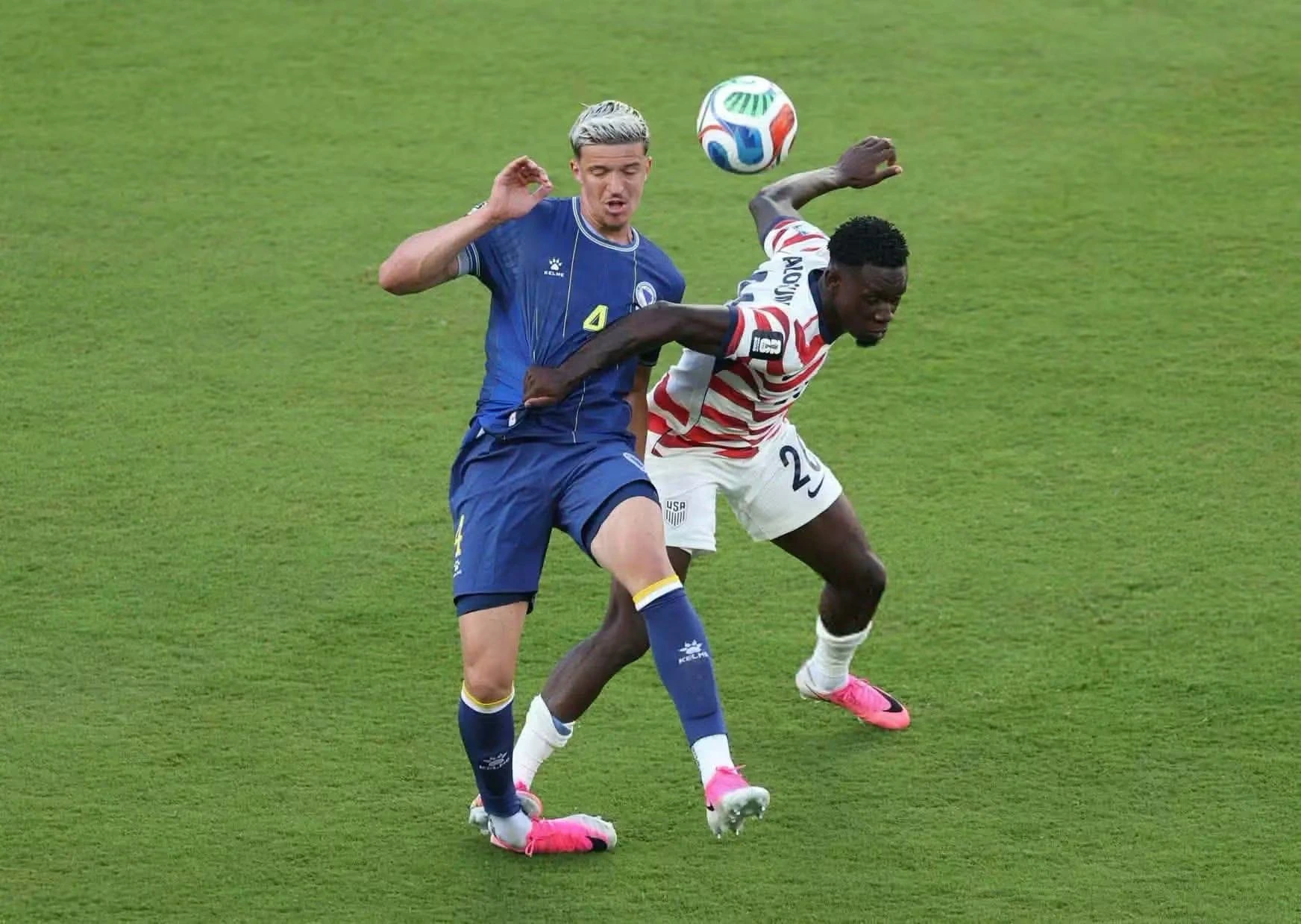
United States forward Folarin Balogun has been cleared to feature in his country’s FIFA World Cup Round of 16 clash against Belgium after FIFA suspended the implementation of his one-match suspension under Article 27 of its Disciplinary Code.
The decision comes after Balogun was shown a red card during the United States’ previous knockout-stage victory over Bosnia and Herzegovina, a dismissal that would ordinarily have ruled him out of the next match.
Instead, FIFA’s judicial authorities opted to temporarily suspend the sanction, allowing the striker to remain eligible while placing him under a one-year probationary period.
What Is Article 27 of FIFA’s Disciplinary Code?
Article 27 gives FIFA’s judicial bodies the authority to suspend the implementation of a disciplinary sanction.
In practical terms, this means that while a punishment remains legally valid, the player is not required to serve it immediately.
Instead, the sanction is effectively put on hold unless certain conditions are breached.
The provision allows FIFA to suspend either all or part of a disciplinary penalty.
However, the Disciplinary Code does not specify the exact circumstances under which such discretion should be exercised, leaving the decision to FIFA’s judicial bodies on a case-by-case basis.
Balogun Placed on One-Year Probation
As part of FIFA’s ruling, Balogun’s suspended ban will remain inactive during a probationary period lasting one year.
Should the striker commit another offence of a similar disciplinary nature within that timeframe, the suspended one-match ban would automatically be reinstated in addition to any fresh punishment imposed for the new offence.
This means Balogun remains under close disciplinary scrutiny despite being available for selection against Belgium.
Which FIFA Bodies Can Suspend a Ban?
The authority to suspend disciplinary sanctions rests with FIFA’s judicial institutions, including the Disciplinary Committee and the Appeal Committee.
The Disciplinary Committee consists of a chairperson, deputy chairperson and additional members.
FIFA rules require both the chairperson and deputy chairperson to be qualified lawyers, while decisions are taken with at least three committee members present.
The committee is currently chaired by Mohammad Al Kamali of the United Arab Emirates.
Committee members are elected by the FIFA Congress for four-year terms and may serve a maximum of three terms.
Are All FIFA Sanctions Eligible for Suspension?
No.
Article 27 does not apply to disciplinary measures involving match manipulation or match-fixing offences. Those sanctions must be served and cannot be suspended under the rule.
For all other disciplinary matters, FIFA retains the discretion to determine whether a suspension of the sanction is appropriate.
A Rule That Has Existed Since 2019
The disciplinary provision is not new.

It originally appeared as Article 26 following revisions to FIFA’s Disciplinary Code in 2019 before being renumbered as Article 27 during a further update in 2023.
Its application in Balogun’s case has attracted significant international attention because it allows one of the United States’ key attacking players to participate in a high-stakes World Cup knockout match despite receiving a red card in the previous round.