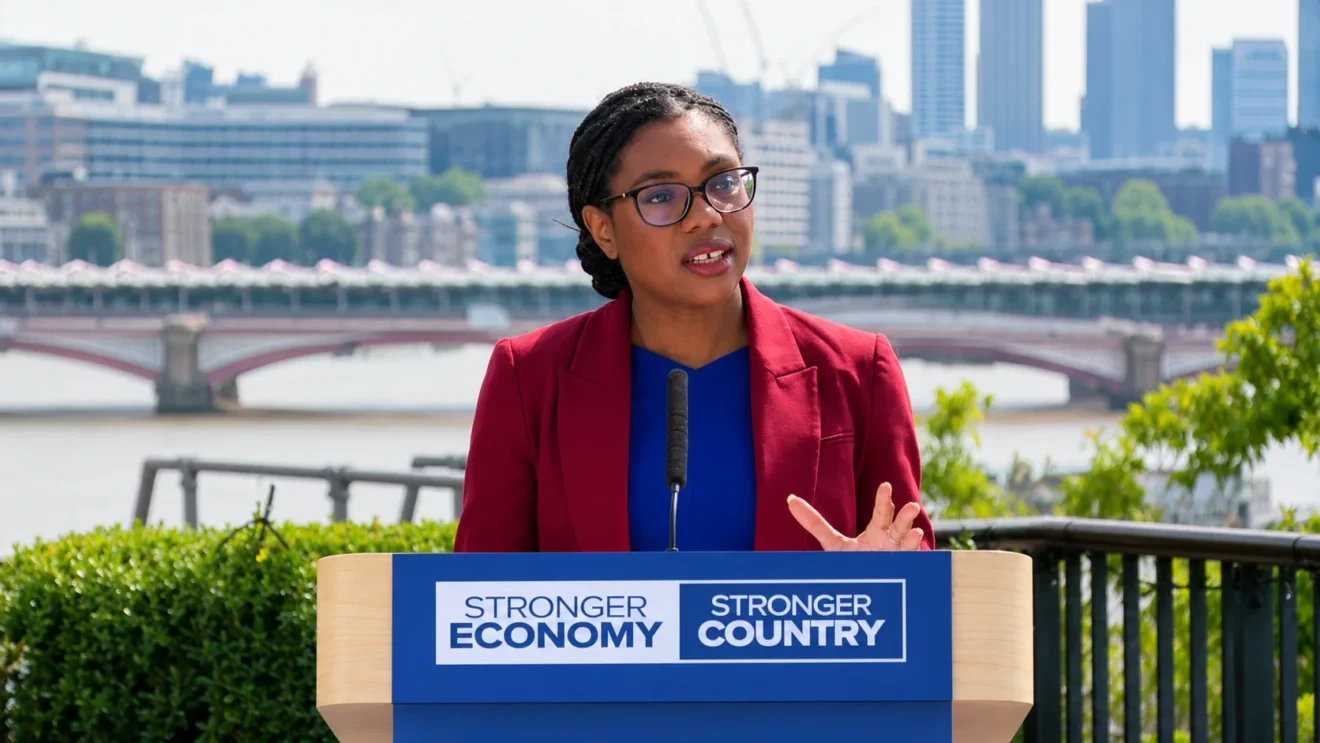
Kemi Badenoch’s response to Andy Burnham’s opening days as prime minister was delivered as mockery — a £2 bus fare cap and £45 knocked off an energy bill, set against wars in Europe and the Middle East, an AI race Britain is not part of, and a borders crisis she says demands harder choices.
The Conservative leader’s framing was rhetorical: the new prime minister’s ambitions for a country she calls the world’s fifth-largest economy are, in her words, too small for the scale of the moment.
The claim worth testing is not whether the policies are small. It is whether they are funded, and what that reveals about the government Burnham has inherited. Burnham entered Downing Street this week as Britain’s seventh prime minister in a decade, following Keir Starmer’s resignation and an uncontested Labour leadership contest.
The turnover rate — an average tenure of barely two years since the 2008 financial crisis — is itself part of the story Badenoch is not telling directly but is trading on: a Westminster system that has struggled to sustain a governing project long enough to see it through, against a backdrop of growth that has averaged under 1.5% a year since 2009, roughly half its pre-crisis pace.
Burnham’s first two policy moves were designed to answer that instability with visible, dated relief. VAT on domestic electricity bills will fall from 5% to zero from 1 October until the end of the financial year in April, a measure the government says will cut roughly £45 off the average annual bill and cost the Exchequer about £850m this year.
Separately, the single bus fare cap in England will drop from £3 to £2 from January, reversing a rise introduced under Starmer. Both measures are time-limited: the VAT cut runs six months, and the bus fare figure has no funding commitment beyond the current financial year.
The funding gap
The funding claim is where the government’s numbers do not yet hold up. Chancellor John Healey, appointed the night Burnham took office in place of Rachel Reeves, said the electricity VAT cut would be paid for by scrapping Labour’s digital ID scheme, which the government now prices at £1.8bn over three years.
But the Office for Budget Responsibility’s own fiscal outlook recorded no specific funding as ever having been allocated to that programme in the first place — meaning the “saving” being used to fund a real, costed tax cut is, on the government’s own prior accounting, money that did not exist as a budget line to begin with.
Labour’s deputy leader, Lucy Powell, when pressed on how much the cancellation would actually save the Treasury, told the BBC the decision was “not just about the money” but about “the attention and the focus” freed up inside government — an answer that concedes the fiscal case is thinner than the announcement implied.
Markets registered the ambiguity before commentators did. Ten-year gilt yields rose eight basis points on Burnham’s first full day after he suggested he would apply “flexibility” to the fiscal rules inherited from Reeves, before easing back once Healey — rather than the more overtly left-leaning candidates initially tipped for the role — was confirmed at the Treasury.
The reversal illustrates the mechanism Badenoch’s own framing gestures toward without naming: a government elected in part on the promise of change is constrained, within days, by the same bond-market discipline that ended Liz Truss’s premiership in 2022 and that shaped every budget since.
Healey inherits that constraint from the defence brief he quit under Starmer, arguing military spending was too low; as chancellor, he must now find room for Britain’s commitment to raise defence spending to 3.5% of GDP by 2035, a pledge the Institute for Fiscal Studies estimates will cost around £36bn a year, inside the same fiscal envelope he is using to fund cost-of-living relief.
The contradiction Badenoch leaves unresolved
Badenoch identifies a genuine tension but does not explain how it should be resolved. Burnham’s government wants to present itself, in Healey’s words, as a “cost of living government”, while continuing to observe fiscal rules designed to restrict precisely this kind of additional spending.
Burnham must therefore satisfy two very different audiences. He has to reassure bond investors that his government will not repeat the mistakes of Liz Truss, while persuading voters that meaningful help is on the way. Doing both will not be easy.
Every additional pound of relief must come either from cuts elsewhere in government or from savings that have yet to be clearly identified. Burnham has already abolished the Department for Science, Innovation and Technology, distributing most of its functions among other departments. The reduction in electricity VAT has similarly been presented as funded by savings that have not yet been fully explained.
Badenoch also invokes a much broader list of dangers: hostile states targeting British infrastructure, an intensifying race with China and the United States over artificial intelligence and energy, demographic pressures and a border crisis requiring “tough choices”. In the transcript, these are largely asserted rather than developed.
Some of the underlying issues are not in dispute. Britain’s defence-spending commitments, the future of North Sea oil and gas, and the costs and trade-offs involved in the transition to net zero are all matters of established government policy.
Her demand that Burnham approve more North Sea licences, including the Jackdaw and Rosebank projects, is different. It is a political prescription, not a statement of fact. It may also overstate the distance between the government and the Conservatives: reports indicate that Burnham is preparing to approve both projects, bringing his position closer to Badenoch’s than her speech admits.
What the polling shows
The hardship Badenoch describes is real: families struggling with household bills, younger people losing hope of owning a home and businesses closing under financial pressure. But these problems did not begin during Burnham’s first week in Downing Street. They formed part of the political crisis that weakened Starmer’s government and eventually forced a change of leadership.
Reform UK has led national polling for more than a year, although its advantage has narrowed considerably. After reaching about 34 per cent last September, its support had fallen to the low-to-mid twenties by July. Several recent polls place Labour within one or two points of Reform under Burnham. Badenoch’s own personal ratings, meanwhile, have improved only slightly.
A poll conducted shortly after Starmer’s resignation found that three-quarters of Britons were dissatisfied with his final period in office, the worst recorded figure for a departing prime minister. That is the inheritance Burnham is trying to address with measures such as £2 fares and a £45 household discount. They are intended as an immediate signal that the government understands the pressure voters are under, not as a complete answer to Britain’s economic problems.
What happens next
The real test will come at the budget.
The government has said that funding for measures extending beyond the current financial year will be settled then. Healey must show how the government intends to pay for its cost-of-living promises while meeting its defence commitments and remaining within the fiscal rules.
He will have to do so before bond markets that reacted within a day of his appointment.
Badenoch’s argument will ultimately be judged not by the sharpness of her attack at the dispatch box, but by what the budget reveals. Either the government will produce properly funded policies, or it will offer another set of announcements dependent on savings that ministers have not yet shown they can deliver.