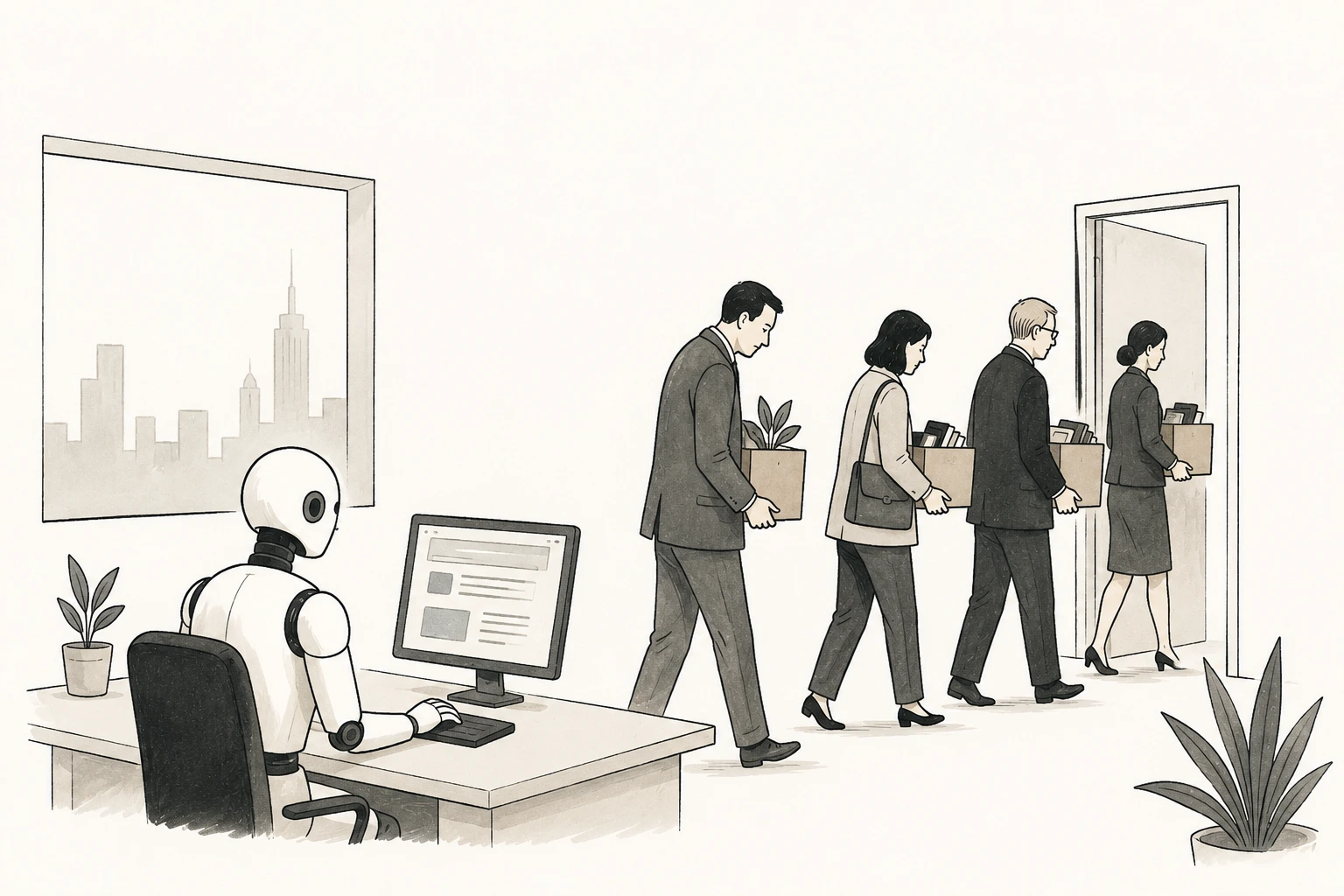
German insurance giant Allianz SE has announced plans to cut between 1,500 and 1,800 jobs across its Allianz Partners business in Europe, becoming one of the latest multinational companies to link workforce reductions directly to the adoption of artificial intelligence.
The restructuring will primarily affect employees in Spain, France, Germany, Italy and the Benelux countries, with the company opting for voluntary departures, severance agreements and early retirement programmes rather than compulsory redundancies.
Allianz Partners, which employs more than 22,000 people worldwide, said the decision follows months of discussions with workers’ representatives as the company accelerates the use of AI to automate parts of its operations.
Chief Executive Officer Tomas Kunzmann said affected employees would be treated fairly, acknowledging the uncertainty that accompanies such a transition.
The announcement is significant not only because of the number of jobs involved but because it reflects a broader transformation taking place across industries as artificial intelligence moves from an experimental productivity tool to a central pillar of corporate strategy.
A growing pattern across industries
Insurance has traditionally relied on thousands of employees to process claims, review documents, assess risks, detect fraud and provide customer support. Today, many of those functions can increasingly be performed by AI-powered systems capable of analysing vast amounts of data in seconds.
For companies, the technology promises faster decision-making, lower operating costs and improved efficiency. For employees, however, the benefits are proving more complicated.
Allianz is far from the only company restructuring around AI. Financial institutions, technology firms, consulting companies and manufacturers across Europe and North America have accelerated investments in artificial intelligence while simultaneously reducing headcount or slowing recruitment.
The trend suggests AI is no longer simply assisting workers. In many cases, it is beginning to redefine how many workers companies need. The Allianz announcement also exposes one of the biggest contradictions in today’s conversation about artificial intelligence.
For years, governments, technology companies and business leaders have argued that AI would not eliminate employment but instead transform it, allowing workers to move into higher-value roles through retraining and reskilling.
Yet many organisations are investing heavily in AI training while announcing job cuts at the same time.
The contradiction raises an uncomfortable question: if workers are expected to transition into new roles, why are so many leaving their organisations altogether? The answer lies partly in economics.
Artificial intelligence enables companies to automate repetitive administrative and knowledge-based tasks, allowing fewer employees to produce the same or greater output.
For shareholders, that translates into improved productivity and lower labour costs.
For workers, it can mean redundancy before opportunities for retraining materialise.
Can reskilling keep pace?
While AI is creating demand for specialists in machine learning, cybersecurity, AI governance and data science, these roles are far fewer in number than many of the positions being automated. They also require specialised technical skills that many displaced workers may not possess. Learning those skills often takes months or years.
Corporate restructuring decisions, by contrast, can be implemented within weeks. The result is a widening gap between the pace of technological change and the speed at which workers can realistically adapt.
This has prompted economists and labour experts to question whether reskilling alone can offset the employment disruptions expected from widespread AI adoption.
More than a corporate story
The implications extend beyond Allianz or the insurance industry. Routine office work—including customer support, claims administration, compliance checks, document review and scheduling—is becoming increasingly susceptible to automation.
These jobs have traditionally served as entry points for graduates and young professionals building careers in finance, insurance and business services.
As AI assumes more of those responsibilities, companies may eventually face a different challenge: fewer opportunities for employees to gain the practical experience needed for future leadership roles.
At the same time, governments could face growing pressure to expand retraining programmes, strengthen social safety nets and encourage industries capable of creating new forms of employment.
What it means for Nigeria
Although Allianz’s restructuring is taking place in Europe, the underlying forces are global.
Nigeria’s banking, insurance, telecommunications and outsourcing sectors are also investing in AI to improve customer service, automate compliance processes, detect fraud and streamline operations.
That presents both risks and opportunities. Workers whose responsibilities consist largely of repetitive administrative tasks may face increasing pressure as automation spreads.
Conversely, professionals who develop expertise in AI tools, data analysis, cybersecurity and digital operations are likely to become more competitive in both domestic and international labour markets.
For businesses, the challenge will be balancing productivity gains with responsible workforce management.
For policymakers, the priority may no longer be simply encouraging digital skills but ensuring economies generate enough high-quality jobs for workers once those skills are acquired.
A defining challenge of the AI era
The Allianz layoffs underscore a debate that is rapidly moving from theory to reality. Artificial intelligence is undeniably improving efficiency across industries.
What remains uncertain is whether the new opportunities it creates will emerge quickly enough—and in sufficient numbers—to absorb workers displaced by automation.

The promise of the AI economy has long rested on the assumption that employees can be retrained for new roles. As more companies announce AI-driven restructuring, that assumption is facing its toughest test yet.
The future of work may ultimately depend not only on how quickly artificial intelligence evolves, but on whether businesses, governments and education systems can ensure that technological progress creates new pathways for employment rather than simply reducing the need for workers.