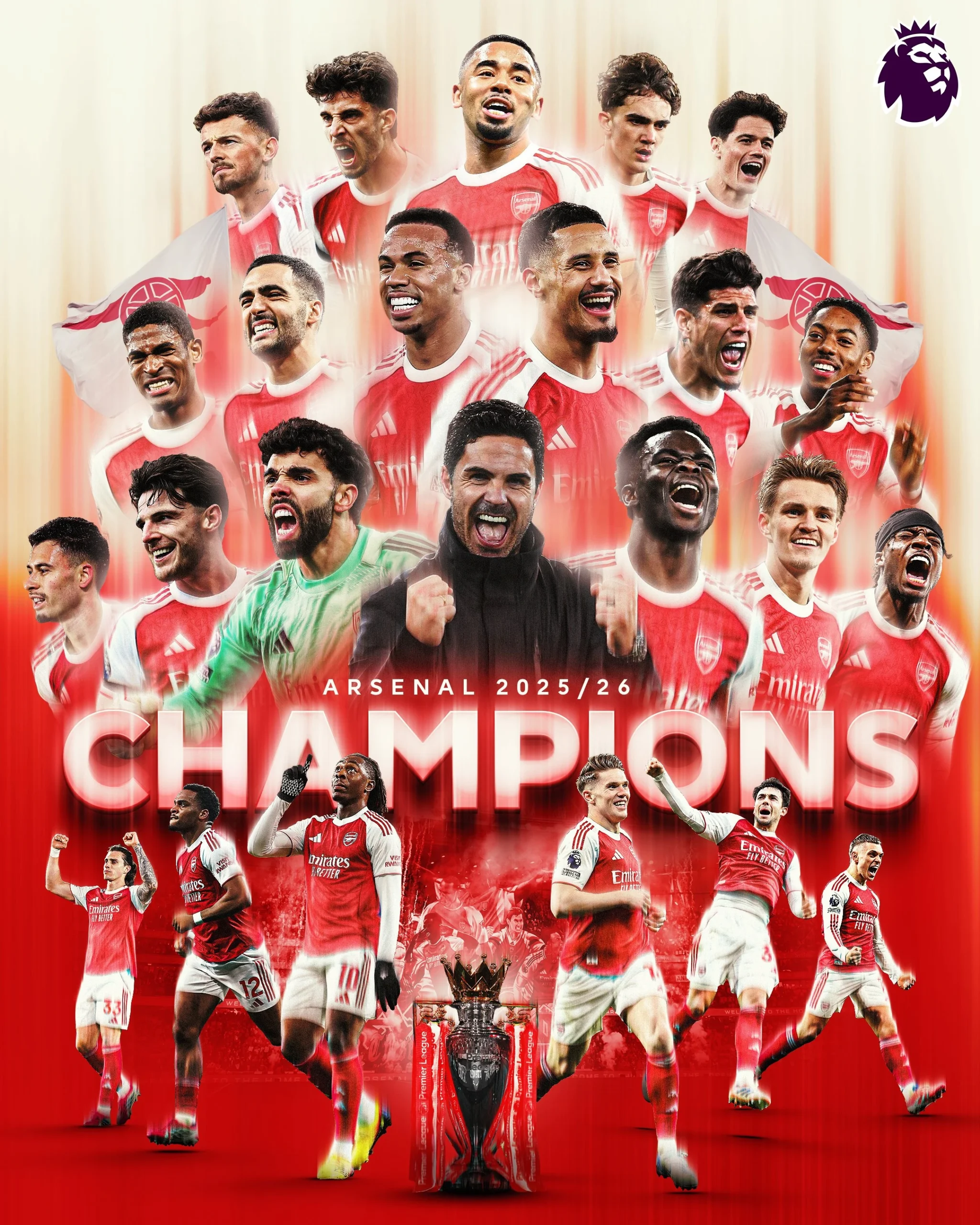
Arsenal Are Champions: Arteta’s Arsenal Finally End the Wait and Reclaim English Football’s Biggest Prize
After years of near-misses, painful collapses, and accusations that they lacked the mentality to finish the race, Arsenal are champions again.
For the first time since the era of Thierry Henry, Patrick Vieira and Arsène Wenger, Arsenal sit at the summit of English football, crowned champions after a season defined by tactical maturity, emotional resilience, and relentless consistency.
This title is not merely a sporting achievement. It is the completion of one of the most ambitious rebuilds in modern football.
Mikel Arteta’s Long-Term Gamble Finally Pays Off
When Mikel Arteta took charge of Arsenal, the club was drifting. The aura of the Wenger years had faded, recruitment looked incoherent, and Arsenal had become synonymous with fragility in big moments.
Arteta inherited a fractured squad and a fanbase exhausted by decline. What followed was a slow, often brutal reconstruction.
There were periods when the project looked close to collapse. Arsenal finished eighth twice. Critics mocked the process. Pundits questioned whether Arteta was too inexperienced to manage an elite club.
But Arsenal’s hierarchy backed him.
Instead of chasing short-term fixes, the club rebuilt around youth, athleticism, tactical discipline, and character. The recruitment strategy became clearer. Players such as Bukayo Saka, Martin Ødegaard, William Saliba and Declan Rice became the spine of a new Arsenal identity.
Now that patience has delivered the ultimate reward.
Arsenal’s Evolution Into a Complete Team
What separates this Arsenal side from previous contenders is balance.
Earlier Arteta teams were technically gifted but emotionally volatile. They could dominate weaker opponents yet still look vulnerable under pressure. This version of Arsenal became harder, smarter, and more adaptable.
Defensively, Arsenal developed into one of the most organised teams in Europe. Saliba’s composure transformed the back line, while Rice gave the midfield physical authority and defensive security.
In attack, Arsenal remained fluid and unpredictable. Saka continued his rise into global superstardom, Ødegaard controlled tempo with intelligence and precision, while the team’s positional rotations overwhelmed opponents across the league.
Most importantly, Arsenal learned how to win ugly.
Champions are not defined only by brilliance. They are defined by the ability to survive tense away fixtures, late-season pressure, injuries, hostile atmospheres, and exhausting title races. Arsenal finally acquired that quality.
The Psychological Barrier Has Been Broken
For years, Arsenal’s biggest opponent appeared to be psychological.
Their late-season collapse during previous title races created a narrative that the club lacked the mentality to finish strongly against elite competition. Every dropped point revived memories of earlier failures.
This season changed that perception.
Instead of fading under pressure, Arsenal became calmer as the stakes increased. The squad showed the emotional control associated with serial winners.
That transformation matters beyond a single trophy.
Winning the Premier League changes how players view themselves, how rivals view the club, and how Europe’s elite talents view Arsenal as a destination.
The club no longer looks like a promising project. It now looks like a proven footballing power again.
A New Era in English Football?
Arsenal’s triumph may also signal a broader shift in English football.
For years, the Premier League title conversation revolved primarily around Manchester City and, intermittently, Liverpool FC. Arsenal’s emergence introduces a younger, sustainable challenger built on long-term squad development rather than short-term fixes.
Unlike many modern title winners assembled around ageing stars, Arsenal’s core remains remarkably young. That creates the possibility that this title is not the end of a journey, but the beginning of a cycle.
The most frightening reality for rivals may be that Arsenal still appear capable of improving.
Arsenal Are Champions Again — And English Football Feels Different
For Arsenal supporters, this title is emotional vindication after years of ridicule and frustration.
For Arteta, it is confirmation that elite football institutions can still be rebuilt through patience, structure, and coherent leadership.
And for the Premier League, Arsenal’s return to the summit restores one of English football’s great institutions to the centre of the game again.

The long wait is over.
Arsenal are champions.