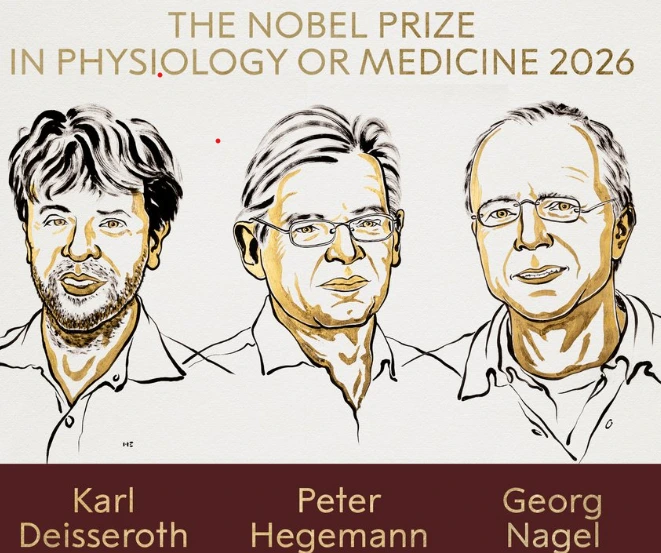
The 2026 Nobel Prize in Physiology or Medicine has been awarded to Karl Deisseroth, Peter Hegemann and Georg Nagel for their discoveries concerning light-gated ion channels and optogenetics.
The Nobel Committee said the scientists were recognised for discoveries that have enabled researchers to control the activity of living cells using light, opening new possibilities for studying the brain and nervous system.
Who are the 2026 Nobel Medicine Laureates?
Georg Nagel, born in 1953, received his PhD from the University of Frankfurt in Germany. He is currently Professor of Molecular Plant Physiology at the Department for Molecular Plant Physiology and Biophysics – Botany I at the University of Würzburg, Germany.
Nagel’s work contributed to the understanding of light-sensitive proteins that respond to light by controlling the movement of ions across cell membranes.
Peter Hegemann: born in 1954, received his PhD from the Max Planck Institute for Biochemistry in Martinsried, Germany. He is currently Hertie Senior Professor of Neuroscience at Humboldt University of Berlin, Germany.
Hegemann’s research on light-sensitive proteins in microorganisms helped lay the scientific foundation for optogenetics, a technique that allows scientists to activate or inhibit specific cells with light.
Karl Deisseroth: was born in 1971 and received both his PhD and MD from Stanford University in the United States. He is currently D.H. Chen Professor and Professor of Bioengineering and Psychiatry and Behavioral Sciences at Stanford University, as well as an investigator at the Howard Hughes Medical Institute.
Deisseroth’s research helped establish optogenetics as a powerful tool in neuroscience. The technique has allowed researchers to investigate how specific groups of neurons contribute to behaviour, brain functions and neurological processes.
What is Optogenetics?
Optogenetics combines genetic techniques with light-based control of cells. Scientists introduce genes that make specific cells produce light-sensitive proteins known as opsins. When exposed to particular wavelengths of light, these proteins open or close ion channels, altering the electrical activity of the cells.

The technique has become particularly important in neuroscience because it allows researchers to manipulate selected neurons with a high degree of precision.
The 2026 Nobel Prize therefore recognises a line of research that has connected discoveries in molecular biology and microbiology with new approaches to understanding the nervous system.