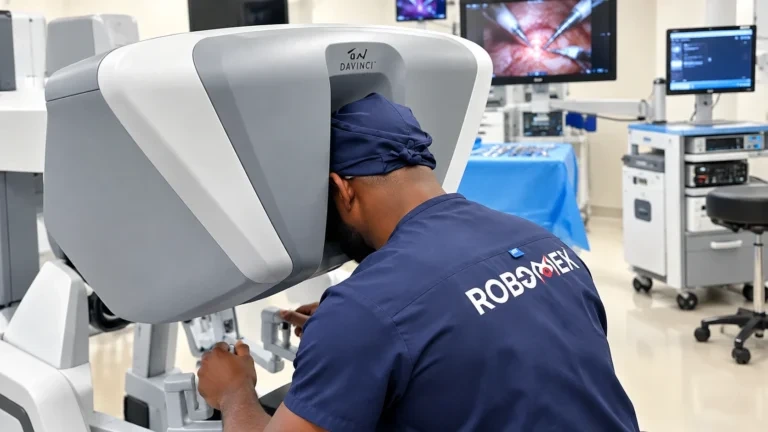
Nigeria has taken a significant step into remote surgical care after a team led by Professor Obi Ekwenna-Davis remotely operated on a patient in Abuja while controlling a robotic surgical system from Redeemer’s Health Village (RHV) in Mowe, Ogun State.
The procedure was performed on September 19 in collaboration with Nisa Premier Hospital in Abuja and RoboMed Global, the US-based organisation co-founded by Ekwenna-Davis. The patient remained in Abuja while the surgeon operated from a Toumai robotic console at RHV.
The operation was a robot-assisted right radical nephrectomy, a procedure in which an entire kidney is removed. In this case, the kidney was affected by a cancerous tumour.
What distinguished the operation from conventional robotic surgery was the distance between the surgeon and the patient.
Rather than standing beside the operating table, Ekwenna-Davis controlled the robotic system remotely, with his movements transmitted to the surgical instruments in Abuja in real time.
How the remote surgery worked
Tele-robotic surgery combines robotic surgical equipment with telecommunications technology to allow a surgeon to operate on a patient from another location.
For the Nigerian procedure, the surgical team used Starlink connectivity, with MTN providing a backup connection, according to reports. The communication link was critical because the surgeon’s movements and commands had to reach the robotic system in Abuja with minimal interruption.
The operation lasted about three hours and included brief pauses to verify that the equipment and communication systems were functioning properly.
Ekwenna-Davis said the patient was in good condition afterwards and was expected to be discharged within 24 hours.
The significance extends beyond the operation itself. If the technology can be deployed reliably, specialist surgeons could potentially provide expertise to patients in locations where particular surgical skills are unavailable without requiring either the patient or the specialist to travel.
That could also create a new channel for Nigerian medical professionals living abroad to participate in procedures in Nigeria remotely.
The robot does not replace the surgeon
The procedure does not mean that the robot independently performed the operation.
Dr Kunle Onakoya, chairman of RHV’s board, stressed that the system remains under the control of a highly experienced surgeon. The robotic platform effectively translates the surgeon’s movements into highly precise movements by the surgical instruments.
This distinction is important as robotic surgery becomes more common in Nigeria. The technology is designed to augment the surgeon’s capabilities rather than eliminate the need for specialist medical expertise.
RHV had already begun its robotic-surgery programme before the remote procedure. On September 17, the hospital announced its first robotic-assisted operation, a radical prostatectomy for a patient with localised prostate cancer. That operation was performed at RHV itself and was separate from the subsequent tele-robotic kidney procedure.
The hospital’s wider robotic-surgery programme is being developed with RoboMed Global and is intended to cover procedures in areas including urology, general surgery and gynaecology.
From robotic surgery to local medical capacity
For RHV and its partners, the longer-term objective is not simply to demonstrate that a robot can operate across geographical boundaries.
Ekwenna-Davis said the sustainability of robotic surgery in Nigeria would depend on training and local expertise. The partners plan to establish a robotic surgery academy to train surgeons and other healthcare professionals, with a target of training at least 150 surgeons over two years, according to reports.
The training requirement extends beyond surgeons. Robotic procedures require operating-theatre nurses, anaesthesia teams, biomedical engineers, technicians and other specialists who can operate, maintain and troubleshoot the equipment.
That makes the skills pipeline almost as important as the surgical robot itself.
RHV has previously said its investment in robotic surgery is intended partly to address Nigeria’s dependence on overseas treatment.
The hospital announced a $4 million investment in robotic surgical services and training in August, with the stated aim of developing Nigerian expertise rather than relying indefinitely on foreign specialists.
What it means for medical tourism
Nigeria spends significant resources on patients seeking specialist treatment outside the country.
Robotic surgery does not by itself solve that problem: sophisticated equipment still requires trained personnel, maintenance, dependable power and communications infrastructure, appropriate patient selection and systems capable of managing complications.
Tele-robotic surgery introduces another requirement — reliable connectivity.
In the Abuja procedure, the use of Starlink alongside an MTN backup illustrates the importance of redundancy.
A remote surgical system cannot depend on a single communications channel when the surgeon’s commands are being transmitted over hundreds of kilometres.
Ekwenna-Davis has also acknowledged that connectivity disruptions and weather conditions could pose challenges as the technology develops.
The successful procedure therefore represents both a medical milestone and a test of whether Nigeria can build the infrastructure needed to make remote specialist care dependable.
The bigger opportunity
The most consequential aspect of the procedure may ultimately be what happens after the headline.
A surgeon in Ogun controlling a robot operating on a patient in Abuja demonstrates that specialist healthcare does not necessarily have to be tied to the physical location of the specialist.
For Nigeria, that could eventually mean a patient in another city receiving specialist surgical expertise without travelling to Lagos, Abuja or overseas — provided hospitals can establish the necessary robotic equipment, clinical teams, connectivity and safety protocols.
RHV’s partnership with Nisa Premier Hospital also shows how different hospitals can contribute different parts of the healthcare chain: one provides the remote surgical expertise and robotic console, while another provides the patient, operating theatre and local clinical team.
That model could become more significant as Nigeria develops its own pool of robotic surgeons and supporting professionals.
The first tele-robotic kidney operation does not by itself establish a nationwide remote-surgery network. But it demonstrates that the technical barrier of distance can be overcome in a Nigerian healthcare setting.

The next challenge is whether that demonstration can be converted into a safe, repeatable and accessible system of specialist care.
For a country where patients have often travelled long distances — and sometimes abroad — for complex medical treatment, that is where the significance of Nigeria’s first tele-robotic surgery ultimately lies.