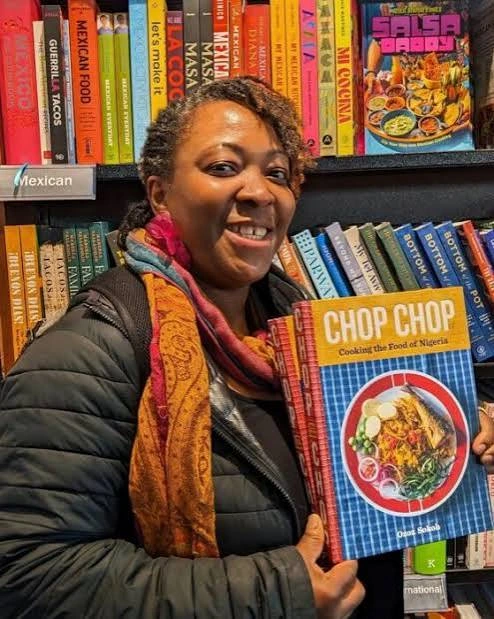
Ozoz Sokoh’s debut cookbook Chop Chop: Cooking the Food of Nigeria won a James Beard Foundation Book Award in June 2026 but her professional journey began as a geologist. Nearly three decades later, the Nigerian-born writer, researcher and educator has become one of the most distinctive voices documenting the country’s food culture.
On June 13, 2026, at the Art Institute of Chicago, Sokoh was announced as the winner of the Emerging Voice in Books category at the James Beard Foundation’s annual Media Awards. The foundation describes the category as recognising a first-time published author whose work has immediate impact and lasting significance and whose perspective expands the reach of its subject matter.
From Geology to The Kitchen
Sokoh was born in Warri and was not particularly interested in food as a child. However, that changed in 1985, when she was nine and encountered a hamburger and Mirinda at Wimpy on Princes Street in Edinburgh.
She studied Urban and Regional Planning at Obafemi Awolowo University, Ile-Ife, before leaving the programme. In 1997, she moved to the United Kingdom to study geology.
While living in the UK, Sokoh began cooking Nigerian food to deal with homesickness. In 1998, she developed what she identifies as her first recipe—a tomato salsa that she says she still makes.
The recipes accumulated as she continued her career as a Geologist and in 2009, while living and working in the Netherlands, Sokoh began writing Kitchen Butterfly, the food blog that would eventually become the foundation of her public identity.
Sokoh’s interest moved from how to cook Nigerian food to questions about where the food came from, how ingredients travelled and what dishes could reveal about the movement of people and ideas.
Her encounter with Brazilian acarajé became a particularly important turning point after she discovered its relationship with Nigerian àkàrà. The connection opened a much larger historical question: how had Nigerian food travelled across the Atlantic, and what survived of West African culinary traditions in the diaspora?
Her own account identifies the discovery of the Nigerian-Brazilian connection around 2009–2010 as a decisive moment in her development as a food researcher.
Food Blog to Archive
Sokoh returned to Nigeria in 2011 and deepened her research into Nigerian ingredients, cooking techniques and culinary practices. She began working systematically to document and codify the cuisine, including developing what she describes as Nigeria’s first seasonal produce calendar.
In 2013, she created #NewNigerianKitchen, a framework through which she explored Nigerian food as a living, evolving cuisine rather than a collection of static traditional recipes.
A year later, she presented “Journey by Plate” at TEDx Port Harcourt, using food to explore travel, identity, history and the connections between Nigerian cuisine and food cultures around the world.
Sokoh was documenting ingredients, tracing culinary relationships, researching historical sources and asking questions about who gets to record the history of food and that concern eventually became one of the defining features of her work.
In 2021, Sokoh graduated with honours from the Museum and Cultural Management programme at Centennial College in Canada. She is now a professor of Food and Tourism Studies at the institution, where she teaches courses including Exploration of Foodways.
Food as Cultural Memory
Sokoh’s ongoing project “Coast to Coast: From West Africa to the World” traces the histories and movements of West African food through ingredients and commodities. It examines connections between West Africa and places including the Caribbean, Latin America, Europe and the United States.
Through Feast Afrique, which she launched in 2020, Sokoh has built an open-access digital library containing more than 250 culinary and literary resources relating to West African and diasporic food, including works dating from the 19th century.
This is perhaps what separates Sokoh’s work from conventional food blogging. as she is not simply asking Nigerians to cook more Nigerian food but asking them and the rest of the world to understand what Nigerian food means.
Chop Chop: 20 years of research in one book
Her winning book Chop Chop: Cooking the Food of Nigeria was a culmination of years worth of research on Nigerian food. Published by Artisan on March 18, 2025, the 352-page book contains 100 recipes and explores foodways across all six geopolitical regions of Nigeria.
It includes familiar dishes such as jollof rice, suya, egusi soup, pepper soup and puff puff, but its ambition goes beyond providing recipes as it also contains a lexicon of Nigerian cuisine, ingredient information and historical and cultural essays explaining how Nigerian food developed and travelled.
Nigeria has more than 250 ethnic groups and a vast range of regional cuisines. What is considered everyday food in one part of the country can be unfamiliar in another.
The book’s ingredient guides therefore help readers understand the building blocks of Nigerian cooking. Its recipes introduce techniques and flavours to readers who may never have cooked Nigerian food. Its historical notes provide context rather than presenting dishes as isolated exotic objects.
The publisher describes it as a guide to classic Nigerian home cooking covering the country’s six regions, with recipes, ingredient information, historical context and photography of food, people, markets and landscapes.
Recognition beyond Nigeria
Before the James Beard award, Chop Chop had already attracted significant international attention. The book was selected as a New York Times Best Cookbook of 2025 and received the Nautilus Book Award.

Yewande Komolafe, in The New York Times, praised Sokoh’s nearly two decades of exploration of Nigerian food and the way the book organises its wide-ranging cuisine for home cooks. Other reviews have described it as functioning simultaneously as a cookbook and culinary textbook
The latest award is very significant as the James Beard Foundation’s Book Awards cover cookbooks and other nonfiction books about food and beverages published in the United States. The Emerging Voice category specifically recognises first-time published authors whose perspectives expand the reach of their subject matter.