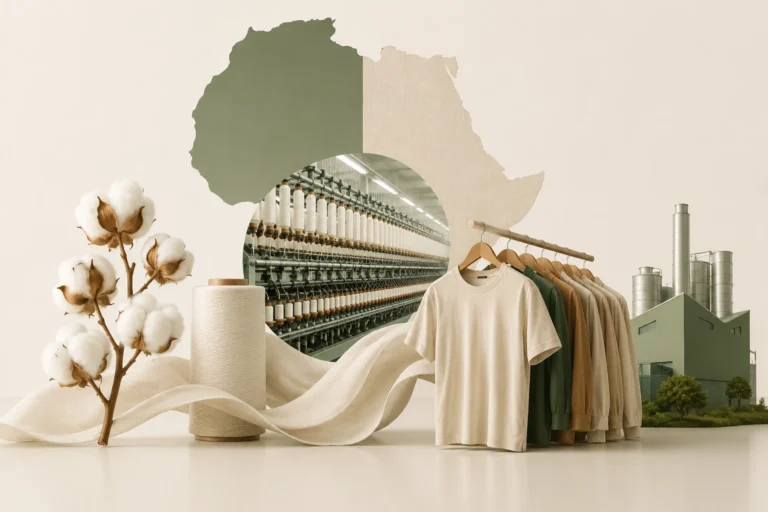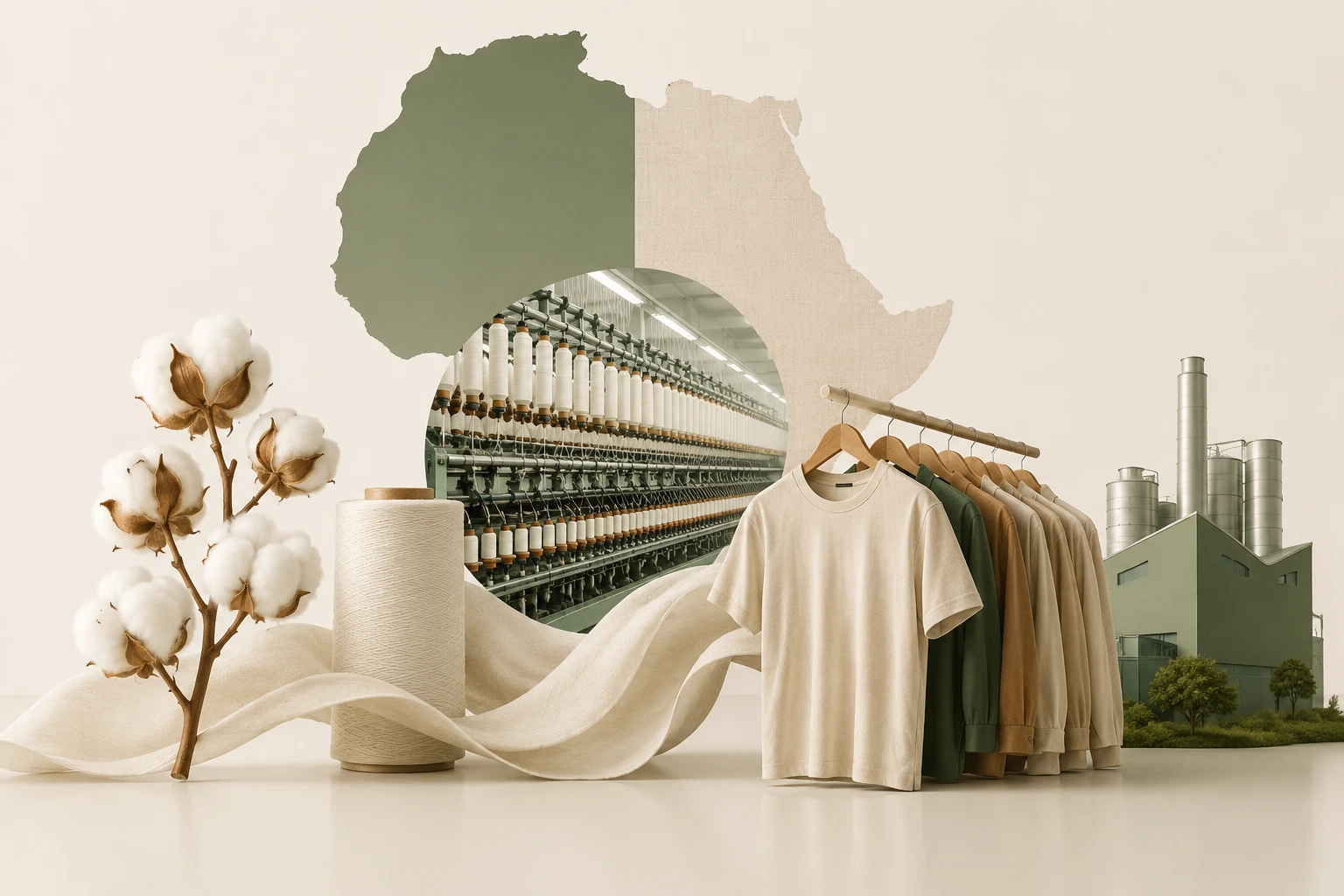
Africa produces significant quantities of cotton, but much of the crop leaves the continent as raw fibre, while African countries import yarn, fabrics and finished garments. Afreximbank’s African Textile Renaissance Plan is designed to change that by moving more of the cotton value chain from spinning and weaving to garment production into Africa.
The initiative was formally launched in 2024 through a partnership involving African Export-Import Bank (Afreximbank), ARISE Integrated Industrial Platforms (ARISE IIP) and Swiss textile machinery manufacturer Rieter. The partners signed a framework agreement in October 2024 to develop 500,000 tonnes of annual African cotton transformation capacity over three to five years, backed by a targeted $5 billion financing structure.
What is Afreximbank Trying to Achieve?
Under the original framework, the programme aims to establish 500,000 metric tonnes of cotton transformation capacity within three to five years, with the possibility of adding another 500,000 tonnes later.
The initiative also targets up to 500,000 jobs, lower African textile imports and greater exports of African-made textiles and clothing. The programme is intended to support exports to the United States under the African Growth and Opportunity Act (AGOA), while also supplying African and other international markets.
In March 2026, Afreximbank gave the programme a broader industrialisation target: its cotton industrialisation programme aims to create 500,000 jobs and generate $10 billion in import substitution by 2030.
The $10 billion import-substitution target is significant because it shifts the emphasis beyond exports. The ambition is also to reduce Africa’s dependence on imported textiles and garments by producing more of them domestically.
Africa’s Relationship With Cotton
Africa has historically captured relatively little of the value created after cotton is produced despite its cotton reserves.
Cotton can pass through several stages before becoming a shirt or other finished product: cultivation, ginning, spinning, weaving or knitting, dyeing, finishing, garment manufacturing, branding and distribution.
A country that exports raw cotton captures the value associated mainly with cultivation and primary processing but a country that converts the cotton into yarn, fabric and finished clothing captures substantially more economic activity and creates more opportunities for manufacturing, logistics, technical services and employment.
Afreximbank’s argument is that Africa needs to move from being predominantly a supplier of raw materials to becoming a participant in the higher-value stages of the textile and apparel chain. The bank says that in Benin, for example, raw cotton that previously generated about $40 million in export receipts could generate as much as $800 million when processed into garments.
Financing Model
The 2024 framework envisages about $5 billion in financing to establish the targeted processing capacity.
Afreximbank and its partners want to make financing textile projects easier and faster by using standardised loan documentation, security packages and business-plan templates. The framework envisages an application process of roughly two months for qualifying projects.
This is important because textile manufacturing requires substantial upfront investment. A spinning or weaving operation needs machinery, power, buildings, working capital, skilled workers and access to logistics.
The programme therefore seeks to combine industrial infrastructure with financing rather than treating textile factories as isolated investments.
ARISE IIP’s Role
ARISE IIP brings industrial-zone infrastructure into the programme. The company operates industrial platforms and special economic zones in several African countries, including Benin, Togo, Côte d’Ivoire, Nigeria, Chad, Rwanda, Gabon and Malawi.
The idea is to locate textile investments within industrial ecosystems where manufacturers can have access to infrastructure, utilities, transport connections and other businesses along the value chain.
Countries participating in the textile programme are expected to be selected partly on the basis of factors such as electricity and gas availability, existing industrial parks and infrastructure, and the capacity for local or equity investment.
This matters because textile production is highly sensitive to infrastructure costs.
Rieter’s involvement addresses another problem: African textile manufacturers often depend on imported machinery and foreign technical expertise.
Under the agreement, Rieter plans to establish a repair and maintenance facility in an ARISE industrial park in Benin, create spare-parts warehousing and potentially introduce machinery assembly in Africa if commercially viable.
Training centres are also planned to improve technical skills with the objective of developing a local ecosystem capable of maintaining textile machinery rather than creating factories that remain dependent on technicians and spare parts shipped from abroad.
Nigeria’s Importance to Initiative
Nigeria is relevant to the plan because of its cotton-producing regions, large domestic consumer market and existing textile industry.
Afreximbank said in April 2026 that it had committed $2 billion to support cotton-sector transformation in Nigeria. The bank’s broader model combines industrial infrastructure, financing and quality assurance, while also supporting energy and transport infrastructure within industrial zones.
The Nigerian opportunity is potentially different from that of smaller cotton-exporting countries because Nigeria has both a large population that consumes textiles and garments and a historical textile-manufacturing base.
That means Nigeria could potentially serve both domestic and regional markets if competitiveness, infrastructure and production capacity can be restored.
The 2024 framework specifically identified exports to the United States under AGOA as one of its objectives but AGOA’s future has become an important uncertainty for the strategy.
The programme’s preferential access arrangements have changed over time, meaning manufacturers cannot base long-term investment decisions solely on the assumption that the existing US trade regime will remain unchanged.
This makes AfCFTA and the African market equally important as the plan is ultimately intended to create an industry that can sell within Africa as well as abroad.
Africa imports enormous quantities of clothing and textiles, including both new garments and second-hand clothing.
A successful African textile industry would therefore have two potential markets: replacing some imported products consumed within Africa and exporting competitive products to the rest of the world.That would make the programme less dependent on every country developing an entire cotton-to-clothing industry by itself.
Potential Challenges
The scale of the ambition also illustrates the difficulty. Africa needs reliable electricity, efficient ports and roads, access to finance, modern machinery, technical skills, competitive production costs and reliable supplies of cotton.
There is also a question of demand. Building textile factories does not automatically create competitive exports. International clothing brands already have established supply chains in countries such as Bangladesh, Vietnam, China and India.
African producers therefore need to compete on price, quality, delivery times and reliability.
Afreximbank itself has acknowledged that financing alone is insufficient with President George Elombi saying the transformation would require political commitment and effective public-sector execution alongside capital.
The distinctive feature of the African Textile Renaissance Plan is however its attempt to address the textile industry as an ecosystem rather than simply finance individual factories.
If successful, the significance would extend well beyond clothing: it would provide a model for how African countries could retain more value from agricultural commodities before exporting them.