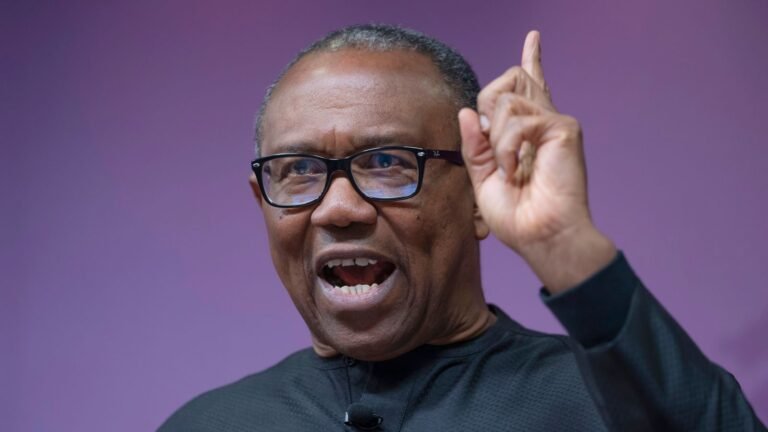
Former Anambra State governor Peter Obi has rejected claims that his administration left the state with about $123 million in debt, saying the figure conflates concessionary development financing with money directly borrowed by the state government.
Obi made the clarification on Thursday, September 24, during an interview with Arise News, amid an escalating dispute with the administration of Governor Chukwuma Soludo over the financial position he handed over in March 2014.
The dispute intensified after the Anambra State Government released records showing eight external loan facilities linked to projects undertaken during Obi’s tenure.
The state said the facilities had a combined contracted value of about $123.77 million and that approximately $92.35 million remained outstanding as of June 30, 2026.
Obi disputed that interpretation, arguing that the facilities identified by the state should not be presented as loans personally contracted by him or as evidence that he left Anambra with a $123 million debt burden.
Obi: I did not borrow money for Anambra
Obi said he did not approach a financial institution to borrow money or issue bonds on behalf of Anambra throughout his eight years in government.
He also maintained that the state had no outstanding salaries, gratuities or pensions due to workers scheduled for payment when he left office. He said contractors and suppliers who had completed, certified and verified their work were also not owed.
According to Obi, the distinction is important because the external facilities being discussed were obtained through the Federal Government and subsequently made available to participating states for specific development programmes.
He said the World Bank and International Fund for Agricultural Development (IFAD) facilities were concessionary arrangements with repayment periods extending between 25 and 35 years.
Anambra’s foreign debt, according to Obi
Obi said Anambra’s foreign debt position was about $18 million when he assumed office and approximately $30 million when he left in March 2014.
He further claimed that the figure had risen to about $45 million by December 2014, nine months after he handed over power.
The former governor said describing the entire $123 million figure as a debt he personally left behind therefore amounted to what he called “very wrong public accounting.”
The Anambra Government, however, has maintained that the facilities were obligations inherited by successive administrations and that the state continues to service them.
The state has said the eight facilities covered projects including education, healthcare, malaria control, erosion management, agriculture and community development.
Obi says he left more than $150m
Beyond disputing the debt figure, Obi said his administration handed over more than $150 million in funds and investments.
He argued that the funds could have been used to settle the state’s foreign obligations while preserving a substantial reserve for Anambra.
Obi said the money comprised cash, investments and foreign-currency holdings and that the figures were documented in the handover records from his administration.
He challenged relevant institutions and financial organisations to verify the records.
According to him, the handover documents contain bank statements showing where the foreign-currency funds were held, details of investments and information on funds expected from the Federal Government as refunds for certain contractor obligations.
Former DMO chief cited in defence
Obi also referred to Abraham Nwankwo, the former Director-General of the Debt Management Office, in support of his claim that he did not seek approval to borrow money during his tenure.
He said Nwankwo had publicly acknowledged at his send-off that Obi was the only governor who had not approached the Debt Management Office for approval to borrow.
Obi argued that governors seeking to borrow through such arrangements were required to obtain Federal Government approval.
The claim forms part of Obi’s broader argument that the external facilities now being attributed to his administration should be understood within the framework through which development financing was arranged between the Federal Government and states.
Why the debt dispute matters
The argument is not simply about the size of Anambra’s historical debt. It centres on how development financing obtained during Obi’s tenure should be classified and attributed.
The Anambra Government has presented the facilities as obligations inherited by later administrations, while Obi says the state’s current presentation wrongly suggests that he directly borrowed the full amount.
The disagreement has also become politically significant because Obi is now the presidential candidate of the Nigeria Democratic Congress ahead of the 2027 election.
Obi said he had no personal dispute with the Soludo administration and urged governors to concentrate on governing while allowing political candidates to campaign freely.
He also called for greater attention to Nigeria’s economic difficulties rather than what he described as distractions arising from political disputes.

The competing accounts have left two distinct questions at the centre of the controversy: what liabilities were legally outstanding when Obi left office in 2014, and how should the concessionary facilities obtained through the Federal Government be attributed in assessing his administration’s financial record?
Those questions can ultimately be tested against the underlying Debt Management Office records, loan agreements, disbursement histories, repayment schedules and Obi’s handover documents.