Nigeria’s livestock industry was substantially larger than its oil sector in the second quarter of 2026, an unusual statistic that illustrates how different the structure of Africa’s largest economy is from the popular conception of Nigeria as predominantly an oil economy.
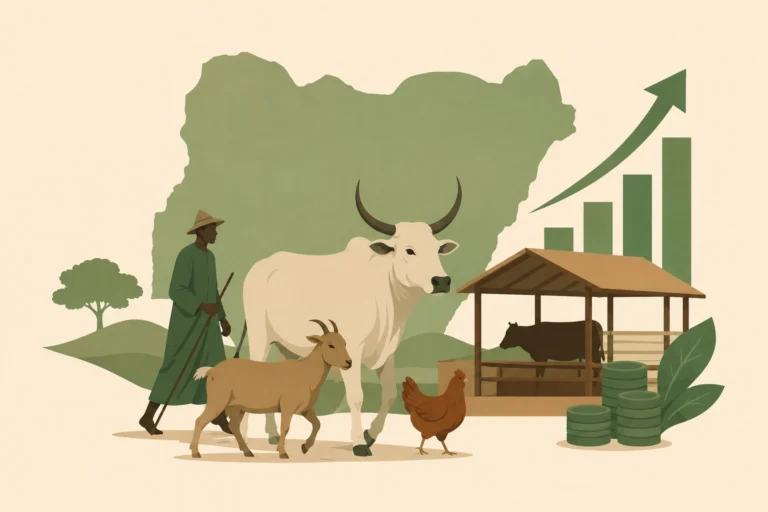
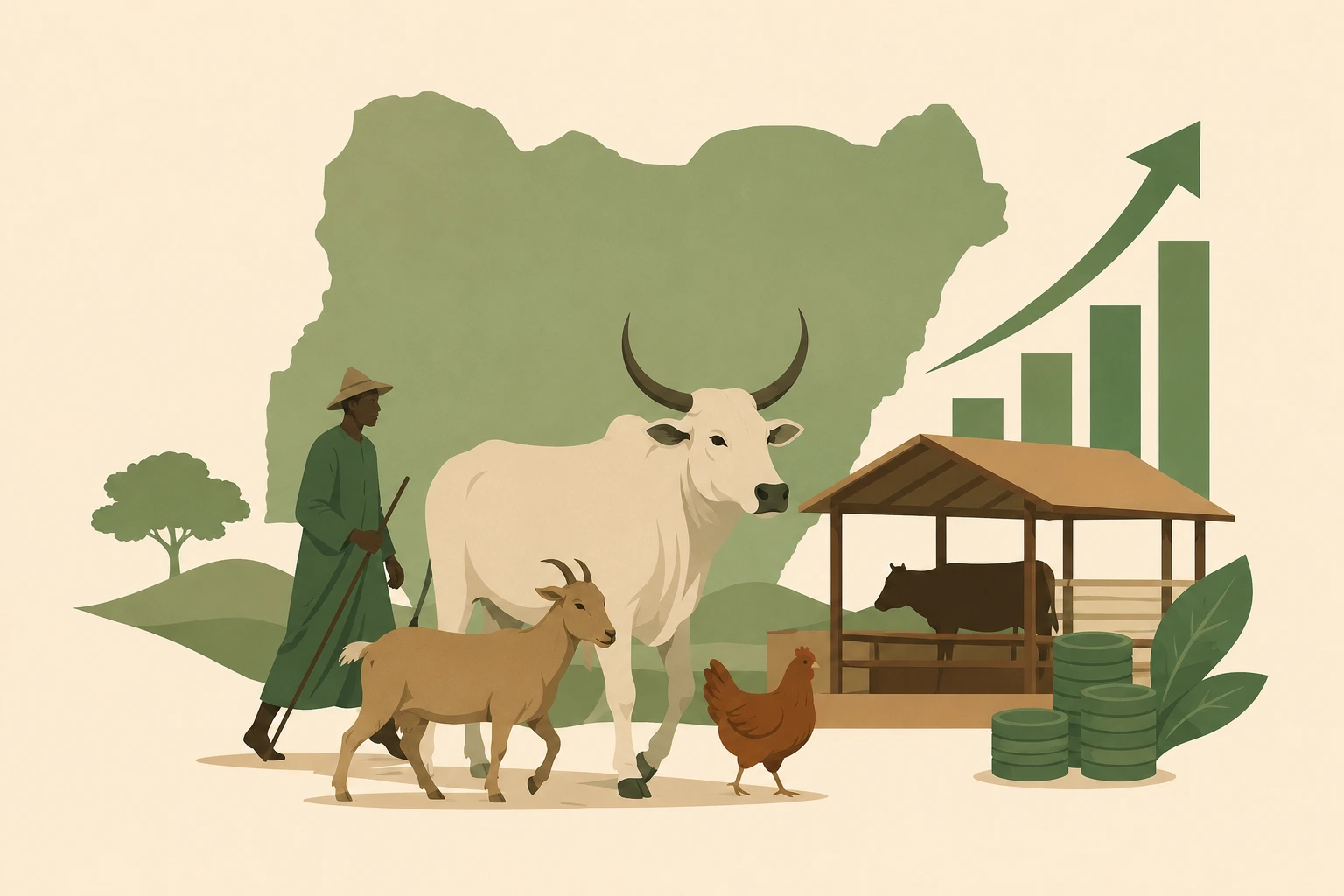
Livestock accounted for 6.04% of Nigeria’s real Gross Domestic Product in Q2 2026, compared with 4.16% for crude petroleum and natural gas, according to the latest Gross Domestic Product report from the National Bureau of Statistics.
In actual output measured at constant 2019 prices, livestock generated about ₦3.23 trillion of economic activity during the quarter, compared with approximately ₦2.23 trillion from crude petroleum and natural gas. That makes the livestock economy roughly 45% larger than the oil sector by real GDP value added.
The comparison is also visible at current prices. Livestock generated about ₦6.65 trillion in nominal output during Q2, against ₦4.77 trillion for crude petroleum and natural gas. Livestock consequently represented 5.57% of nominal GDP, compared with 4% for crude petroleum and natural gas.
The numbers do not mean that cattle, poultry and other livestock have become more important than oil to Nigeria’s public finances or external accounts. Petroleum remains disproportionately important as a source of export earnings, foreign exchange and government revenue. GDP, however, measures the value added by economic activity within the country rather than the amount of foreign exchange or fiscal revenue an industry generates.
On that measure, the NBS data show an economy in which oil constitutes a surprisingly small proportion of domestic production.
Livestock Growth Accelerates
The livestock sector also expanded considerably during the quarter. Real livestock output grew 6.92% year-on-year in Q2 2026, accelerating from 2.20% in the first quarter and from 1.64% in the corresponding quarter of 2025.
Crude petroleum and natural gas grew slightly faster, at 7.31%, as average oil production increased to 1.72 million barrels per day, from 1.68 million barrels per day a year earlier and 1.55 million barrels per day in Q1 2026. But oil’s faster growth did little to overturn the striking difference in scale between the two activities.
The wider agricultural sector accounted for 26.15% of real GDP, making it more than six times the size of the oil economy. Crop production alone contributed 17.66% of GDP, more than four times oil’s contribution.
Agriculture grew by 4.39% year-on-year, a significant improvement from 2.82% in Q2 2025 and 3.15% in the first quarter of 2026.
Nigeria Is Far Less of an ‘Oil Economy’ Than Commonly Assumed
The GDP figures underline the distinction between an economy that depends on oil for dollars and one in which oil dominates actual domestic production.
Nigeria fits the former description much more closely as Oil contributed only 4.16% of real GDP in Q2, while the entire non-oil economy accounted for 95.84%. Non-oil activity grew by 4.31%, compared with 7.31% growth in oil.
Several individual Nigerian industries were however substantially larger than petroleum. Trade accounted for 17.93% of GDP, crop production 17.66%, real estate 12.71% and telecommunications and information services 9.72%. Livestock, at 6.04%, was another activity that exceeded crude petroleum and natural gas.
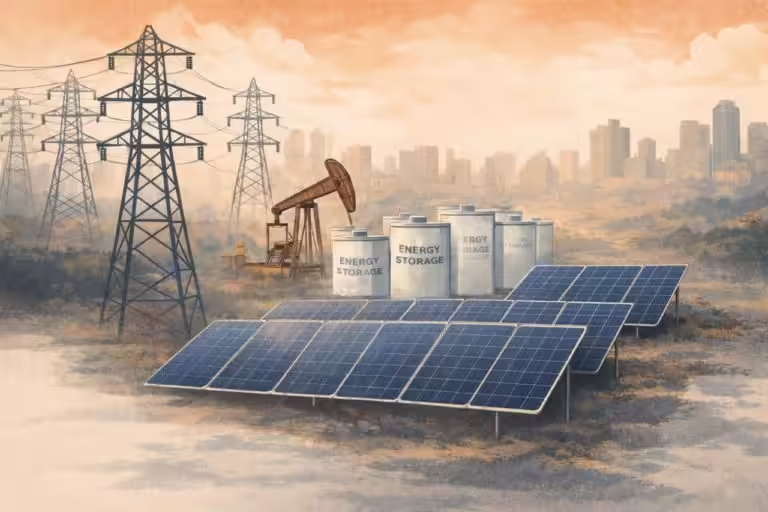
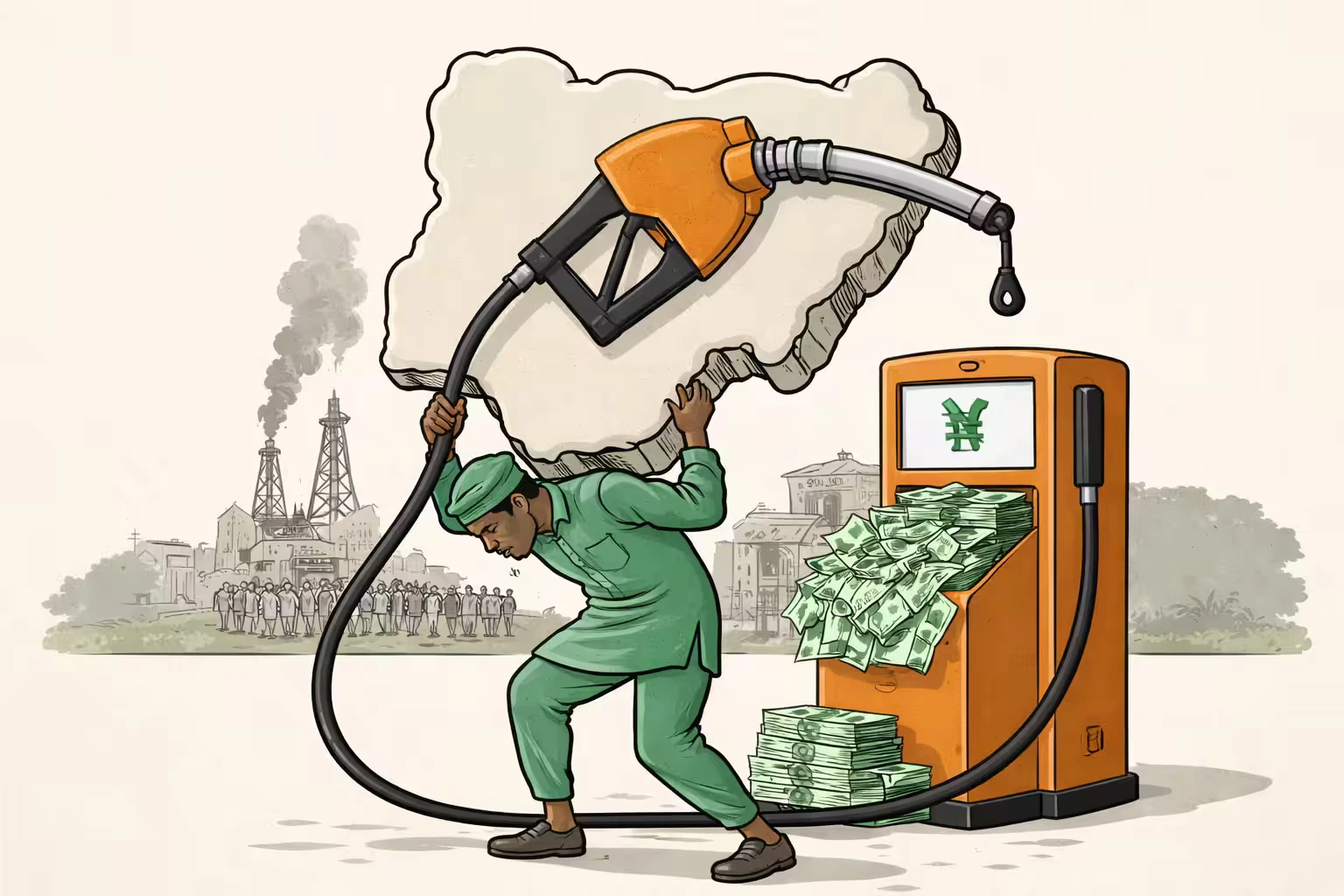
This creates an important paradox in the Nigerian economy. Oil is relatively small when measured by its contribution to GDP but remains enormously influential because it produces a large share of the dollars that Nigeria needs to pay for imports and supports government revenues through petroleum taxes, royalties and other receipts.
The result is that movements in a sector representing barely one twenty-fourth of domestic output can have outsized consequences for the exchange rate, government finances and inflation.
A Broader Economic Recovery
Nigeria’s economy expanded by 4.43% year-on-year in real terms, up from 4.23% in the corresponding quarter of 2025 and 3.89% in the first quarter of 2026.
Services, which constitute the largest part of the economy, grew 4.60% and accounted for 56.62% of GDP. Agriculture contributed 26.15%, while industries represented 17.23%.
Among the faster-growing significant activities were telecommunications and information services, which expanded 10.38%, insurance at 16.13%, construction at 6.75% and livestock at 6.92% while Manufacturing grew by a more modest 3.24%.
The NBS figures therefore present a picture considerably more complicated than Nigeria’s traditional description as an oil-dependent economy. Nigeria remains highly dependent on petroleum for foreign exchange and government revenue. But in terms of the actual production of goods and services across the economy, oil is dwarfed not only by trade, telecommunications, property and crop farming, but now also by livestock.
For a country where debates about economic policy frequently revolve around crude production, oil prices and petroleum revenues, the comparison is a reminder of where most Nigerian economic activity actually takes place.