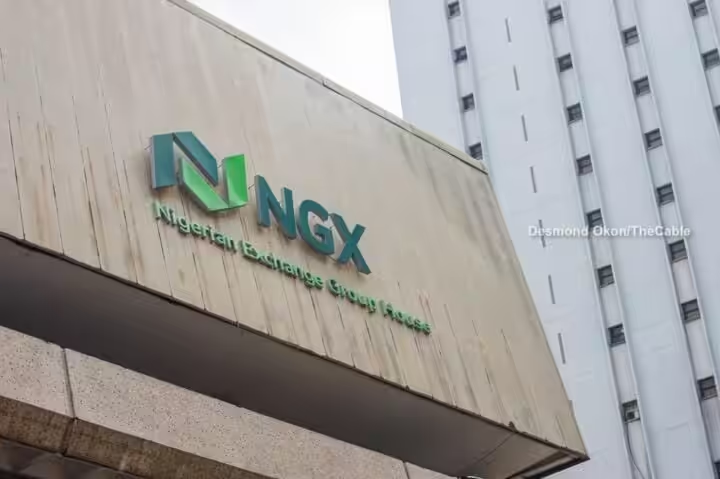
Nigeria’s biggest energy businesses could become the next frontier of the country’s stock-market expansion if the Nigerian Exchange Group succeeds in persuading major companies including Nigerian National Petroleum Company Limited, Nigeria LNG Limited and Indorama Eleme Petrochemicals Limited to list their shares.
Temi Popoola, Group Managing Director and Chief Executive of Nigerian Exchange Group, has made the case for bringing more of Nigeria’s strategically important companies to the exchange, as the market seeks to build on a sharp rise in valuations and investor activity under President Bola Tinubu.
The proposal goes beyond adding a few large stocks to the Nigerian Exchange. It touches a much older problem in Nigeria’s economy: some of the country’s most valuable productive assets have historically remained outside the public capital market, limiting ordinary Nigerians’ ability to participate directly in their ownership and depriving the exchange of potentially deep pools of liquidity.
The push also comes after the NGX passed the N100 trillion market-capitalisation threshold at the end of 2025, following a 51.19% rise in its All-Share Index during the year.
A bigger market needs bigger companies
The argument from the exchange is straightforward. Nigeria cannot build a deep capital market simply by adding smaller companies while some of its largest businesses remain privately held or controlled through government ownership.
That problem is particularly pronounced in the energy industry.
NNPCL, created as a commercial entity under the Petroleum Industry Act, sits at the centre of Nigeria’s petroleum industry. A public listing would potentially give investors direct exposure to the national oil company’s operations while subjecting the business to the disclosure, reporting and governance requirements associated with a quoted company.
The idea is not new. Capital-market operators have been calling for NNPCL and NLNG to be listed for years. In 2024, the Securities and Exchange Commission said 14 state-owned enterprises had been shortlisted for possible listings on the NGX, including NNPC and NLNG, alongside Ajaokuta Steel, the Bank of Agriculture and other government-controlled enterprises.
The Federal Government itself has previously said it wanted NNPCL, NLNG and other large companies to enter the market. In January 2025, Vice President Kashim Shettima said the government was working to encourage NNPC, Dangote Refinery and NLNG to list, describing the capital market as an instrument for national development rather than merely a trading venue.
Eleme is a different proposition
The inclusion of Indorama Eleme Petrochemicals is more complicated because the company is not simply another government-owned corporation waiting to be privatised.
Eleme Petrochemicals was established by the Federal Government through the former Nigerian National Petroleum Corporation and began operations in 1996. But in 2006, 75% of the company’s equity was sold to Indorama for $225 million. Subsequent transactions left the Federal Government with a much smaller stake.
Indorama subsequently transformed the plant from an underperforming state asset into a major petrochemicals operation. The Bureau of Public Enterprises says the company had suffered from underinvestment, operational problems and low capacity utilisation before privatisation, while Indorama’s takeover was followed by turnaround investment and a rapid return to profitability.
That history makes an Eleme listing potentially more interesting than a conventional government privatisation.
A flotation could give Nigerian investors exposure to a large industrial business that converts hydrocarbons into polyethylene and polypropylene, materials used across manufacturing and consumer industries. It would also provide a public valuation for an asset whose ownership is already shared between private and Nigerian interests.
There is precedent for the idea. Indorama Eleme Petrochemicals said in 2017 that it was considering a listing on the Nigerian Stock Exchange, then expected within two to three years. That plan did not materialise on the timetable announced.
Why the exchange wants them
For the NGX, the attraction is not simply prestige.
Large listings create trading volume, increase the number of shares available to institutional investors and provide the exchange with companies capable of attracting international funds. They can also give pension funds, asset managers and retail investors more opportunities to invest in productive parts of the economy.
Nigeria has already seen what a major listing can do to the composition of its market.
MTN Nigeria, Airtel Africa and BUA Cement became major components of the exchange after their listings, helping alter the balance of the market away from its traditional concentration in banks and consumer companies. The Guardian has previously noted that the large listings materially increased the exchange’s market capitalisation and visibility.
The energy sector could produce an even larger transformation because of the scale of the underlying businesses.
NLNG, for example, is one of Nigeria’s most important sources of export earnings and a major player in the global liquefied natural gas industry. Bringing such an enterprise into the public market would create a very different investment proposition from the smaller companies that dominate many emerging-market exchanges.
The real obstacle is not the stock exchange
The difficult question is therefore not whether NGX can accommodate these companies.
It can.
The harder question is whether their owners and government stakeholders are willing to accept the transparency, valuation scrutiny and shareholder accountability that come with public ownership.
Listing a company means publishing financial information to investors, maintaining continuing disclosure obligations and allowing the market to place a value on the business every trading day.
For government-controlled enterprises, that can create uncomfortable comparisons between commercial performance and political expectations.
There is also the question of how much equity would actually be sold. A company can list a minority stake while government or a strategic shareholder retains control. That model would allow the state to raise capital and broaden ownership without necessarily surrendering control.
Nigeria has already used similar structures in other major listings.
A capital-market reform with an ownership agenda
The broader objective is therefore not merely to make the NGX bigger. It is to make more Nigerians owners of the economy.
The SEC has explicitly framed the proposed listings of state-owned enterprises as a way of broadening ownership, improving governance and allowing citizens to participate in companies traditionally controlled by government. The commission has also worked with the NGX on electronic systems designed to make public offerings easier for retail investors.
That matters because Nigeria’s pension funds and domestic institutional investors already control substantial pools of long-term capital. A deeper market gives that money more productive assets in which to invest rather than forcing investors to concentrate on a relatively narrow group of listed companies.
Popoola has increasingly presented this as part of a larger effort to make Nigeria’s capital market a regional investment hub. In recent comments, he argued that the country’s reforms, improved market infrastructure and growing pipeline of businesses could help Nigeria build one of Africa’s leading capital markets.
The timing is favourable but the test will be execution.
Nigeria has announced major listings before without seeing them completed on schedule. The history of Eleme itself shows how long the journey from intention to quotation can take.

For NNPCL and NLNG, the political and ownership questions are even larger.
If the government and corporate owners eventually turn the NGX’s wishlist into actual offers, the result would be more than a handful of new ticker symbols. It would give Nigerian investors a direct stake in some of the country’s most consequential energy and industrial businesses — and test whether the country’s renewed stock-market boom can be converted into lasting economic ownership.