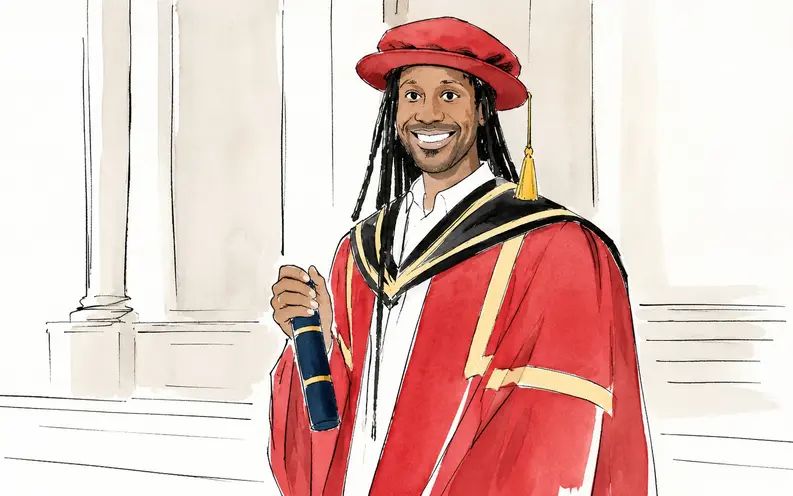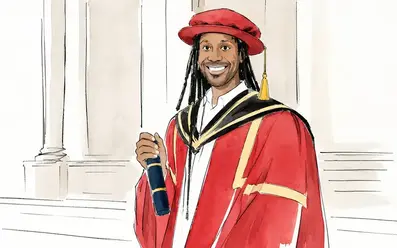
Jason Arday’s rise through Britain’s academic system was extraordinary enough to become a story in its own right.
The sociologist and race scholar became a professor at the University of Cambridge at 37, after moving through a succession of British universities and building a public profile around race, inequality, education and social mobility.
But that rise is now being examined from a different perspective.
Allegations of plagiarism involving Arday’s academic work have prompted renewed scrutiny of his publications and doctoral research, while Kathleen Stock, a former philosophy professor at the University of Sussex, has gone further by questioning whether his scholarship ever justified the reputation he acquired.
Speaking to UnHerd’s Freddie Sayers, Stock said she had read some of Arday’s journal articles and books and described the academic writing in deeply negative terms. She argued that the work did not meet the standard she would expect from a professor, even if the plagiarism allegations were put aside.
Her most pointed criticism was about the source of Arday’s public prominence.
“There is no academic contribution this man ever made that explains his star quality,” Stock said, adding that he was a “star because of his story.”
That distinction is at the centre of the controversy: whether Arday’s remarkable personal journey and public significance became so closely associated with his academic identity that the quality of his scholarship received less scrutiny.
From extraordinary personal story to Cambridge professor
Arday’s career has attracted attention partly because of the obstacles he said he encountered before entering academia.
His professional biography has emphasised his unconventional route into higher education and the challenges he faced in developing an academic career. He eventually progressed through British universities before reaching some of the country’s most prestigious institutions.
His areas of research include race and higher education, racial inequality, intersectionality, mental health, neurodiversity and cultural studies. That combination of personal experience and academic work made him a prominent voice in debates about race and inequality in British education.
His appointment at Cambridge consequently represented more than another academic promotion. It became part of a wider story about social mobility and the changing face of Britain’s universities.
It is also what makes the current controversy particularly uncomfortable for institutions that celebrated his trajectory.
If an academic’s public reputation is partly built around an inspirational personal narrative, questions about the underlying scholarship inevitably become questions about the institutions that helped turn that narrative into professional authority.
Stock’s criticism goes beyond plagiarism
Stock’s assessment was not limited to the allegations of plagiarism.
She argued that, even without those allegations, she did not consider Arday’s work to represent the level of scholarship expected from a professor.
She described what she saw as a sharp difference between his journal articles and books. His academic papers, she said, relied heavily on familiar terminology associated with critical race theory, while his books moved between autobiographical material, self-help language and academic terminology.
One of the books she discussed was Cool Britannia, which examines Britpop and racism partly through Arday’s own experience of discovering bands such as Oasis and Blur. She also referred to his work on neurodiversity, co-authored with academic Chantelle Lewis.
Stock’s assessment is, however, a personal academic judgment rather than a formal finding by a university or research-integrity body.
That distinction matters.
The plagiarism allegations remain allegations unless and until the relevant institutions establish that academic misconduct occurred. A criticism of the intellectual quality of someone’s work is also fundamentally different from a formal determination that the work breached academic-integrity rules.
A bigger question for British universities
The controversy nevertheless touches a problem extending beyond one academic.
Universities increasingly expect scholars to operate outside the traditional boundaries of academic publishing. Professors are asked to engage with the public, advise governments, participate in institutional initiatives and contribute to debates about social issues.
Public visibility can therefore become part of academic influence.
Arday became prominent in precisely that space. His work and personal story placed him at the intersection of academic research, debates about racial inequality and questions about access to Britain’s universities.
The case now presents universities with an uncomfortable question: how should institutions balance the value of an extraordinary personal story with the conventional standards used to judge academic achievement?
A compelling biography can explain why an individual attracts attention. It cannot, by itself, establish the quality of the research attached to that reputation.

That is ultimately what makes Stock’s comments more consequential than a simple dispute between academics. They challenge the assumption that professional prominence and scholarly distinction necessarily arrive together.
For Arday, the continuing plagiarism controversy will determine whether the allegations withstand formal scrutiny. For Britain’s universities, the episode raises a broader issue about how academics become stars — and whether institutional enthusiasm for an exceptional story can sometimes move faster than scrutiny of the work behind it.