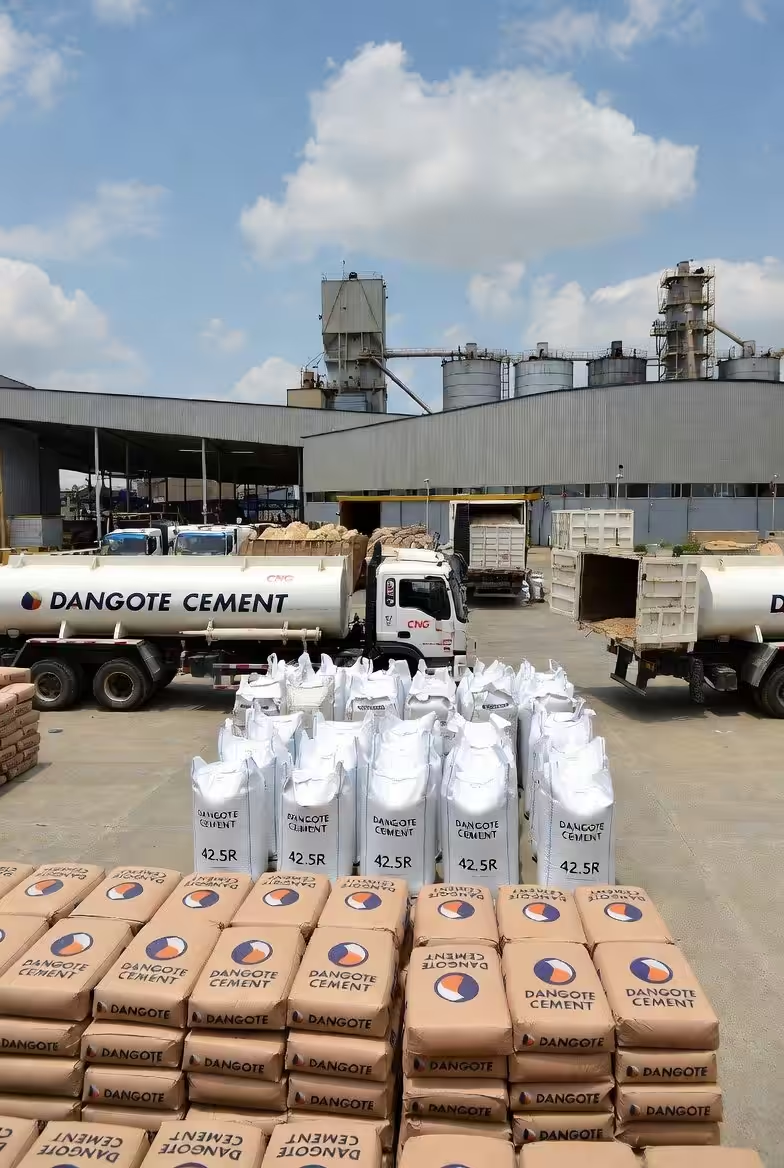
The Federal Competition and Consumer Protection Commission (FCCPC) has opened a formal investigation into possible manipulation of cement prices in Nigeria after a three-month industry-wide review raised concerns about unusually high retail prices despite substantial domestic production capacity.
The Commission said in a statement on Tuesday that findings from a 40-page field report compiled by its Anticompetitive Practices Department suggest that the cement market may not be functioning competitively.
The investigation follows widespread complaints from consumers over the rising cost of cement, a key input for housing construction, commercial real estate and public infrastructure.
According to the FCCPC, Nigeria has an installed cement production capacity of between 60 million and 65 million metric tonnes annually, compared with estimated domestic consumption of only 25 million to 30 million metric tonnes.
The country is also a net exporter of cement to neighbouring markets. Despite this excess production capacity, however, the retail price of a 50kg bag of cement increased significantly during the first half of 2026.
The FCCPC said prices rose from about N9,300–N9,700 in January to between N10,500 and N13,000 by mid-year, with some locations recording prices of between ₦13,000 and ₦15,000.
Cross-border Price Comparison
In Nairobi, Kenya, where the population is roughly 76% lower than Nigeria’s, a 50kg bag was selling for about $5.40, equivalent to approximately ₦7,344 based on the exchange rate used in the report. Prices were about $4.80 (₦6,528) in Tanzania and $6.75 (₦9,180) in Togo.
The FCCPC said the price differential was notable given Nigeria’s significant limestone reserves and excess production capacity, factors that would ordinarily be expected to exert downward pressure on prices in a competitive market.
All but one of the major cement manufacturers cooperated with the Commission during the preliminary review by providing access to their records.
The FCCPC has now issued Notices of Commencement of Investigation and Summons to Produce to the companies, requiring them to provide detailed information on pricing methodologies, production levels, capacity utilisation, exports and commercial relationships.
FCCPC Executive Vice Chairman and Chief Executive Officer, Tunji Bello, said the investigation was part of the Commission’s responsibility to examine market conditions that have significant implications for consumers and the wider economy.
“Cement occupies a strategic place in the Nigerian economy. Its price affects the cost of building a home, developing commercial property, delivering public infrastructure and, ultimately, the cost of doing business,” Bello said.
He added that where concerns persist over the functioning of a strategically important market, the Commission has a duty to establish the facts rather than rely on assumptions.
According to him, businesses remain free to determine their legitimate commercial strategies and earn returns on their investments. The Commission’s responsibility is to establish whether prices and other market outcomes are being determined by genuine competition.
The FCCPC said the investigation will examine possible coordinated conduct, abuse of market power, restrictions on domestic supply, anti-competitive distribution practices and other conduct that could contravene the Federal Competition and Consumer Protection Act.

Cement producers and other industry participants have previously cited rising energy costs, the depreciation of the naira and its effect on imported machinery and spare parts, as well as transportation and logistics expenses, as factors contributing to higher prices.
The FCCPC said it is testing these explanations against verified information on production costs, output, pricing and broader market conditions.