Real GDP in Electricity, Gas, Steam and Air Conditioning Supply contracted by 10.63% year-on-year in Q2, after shrinking 15.30% in Q1. Overall GDP, meanwhile, grew 4.43%, up from 3.89% in the first quarter.
The divergence is one of the most important signals buried in the latest National Bureau of Statistics GDP report.
Construction expanded 6.75%, manufacturing 3.24% and information and communication 9.62% even as the electricity-related sector recorded a second consecutive quarter of double-digit contraction.
The immediate question is how an economy can accelerate while formal power supply is weakening so severely.
The NBS report does not provide a causal explanation, and its measure is value added in the broader electricity, gas, steam and air-conditioning category rather than simply the number of megawatt-hours generated.
But operational data from the power industry point to a combination of gas shortages, low plant availability and the sector’s longstanding liquidity crisis.
Gas Shortages Are Starving Nigeria’s Power Plants
In February, the Nigerian Independent System Operator, NISO, said thermal plants required about 1,629.75 million standard cubic feet of gas a day to operate optimally but were receiving only about 692 million — less than 43% of requirements.
“The current low generation level is fundamentally driven by inadequate gas supply to thermal generating units,” NISO said.
The shortage reduced available generation to roughly 4,300MW and forced load shedding.
The weakness was still visible as Q2 began. NERC reported that in April grid-connected plants had an average plant availability factor of only 31%: about 4,286MW was available for dispatch out of 13,625MW of installed capacity.
In Q1, average available generation capacity had already fallen 17.45% from the previous quarter to 4,457.96MW.
Nigeria’s Electricity Crisis Is Ultimately a Money Problem
Behind the gas shortage lies a deeper commercial problem. Nigeria’s electricity market has for years failed to generate enough cash to pay the full cost of power supplied through the system.
Tariff subsidies, incomplete collections, distribution losses and unpaid market invoices have produced large arrears to generation companies, which in turn owe gas suppliers, lenders and contractors.
The Federal Government’s power-sector debt programme is itself an acknowledgement of the scale of the problem.
Following verification, outstanding legacy claims were reduced from more than ₦4 trillion to about ₦3.3 trillion, with government-backed bonds being issued to clear part of the liabilities and restore payments through the electricity value chain.
This produces a vicious circle. When GenCos are not fully paid, they struggle to pay gas suppliers and finance maintenance.
Gas suppliers reduce deliveries or demand stronger payment assurances. Plants become unavailable, generation falls, DisCos receive less electricity to sell and the industry’s revenue pool shrinks further. A financial problem becomes a physical electricity shortage.
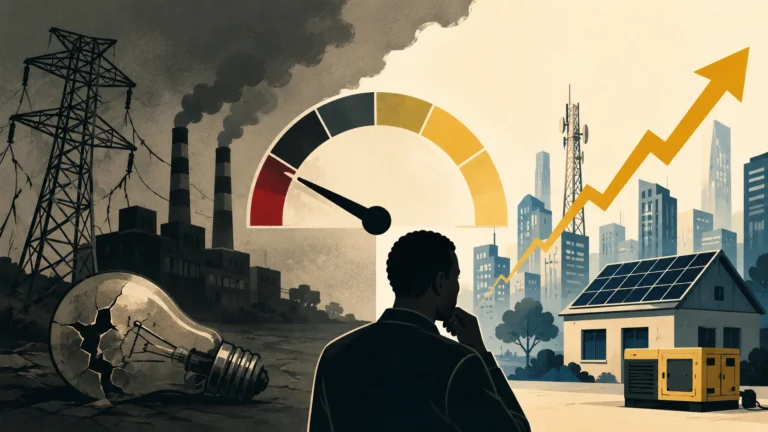
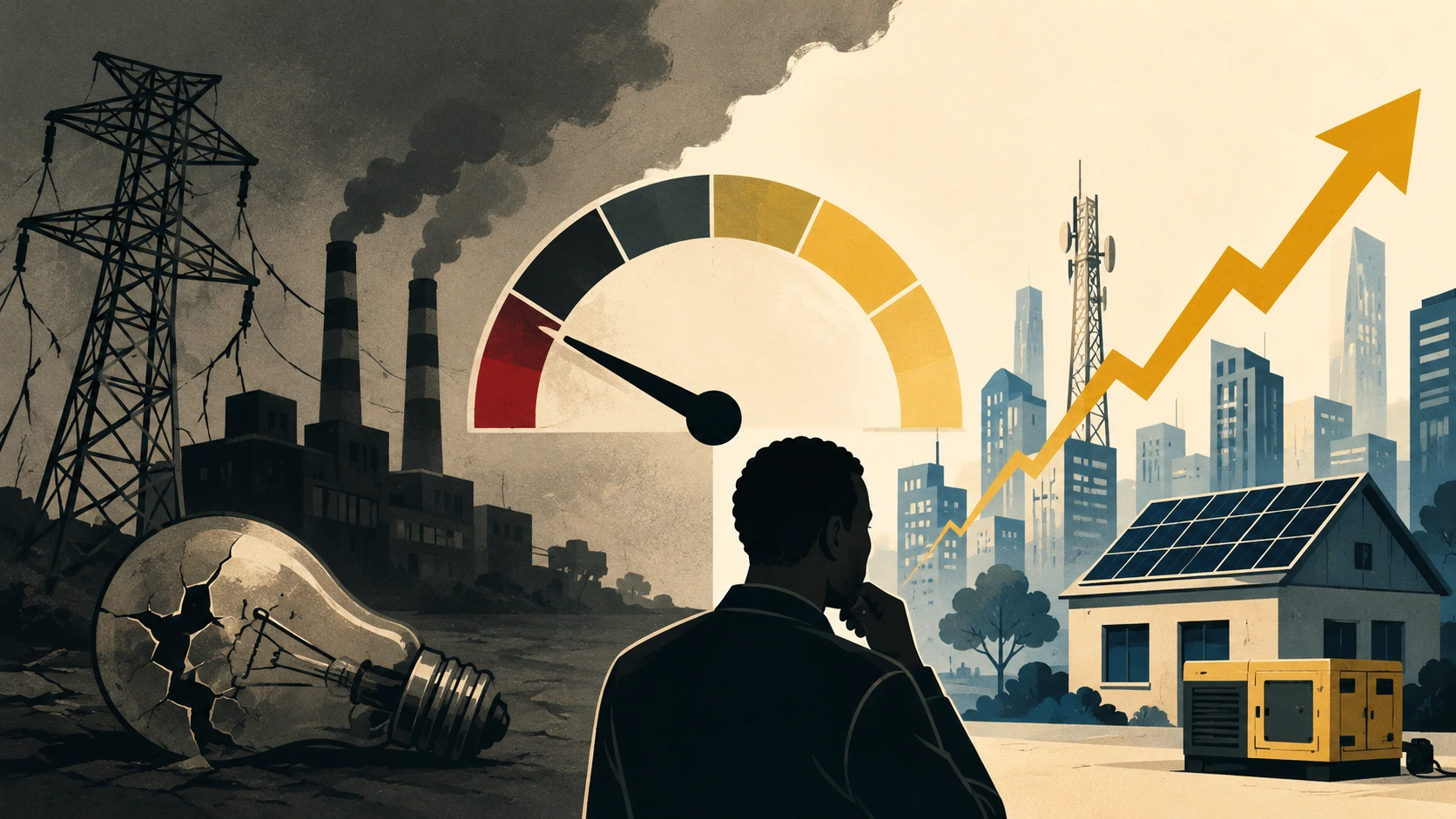
Yet the wider economy continues growing because Nigerian businesses have spent decades learning to operate around the grid.
Diesel and petrol generators, captive gas plants, rooftop solar, batteries and mini-grids allow firms to substitute privately generated electricity for unreliable grid supply.
That resilience helps explain how manufacturing, construction, telecommunications and services can expand while the formal electricity sector contracts. But it is expensive resilience.
Businesses effectively finance two electricity systems: their connection to the public grid and whatever alternative they require when the grid fails.
The World Bank has long identified unreliable electricity as a major constraint on Nigerian firms, arguing that dependence on self-generation raises production costs and reduces competitiveness.
The GDP figures should therefore not be interpreted as evidence that electricity has become less important to economic growth.
They suggest something almost opposite: Nigerian firms are spending substantial amounts of money merely to overcome the deficiencies of the electricity system.
That has consequences for productivity. Capital spent on generators, solar installations, batteries and fuel simply to keep existing operations running cannot simultaneously finance new machinery, warehouses, research, logistics or additional workers.
Output can continue rising, as Q2 demonstrates, while the economy grows more slowly than it might have done with reliable electricity.
There is also a dangerous implication for the power industry itself. As larger companies and wealthier households increasingly invest in captive generation and solar, the grid risks losing some of its most creditworthy customers.
That can leave distribution companies with a weaker revenue base, making network investment harder — the beginnings of a utility “death spiral” in which poor service encourages customers to exit and customer exit further weakens service.
Nigeria Does Not Just Need More Power Plants
The answer therefore cannot simply be adding more nominal generation capacity. Nigeria already has far more installed capacity than it routinely delivers.
The commercial chain has to work: sustainable tariffs accompanied by targeted subsidies, stronger collections, lower distribution losses, reliable payment to GenCos, secure gas supplies and greater transmission investment.
Distributed solar and mini-grids should meanwhile be treated as part of Nigeria’s electricity architecture rather than merely emergency substitutes for the grid.

The paradox in the Q2 GDP numbers is ultimately a warning. Nigeria has demonstrated that its economy can grow despite a shrinking formal electricity sector. What it has not demonstrated is that it can industrialise rapidly that way.
An economy can improvise around unreliable electricity for years; it cannot become highly productive while treating power as something every serious business must generate for itself.