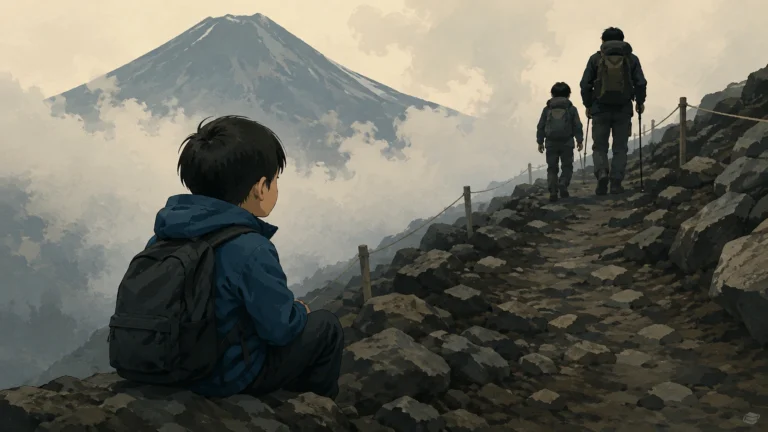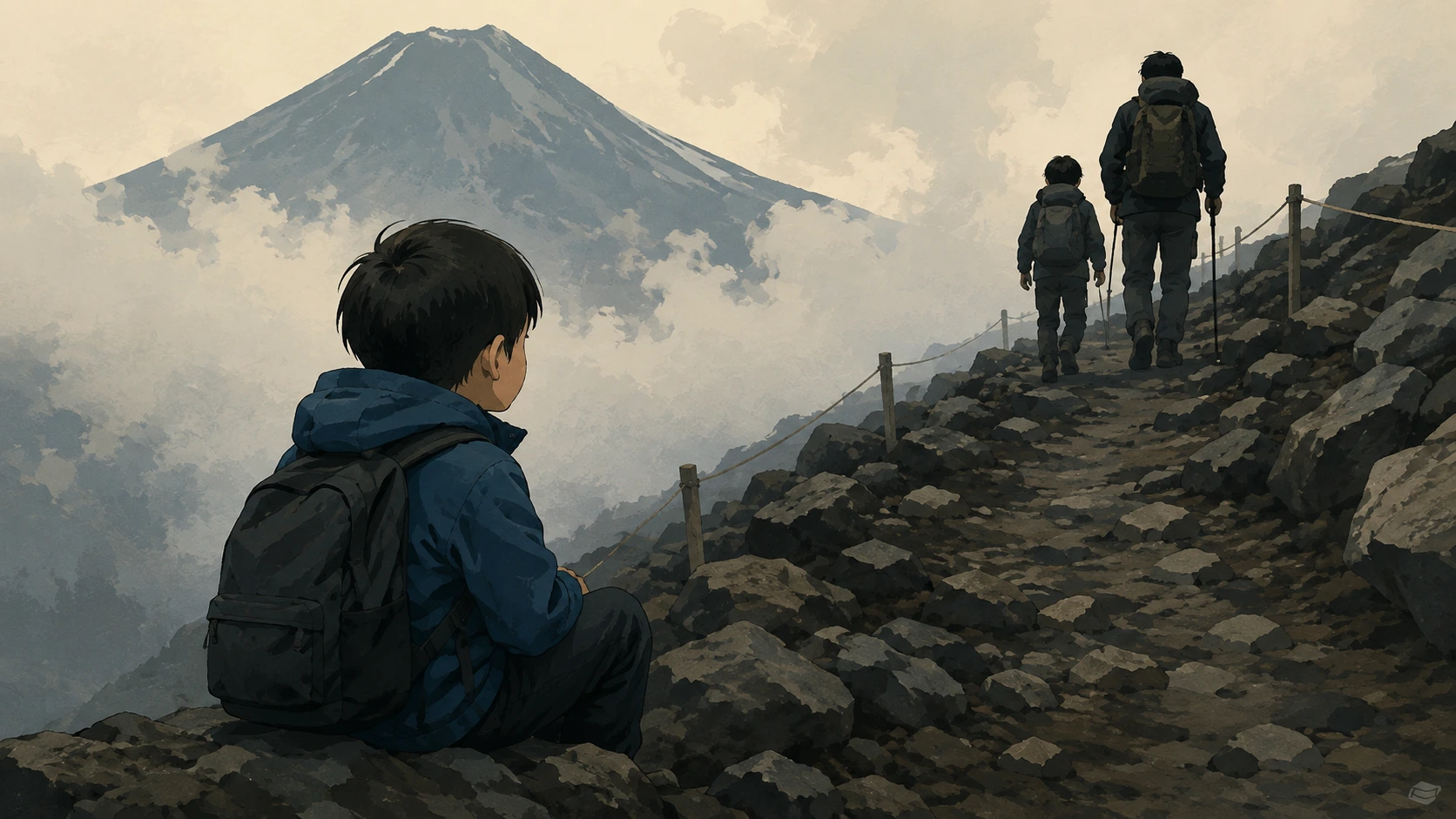
A seven-year-old boy was left alone on Mount Fuji after telling his father he was too tired to continue climbing, prompting police intervention after a mountain hut worker found him sitting by himself in the early morning.
The incident occurred on Thursday, Aug. 20, on the Fujinomiya Trail, one of the routes used to climb Japan’s highest mountain. The boy had been hiking with his 48-year-old father and an older brother from Nagoya, according to Japanese media reports.
The child was found near the trail’s sixth station, at an elevation of roughly 2,490 to 2,500 metres. He told people who found him that his father had instructed him to wait there while he continued climbing with the older son.
Police found the father higher up the mountain
A mountain hut worker noticed the boy alone at around 7:30 a.m. as rain fell and fog began to develop around the trail. The worker took him into the hut and contacted police.
By then, the father had continued upward and was reportedly near the eighth station. Police located him and instructed him to stop the ascent and return to his younger son. He eventually came back and was reunited with the boy.
Japanese television broadcaster TV Asahi reported that the boy said his father had told him to wait for as long as eight hours.
Police later warned the father that leaving a child alone in such circumstances could constitute conduct that violates criminal law and told him that a mountain hut was not a childcare facility.
The father reportedly acknowledged his mistake and expressed remorse.
The boy was not injured.
The precise length of time he spent alone is not completely established. Earlier reports estimated that the father may have left him around 4:30 a.m., based on the time needed to travel between the stations. The boy was discovered several hours later.
Mount Fuji is more demanding than its tourist image suggests
The circumstances matter partly because the sixth station is already at an altitude where conditions can be substantially different from those at the mountain’s lower elevations.
The Fujinomiya Trail begins at about 2,380 metres, making it the highest of Mount Fuji’s main trailheads. The official Mount Fuji climbing website specifically warns that climbers unfamiliar with high-altitude hiking — including young children — need to acclimatise before beginning the ascent.
Children can also be more vulnerable to altitude-related problems. Mount Fuji’s official safety guidance says children have weaker cardiopulmonary systems and can face a higher risk of altitude sickness, particularly on a first ascent. It advises parents to monitor their children’s condition closely and not push them beyond their limits.
That makes the boy’s complaint that he was too tired more than a minor obstacle to a family hike. At roughly 2,500 metres, fatigue can be an indication that a child needs to stop, rest or descend rather than simply wait for the rest of the group to return.
Weather can turn quickly above the trailhead
The weather added another layer of risk.
Mount Fuji’s official climbing authority warns that conditions can change rapidly because of the mountain’s elevation and exposed position. Even during summer, temperatures near the summit can approach freezing before sunrise, while rain, strong winds, thunderstorms and dense fog can develop quickly.
The authority also warns that children and older people are particularly susceptible to hypothermia and that temperatures at the summit can be about 20 degrees Celsius lower than at sea level. Rain and strong winds can make conditions feel colder still.
In the incident, the boy was reportedly sitting alone as rain fell and fog gathered. That turned what might otherwise have appeared to be a simple disagreement over whether to continue climbing into a potentially dangerous situation.
The mountain’s popularity can conceal its risks
Mount Fuji attracts large numbers of climbers during its short summer season, but the mountain authorities repeatedly caution visitors against treating it as an easy tourist attraction.
The official climbing guidance describes Mount Fuji as Japan’s highest mountain and warns that climbers must prepare for sudden weather changes, navigation problems and other hazards. It specifically advises inexperienced climbers not to act alone.
The 2026 climbing season was operating normally when the incident occurred. The Fujinomiya summit route is scheduled to operate from July 10 to Sept. 10, while the section between the fifth and sixth stations operates for a longer period.
The distinction matters because Mount Fuji’s infrastructure can create the impression that the mountain is relatively accessible. Roads and facilities reach high elevations, and mountain huts provide shelter along the routes. But those facilities do not remove the underlying hazards of altitude, exposure and rapidly changing weather.
The lesson from the incident is about the slowest member of the group
Japanese authorities and Mount Fuji’s climbing guidance consistently emphasise a basic principle for group hiking: the itinerary has to account for the capabilities of everyone taking part.
The guidance recommends a slow, steady pace, regular breaks and careful attention to symptoms of altitude sickness. It also tells climbers to descend if conditions or their physical state make continuing unsafe.
In this case, the seven-year-old could not maintain the pace of the other two hikers. The decision to continue without him separated the least capable member of the group from the people responsible for his safety.

That is what ultimately brought police into the episode. A mountain hut worker, rather than the family, became the adult responsible for the child until officers could locate his father.
The boy was eventually returned safely to his family. But the incident illustrates why the practical rule on a high-altitude climb is simple: when one member of the group cannot continue, the plan has to change for everyone.