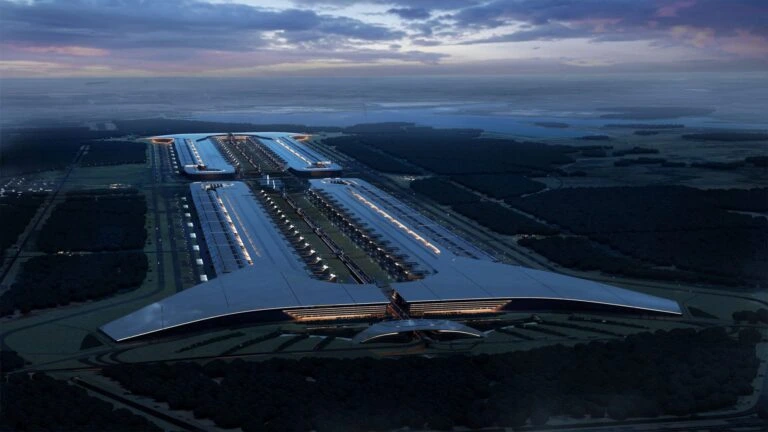
Elon Musk’s plan for a semiconductor factory in rural Texas is much more than an attempt to build a very large building.
Terafab is designed to bring one of the most strategically important parts of the technology supply chain — advanced chip manufacturing — inside the increasingly self-contained industrial ecosystem Musk is building across Texas.
SpaceX and Tesla said on August 6 that the first phase of Terafab would require more than $16.8 billion and create about 3,000 jobs in Grimes County, near College Station.
The planned complex is expected to cover more than 100 million square feet, with manufacturing, packaging and testing of advanced logic and memory chips conducted at the same site.
The scale is extraordinary, although claims that it will simply become the world’s “largest building” depend on how size is measured. The AvtoVAZ assembly plant in Russia has a footprint of about 65 million square feet, while China’s New Century Global Center is generally regarded as the largest building by total floor area.
Terafab’s proposed footprint would nevertheless put it in a category of industrial complexes rarely attempted at this scale.
Musk is trying to control the chip supply chain
The deeper purpose of Terafab is supply-chain control.
SpaceX, meanwhile, is pursuing large-scale computing infrastructure, including plans for data-processing capacity in orbit. Both businesses are therefore becoming more dependent on access to enormous quantities of advanced computing hardware.
SpaceX has described Terafab as part of a strategy to extend its vertical integration from chip design through manufacturing and packaging.
The company’s regulatory disclosures say it wants the facility to help reduce potential future chip shortages, improve chip performance and lower costs.
That strategy follows a pattern already visible across Musk’s companies. SpaceX manufactures large portions of its rockets and spacecraft internally; Tesla produces vehicles, batteries and other components at its own factories; and Musk’s broader AI operations are increasingly tied to dedicated computing infrastructure.
Terafab would push that model down another layer — into the semiconductor factory itself.
Intel’s involvement gives the project an important industry link
The project is not entirely a Musk-only experiment.
Intel joined the Terafab initiative in April, offering expertise in chip design, fabrication and advanced packaging. Intel’s own statements about the partnership have framed it as an effort to rethink semiconductor manufacturing economics at a time when demand for advanced computing is rising rapidly.
But the precise scope of Intel’s role remains less settled than the headlines might suggest. SpaceX’s regulatory filings say the companies have a general framework for the collaboration, while specific projects, development schedules, milestones and capital commitments remain subject to separate agreements.
The filings also say neither Tesla nor Intel is obligated to remain involved.
That distinction matters because a semiconductor fab is among the most technically demanding industrial projects to build. Producing advanced chips requires specialised fabrication equipment, extremely controlled environments, reliable power and water supplies, sophisticated packaging facilities and highly trained workers.
Terafab is therefore not simply a construction project. It is a bet that Musk’s companies can coordinate an industrial supply chain that normally spans multiple specialised firms.
Texas is offering more than cheap land
The choice of Grimes County also reflects the industrial policy behind the project.
Texas Governor Greg Abbott announced that the first phase would receive a $30 million Texas Enterprise Fund grant and qualify for incentives under the state’s Jobs, Energy, Technology and Innovation programme. County authorities have also established tax arrangements connected to the development.
That puts Terafab inside a much broader US effort to attract semiconductor manufacturing domestically.
For Texas, the attraction is not difficult to understand. The state already hosts major operations for SpaceX and Tesla and has positioned itself as a centre for advanced manufacturing, energy and technology. A giant chip plant would deepen that industrial cluster rather than creating an isolated technology project.
But the incentives also expose the tension surrounding the development: governments want the investment and jobs, while local communities have to absorb the infrastructure and environmental consequences of an industrial facility of unprecedented size.
Rural Texas is being asked to accommodate a technology megaproject
Grimes County is not Silicon Valley. The proposed facility is being developed around the Gibbons Creek Reservoir, roughly 15 miles east of College Station, in an area whose economy and landscape are markedly more rural than the technology centres normally associated with advanced semiconductor manufacturing.
Local residents have raised concerns about water, traffic, emergency services, infrastructure and the scale of the incentives attached to the project. Some have also questioned how quickly the county’s rural environment could adapt to a development of this magnitude.
Water is particularly important because semiconductor manufacturing is highly water-intensive. SpaceX has said Terafab will use water from the Gibbons Creek Reservoir rather than local groundwater for industrial operations.
The choice of the site is therefore partly an infrastructure calculation. The project is being built around an existing reservoir and an area with industrial infrastructure, rather than treating the development as a completely new industrial settlement.
The $16.8 billion figure is only the beginning
The initial investment announced in August should not be confused with the potential final cost of Terafab.
Earlier county documents described a possible $119 billion total investment if multiple phases were constructed. Those documents also contemplated a much larger initial build-out than the $16.8 billion first phase now formally announced.
That makes the headline figure both enormous and incomplete.
The first phase alone would rank among the world’s most expensive industrial developments. But the ultimate scale remains dependent on future investment decisions, agreements and construction.
The companies have also not published a definitive production date for the completed complex, meaning the 100-million-square-foot target should be understood as a planned scale rather than an already operating facility.
Terafab is ultimately a bet on physical AI
The most consequential part of the project may be what Musk believes the future of artificial intelligence will require.
AI companies have spent years competing over models, software and access to computing power. Musk’s strategy increasingly treats the physical infrastructure underneath AI as the strategic bottleneck: electricity, data centres, specialised processors, manufacturing capacity and eventually space-based computing.
SpaceX has explicitly described Terafab as part of an effort to control more of that physical stack. Its long-term ambition is to produce computing hardware equivalent to one terawatt of compute capacity a year.
The chips would serve two broad markets: terrestrial systems such as Tesla’s Optimus robots and vehicles, and processors designed for SpaceX’s planned orbital computing infrastructure.
That ambition explains the otherwise unusual combination of companies involved. Tesla brings a huge potential market for AI processors; SpaceX brings demand for space and computing infrastructure; Intel brings semiconductor manufacturing expertise.
If Terafab reaches anything close to its proposed scale, it would represent a shift from Musk’s traditional strategy of buying critical components and assembling them into products toward owning more of the underlying industrial machinery itself.
For Texas, that could mean thousands of high-skilled jobs and billions of dollars in investment.

For Musk, the prize is larger: a supply of chips designed around his companies’ own machines, robots, vehicles and satellites, produced within an industrial network he increasingly controls.
The question is whether the engineering, capital, power, water and workforce required to build that network can expand as quickly as his ambitions for AI and robotics. That will determine whether Terafab becomes a functioning pillar of Musk’s technology empire or remains one of the world’s most ambitious industrial proposals.