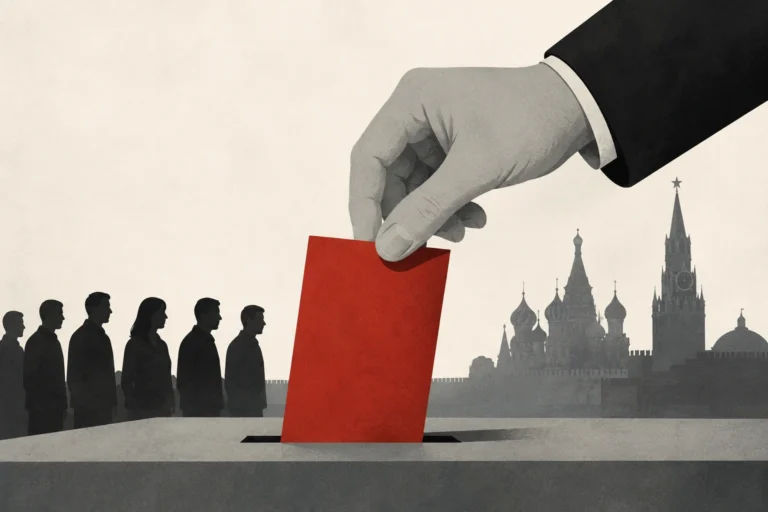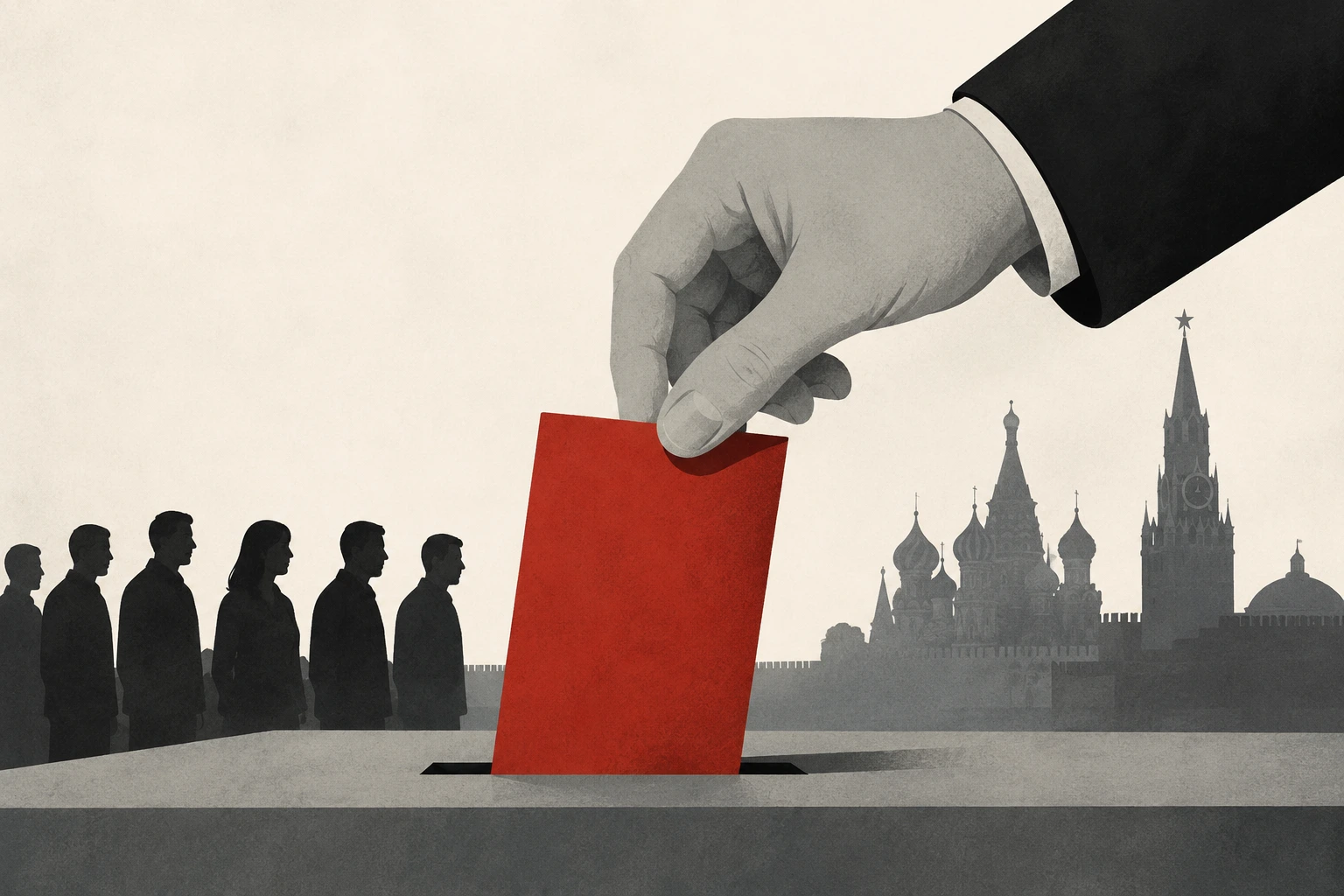
Russia’s Supreme Court has removed Yabloko, the country’s only registered political party openly opposing the war in Ukraine, from the ballot for next month’s parliamentary election.
The ruling came on August 10, less than two weeks after Russia’s Central Election Commission had approved the party’s federal candidate list. Yabloko plans to appeal the decision.
The case was brought by Rodina, a nationalist party, which accused Yabloko of receiving undeclared campaign support from foreign sources. Yabloko rejected the allegations and described the case as an attempt to prevent it from taking part in the election.
The immediate effect is straightforward: Yabloko will not appear on the federal party list when Russians vote for the State Duma on September 20.
The political consequences are more difficult to measure.
Yabloko was unlikely to win power
Yabloko is a long-established liberal party, but it is no longer a major electoral force in Russia.
It was one of the more important opposition parties during the early post-Soviet years and won seats in the State Duma during the 1990s. Its influence has since declined sharply. The party currently has no seats in the national parliament.
That makes its removal from the 2026 election unusual for another reason: the party was not considered a serious threat to United Russia, President Vladimir Putin’s dominant political machine.
Yabloko itself acknowledged before the election that forming a parliamentary faction was highly unlikely. Its campaign was instead focused on using the election to promote peace, political freedom and opposition to repression.
The party had nominated 275 people for its federal list and another 137 candidates for single-member constituencies. The Central Election Commission certified the federal list on July 10.
The question, therefore, was never simply whether Yabloko could defeat the Kremlin.
It was whether Russian voters should be given a legal political vehicle for explicitly rejecting the war.
A different kind of opposition
Yabloko’s 2026 campaign was built around the slogan “For peace and freedom.”
The party called for an immediate ceasefire and negotiations with Ukraine while linking its anti-war position to wider demands for civil liberties and an end to political repression.
That distinguishes Yabloko from the other parliamentary parties.
Russia still has several parties represented in the State Duma, including the Communist Party, LDPR, A Just Russia and New People. But none has made opposition to the war the central issue of its federal campaign.
Yabloko therefore occupied a narrow but politically distinct space: it offered voters the opportunity to oppose the war through an established political party rather than through protest, independent campaigning or unauthorised demonstrations.
That space has now disappeared from the federal ballot.
The decision followed mounting pressure
The Supreme Court ruling was not the first setback for Yabloko this summer.
Regional election authorities had already blocked the party from some contests.
In July, St Petersburg’s electoral commission refused to register Yabloko’s candidates for the city legislature, citing problems with their paperwork. The party challenged the decision.
Yabloko chairman Nikolai Rybakov also faced legal pressure. In July, Russia’s Supreme Court upheld a ruling against him under legislation concerning the display of extremist symbols.
Several Yabloko members have also faced criminal prosecution over their anti-war activities. The party says eight of its members were facing criminal cases connected with their opposition to the war as of July, with three already serving prison sentences.
The pattern has made the party’s participation in the election increasingly difficult even before the federal registration was cancelled.
What does the decision say about Russian public opinion?
The Kremlin has repeatedly presented the war as enjoying broad support among Russians.
But measuring genuine public opinion in wartime Russia is difficult.
People can face serious consequences for publicly criticising the military, while independent media outlets and opposition organisations have been heavily restricted. That makes an election particularly important as a potential channel for measuring political preferences.
Yet an election can only measure preferences among the choices available to voters.
Removing Yabloko means that Russians who want to support an explicitly anti-war party will have no such option on the federal party list.
That does not prove that most Russians oppose the war. Nor does it mean Yabloko would have won a significant number of seats.
It does mean the September election will provide a narrower picture of Russian attitudes towards the conflict.
Support for the war is becoming harder to interpret
Recent polling illustrates why the issue is complicated.
The independent Levada Center reported in July that 66% of respondents said they approved of the actions of the Russian armed forces in Ukraine. That was the lowest level recorded by the organisation since the full-scale invasion began in February 2022.
Approval of the military, however, does not necessarily mean that every respondent wants the war to continue indefinitely.
Some Russians may support the military while also favouring negotiations or an end to the fighting. Others may avoid expressing an opinion because of the political risks involved.
Yabloko’s presence on the ballot would have provided one clearer test of whether that sentiment could translate into votes for an explicitly anti-war programme.
Its exclusion removes that test.
The election will still have opposition parties
Yabloko’s removal does not mean Russia is cancelling the parliamentary election or eliminating every opposition party.
The September vote will feature other parties, including the Communist Party, LDPR, A Just Russia and New People, alongside United Russia and smaller groups. Russia’s electoral system therefore continues to offer voters multiple choices.
The dividing line is what those parties are willing to challenge.
Russia’s current parliamentary parties have broadly supported the Kremlin’s position on the war, while Yabloko has made opposition to the conflict central to its political identity. Yabloko itself described the 2026 election as the first parliamentary vote since the invasion in which it was the only party openly campaigning for peace.
That makes its removal more significant than its likely vote share would suggest.
A ballot with fewer choices
The September election is expected to reinforce the dominance of United Russia and the Kremlin’s wider political system.
Yabloko was never expected to form a government. It did not have the numbers, the nationwide organisation or the political environment required for such an outcome.
But elections are not only about who wins.
They also determine which political arguments can be presented to voters, organised nationally and converted into votes.
By removing Yabloko, Russia’s Supreme Court has eliminated the only registered party offering a direct federal electoral choice against the Kremlin’s war policy.

The party may still appeal the ruling, and the final legal process is not necessarily over. But unless the decision is overturned, Russian voters heading to the polls in September will have to choose among parties that do not offer Yabloko’s explicit anti-war alternative.
For a government that repeatedly points to elections as evidence of popular legitimacy, that is an important limitation on what the ballot can actually reveal.