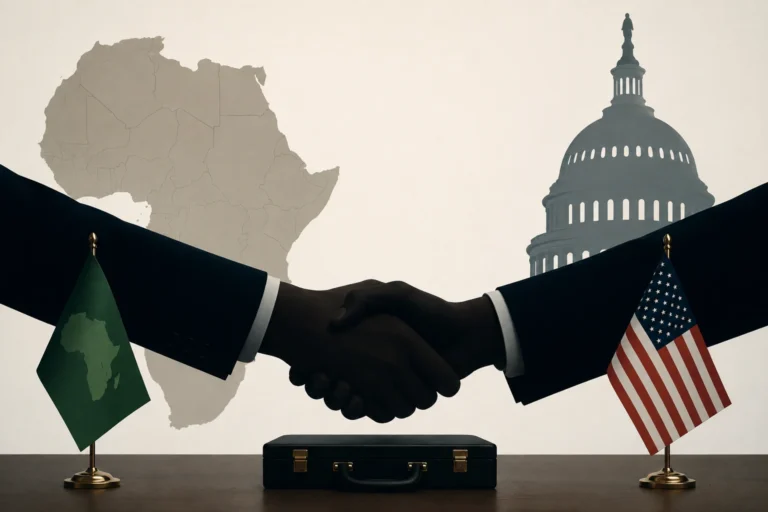
Nigeria has emerged as one of several African governments spending millions of dollars hiring Washington lobbying and public-affairs firms as they seek access to President Donald Trump’s administration,
Nigeria recently signed a lobbying agreement with DCI that could cost up to $9 million, while the Democratic Republic of Congo, Angola, Tanzania, Kenya, Somalia, Rwanda and Liberia have also entered significant lobbying or government-relations arrangements with US firms.
These arrangements are disclosed under the US Foreign Agents Registration Act, or FARA, which requires certain people and organisations representing foreign principals to publicly disclose their relationships, activities, receipts and disbursements. The law does not prohibit foreign governments from hiring lobbyists.
Nigeria’s $9 million Lobbying Deal
Nigeria’s arrangement with DCI Group is the most prominent African example. The Federal Government, acting through Kaduna-based Aster Legal on behalf of National Security Adviser Nuhu Ribadu, engaged DCI Group AZ LLC under an agreement signed on December 17, 2025.
The contract provides for a monthly retainer of $750,000. The initial six-month period was therefore worth $4.5 million, with the arrangement capable of extending to 12 months and taking the potential value to $9 million. The US Justice Department’s FARA records continue to list Nigeria through Aster Legal as a foreign principal of DCI Group, with subsequent filings showing continuing activity during 2026.
The stated assignment is to communicate Nigeria’s actions to protect Christian communities and maintain US support for its campaign against jihadist groups and other destabilising forces in West Africa. This has been described in many quarters as an effort to counter narratives that Christians are being systematically targeted in Nigeria.
On October 31, 2025, Trump designated Nigeria a Country of Particular Concern under the International Religious Freedom Act, placing religious freedom and the treatment of Christian communities at the centre of US – Nigeria relations.
Nigeria’s lobbying campaign therefore came as the government was attempting to prevent the religious-freedom dispute from damaging its wider security relationship with Washington.
The strategy appears to have produced at least some diplomatic dividends. The Financial Times reported in August 2026 that DCI’s work included facilitating First Lady Remi Tinubu’s participation in the National Prayer Breakfast in Washington, where Trump publicly praised her and spoke positively about US-Nigeria cooperation against Islamist terrorism. The newspaper described the episode as a tangible example of the lobbying campaign’s influence.
The same report said the campaign involved Trump associate Roger Stone, whose participation is reflected in DCI Group’s FARA filings.
At $750,000 a month, Nigeria’s contract costs $9 million if maintained for a full year. That is a substantial expenditure for a country simultaneously confronting terrorism, a severe security burden and competing demands for public resources.
DRC: lobbying, war and critical minerals
The Democratic Republic of Congo has perhaps the clearest example of lobbying becoming intertwined with security and natural resources.
Kinshasa has used several Washington firms as it sought American backing in its confrontation with the M23 rebellion in eastern Congo and attempted to strengthen its position in negotiations involving the United States.
Ballard Partners, founded by Republican fundraiser Brian Ballard, had represented the DRC since 2022. Its contract was renewed in January 2025 at $100,000 a month, or approximately $1.2 million a year. The stated objectives included strengthening US-DRC relations, democratic institutions and economic growth.
Ballard’s political connections are significant. Brian Ballard was a major Trump fundraiser and the firm’s Washington influence expanded substantially during Trump’s second term. Reuters reported that Ballard Partners generated $14 million in federal lobbying revenue in the first quarter of 2025, up 225% from a year earlier.
The DRC also signed a $5 million, six-month agreement with Earhart Turner, a firm founded by Karen Giorno, a former senior adviser to Trump’s 2016 campaign. Global Witness described the contract as the firm’s first lobbying deal.
In April 2025, President Félix Tshisekedi’s office suspended all lobbying contracts and proposals involving US firms, explicitly including Earhart Turner. The presidency said it wanted to prioritise direct relations with the new US administration through official channels.
The DRC case illustrates why lobbying has become particularly important in Trump’s Africa policy: Congo possesses enormous deposits of cobalt, copper, lithium, coltan and other minerals that the US views as strategically important in its competition with China.
The US subsequently deepened economic and security engagement with both Congo and Rwanda. The US International Development Finance Corporation announced in December 2025 that it was exploring investments connected to Congo’s state mining company Gécamines and supply-chain security.
Angola: $3.75 million a year Lobbying Contract
Angola has one of the longest-running lobbying relationships in this group. Squire Patton Boggs has represented the Angolan government for years, and a new one-year agreement renewed in January 2025 is worth $3.75 million.
The contract covers developing projects, increasing US trade and investment, improving Angola’s profile in the United States and providing strategic communications advice. The US Justice Department’s FARA records confirm the relationship.
Global Witness reported that Angola’s relationship with Squire Patton Boggs dates back to 2019 and that the country had paid the firm more than $28 million over the years. The firm has also highlighted Angola’s role in the Lobito Corridor, the infrastructure route intended to connect mineral-producing regions of the DRC and Zambia with Angola’s Atlantic port.
The lobbying therefore serves interests extending well beyond public relations. Angola wants American investment and stronger economic ties, while Washington wants greater access to critical-mineral supply chains that can reduce dependence on China.
Tanzania: the newest $3 million contract
Tanzania represents the newest major addition to the lobbying wave.
In June 2026, Tanzania entered a one-year, $3 million agreement with BGR Government Affairs. The retainer is $250,000 a month and covers government affairs, public relations, strategic communications and outreach to US officials, non-governmental organisations and the media.
The US State Department had been reviewing its relationship with Tanzania amid concerns about religious freedom, freedom of expression and the violent aftermath of the October 2025 elections. Reporting on the agreement has therefore linked the lobbying campaign to Tanzania’s attempt to manage its international reputation in Washington.
BGR also has Republican connections. Its managing director David Urban worked on Trump’s 2016 presidential campaign, while the firm has long operated as a major Washington government-affairs business.
The Tanzania contract means the country could spend $3 million in one year on this single US lobbying relationship, separate from other lobbying arrangements.
Kenya: $175,000 every month
Kenya hired Continental Strategy LLC in August 2025 for federal-level lobbying and government-relations work in Washington.
The agreement provides for a $175,000 monthly retainer, with additional reimbursable expenses. The firm was founded by Carlos Trujillo, a former US ambassador to the Organization of American States during Trump’s first administration and a Trump ally.
The contract was designed to strengthen Kenya’s engagement with US policymakers and support its diplomatic, trade and security interests.
Kenya’s decision was particularly notable because it came around President William Ruto’s efforts to deepen relations with Trump and Washington. The FARA filing confirms that the Republic of Kenya is the foreign principal represented by Continental Strategy.
At $175,000 a month, the basic annual cost is $2.1 million before reimbursable expenses.
Somalia: $44,000 a month and Roger Stone
The Somali government signed a 12-month agreement with Arsenal Government and Public Affairs Group at $44,000 a month. The contract covers US-Somali relations, government affairs and public relations, including efforts to arrange meetings with US officials and generate media exposure.
The agreement identifies Christopher Neiweem as the firm’s chief executive and Roger Stone Jr. as an adviser and campaign co-leader on the Somalia account. The contract runs from September 2025 to October 2026 and is worth about $528,000 before reimbursable expenses.
Reporting from Somalia has shown that the lobbying effort included efforts to obtain media exposure for President Hassan Sheikh Mohamud and strengthen his government’s relationship with Washington.
Rwanda: $80,000 a month
Rwanda’s lobbying arrangement is less expensive but strategically significant. In March 2025, Rwanda Development Board signed a contract with Yorktown Solutions worth $80,000 a month, or $960,000 over a year if maintained for 12 months.
Global Witness identified the contract as part of the post-election wave of lobbying by countries seeking stronger access to Washington. Yorktown Solutions also represents several Ukrainian state agencies.
Rwanda’s US campaign unfolded against its increasingly complicated relationship with the US over the conflict in eastern Congo. The US has accused Rwanda’s military of supporting M23. In March 2026, the US Treasury Department sanctioned the Rwanda Defence Force and four senior officials, accusing the RDF of supporting, training and fighting alongside M23.
At the same time, the US has pursued a strategic relationship with both Rwanda and Congo, including economic and mineral interests.
That contradiction helps explain the value of having professional advocates in Washington: governments are not merely seeking favourable publicity but access to policymakers capable of influencing sanctions, trade, investment and security policy.
Liberia: another Ballard contract
Liberia joined the newer wave in 2026 when President Joseph Boakai’s administration signed a one-year agreement with Ballard Partners in May 2026 worth $100,000 a month, or $1.2 million annually.
The agreement was filed with the US Department of Justice on May 29 and identifies Liberia as the foreign principal. Brian Ballard signed for the lobbying firm.
The contract calls for Ballard Partners to provide strategic consulting and advocacy before US government officials, businesses and non-governmental organisations, with the stated objective of strengthening US-Liberia relations.
Liberia is not new to American lobbying, but the choice of Ballard is significant because of the firm’s close Republican and Trump connections.
Widespread Phenomenon
The broader phenomenon was documented in a 2025 investigation by Global Witness. The organisation examined FARA records and found that 17 countries classified as least-developed countries or major recipients of US aid had signed lobbying contracts with American firms worth more than $21 million in fees payable through the end of 2025.
The 17 countries were Angola, Cambodia, the Democratic Republic of Congo, Haiti, Honduras, India, Iraq’s Kurdistan region, Liberia, Moldova, Mozambique, Pakistan, the Philippines, Rwanda, Somalia, Ukraine, Venezuela and Yemen.
Global Witness found that more than $17 million of the fees were due in 2025 from contracts involving firms with links to Trump and people in his political network.
The organisation argued that the timing was significant because the Trump administration had frozen more than $60 billion in foreign-aid programmes while simultaneously emphasising American access to strategic minerals and resources.
As such, governments that previously relied heavily on American aid are increasingly paying Washington professionals to secure political access, protect security relationships and position themselves for trade and investment.