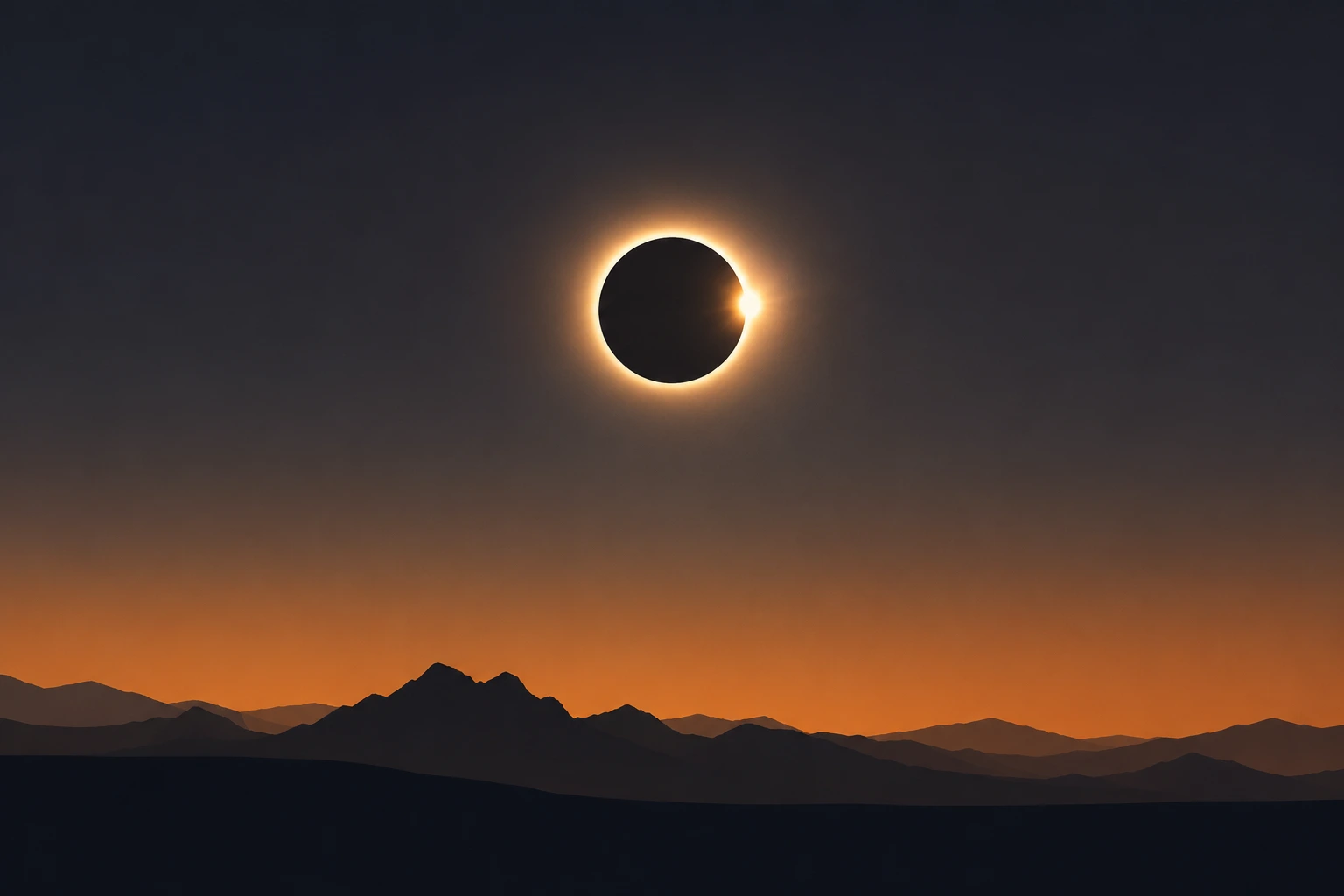
A narrow corridor of the northern hemisphere is falling into darkness on Wednesday as the Moon passes directly between Earth and the Sun, creating a total solar eclipse that has turned parts of Spain, Iceland and Greenland into temporary centres of scientific research and mass tourism.
The eclipse is crossing eastern Greenland, western Iceland, the North Atlantic and northern Spain before reaching a small section of Portugal. Much of Europe, western Africa and parts of North America are seeing a partial eclipse instead.
For observers inside the path of totality, the event is measured in minutes. At its longest, the Moon will completely cover the Sun for about two minutes and 18 seconds. In Spain, the timing is particularly dramatic: the eclipse occurs late in the afternoon and approaches sunset, leaving relatively little margin for poor weather or an obstructed horizon. Spain’s National Geographic Institute says totality will last about 76 seconds in A Coruña, for example.
That combination of rarity, accessibility and timing has made Spain the main European destination for eclipse watchers.
Spain becomes the centre of eclipse tourism
The eclipse is also becoming a test of how destinations cope with sudden astronomical tourism.
Spanish authorities have been preparing for millions of visitors along the eclipse’s route, with large concentrations expected in northern and central parts of the country. The event is particularly valuable to rural areas that normally compete with Spain’s better-known coastal and urban destinations for international visitors.
The attraction is not simply the darkness. A total eclipse produces conditions that cannot be reproduced by an ordinary sunset or by covering the Sun with an artificial instrument. When the Moon completely blocks the Sun’s bright surface, the normally hidden corona — the Sun’s outer atmosphere — becomes visible.
That fleeting view is also what makes the event useful to scientists.
Two minutes that can reveal the Sun
NASA is sending a WB-57 high-altitude research aircraft into the eclipse, flying at about 50,000 feet. The aircraft will follow the Moon’s shadow, allowing its instruments to observe the corona for nearly three minutes rather than the roughly two minutes available to observers on the ground.
The altitude solves another problem: Earth’s atmosphere. From above much of the atmosphere and above clouds, the aircraft can collect clearer observations and examine infrared wavelengths that are partly absorbed before reaching ground-based instruments.
The target is not merely a better photograph.
The corona is a key part of the Sun’s atmosphere and is closely connected to the processes that drive solar wind and space weather. Better observations can help scientists understand the structure and behaviour of this region and improve the models used to predict solar activity.
NASA is also supporting balloon experiments in Iceland and Spain. Student research teams are launching dozens of balloons before, during and after the eclipse to measure changes in the atmosphere as daylight disappears and then returns. In Iceland alone, two teams plan to launch 80 balloons over an extended period around the event.
The eclipse is also a test of scientific models
The European Space Agency is approaching the event from a different direction.
Scientists can create artificial eclipses with coronagraphs — instruments that block the bright solar disc so the much fainter corona can be observed. But an actual eclipse provides a natural benchmark against which those simulations can be tested.
ESA researchers will compare observations made during totality with computer predictions and artificial-coronagraph observations. The goal is partly methodological: determine how accurately scientists can reproduce what the corona should look like and identify where their models fall short.
That matters beyond eclipse photography. Solar observations underpin efforts to understand space weather, which can affect satellites, communications and other technologies that depend on Earth’s space environment.
The eclipse therefore creates an unusual convergence: an event that lasts only minutes becomes an opportunity to test years of scientific modelling.
A rare event, but not a one-off
The excitement surrounding August 12 is partly driven by geography.
Total solar eclipses occur regularly somewhere on Earth, but any particular location can wait centuries for another one. A 2026 study of eclipse frequency estimates that a given place experiences a total solar eclipse, on average, only about once every 373 years, although the frequency varies substantially by latitude.
For Spain, the wait is particularly notable. The country is now part of a sequence of major eclipses crossing the region. Another total solar eclipse will pass through southern Spain and North Africa on August 2, 2027, followed by another in 2028. NASA lists the 2027 event as passing through Spain, Morocco, Algeria, Tunisia, Libya, Egypt, Saudi Arabia and Yemen.
For Iceland, the opportunity is considerably rarer.
The country’s position on the path means that eclipse chasers have travelled there despite the greater risk of cloud. Spain’s advantage is its larger area of totality and, in many locations, more favourable prospects for viewing.
The danger comes before totality
The spectacle has one important limitation: most of the eclipse cannot safely be watched with the naked eye.
During the partial phases, even a small uncovered portion of the Sun remains intensely bright enough to damage the retina. NASA says direct viewing becomes safe only during the brief period of totality, when the Moon completely covers the Sun’s bright surface.
That distinction is crucial because the overwhelming majority of the eclipse experience is partial. Certified solar-viewing protection is required before and after totality; ordinary sunglasses do not provide equivalent protection.
For those outside the narrow path, the eclipse will still be visible as a partial event across a huge area of the northern hemisphere, including much of Europe and northwestern Africa. NASA and ESA are also providing live coverage for people who cannot reach the zone of totality.

The Moon’s shadow will disappear almost as quickly as it arrived.
For scientists, however, the data collected during those few minutes will remain long after the sky has returned to normal. For the millions who travelled to see it, the memory will be even harder to measure: a brief moment when daytime became night, the stars appeared and the normally invisible atmosphere of the Sun emerged around a black lunar disc.