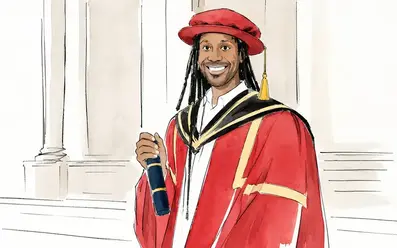
Professor Dame Ijeoma Uchegbu, president of the Wolfson college, Cambridge has withdrawn her support for the Cambridge professor Jason Arday amidst the cloud of plagiarism allegations surrounding him.
Professor Dame Ijeoma Uchegbu, a nanoscientist and the head of Wolfson College, had previously signed an open letter in support of Arday that was circulated by the Good Law Project.
Arday, who was the youngest black professor to be appointed by the university, has been accused of plagiarism and making exaggerated claims about his sporting and fundraising achievements.
Arday, a professor of sociology of education, is alleged to have plagiarised his PhD thesis and parts of his published academic research. He has also been accused of lying about or exaggerating parts of his life, including claims to have run 600 miles in six days, and raising more than £5 million for charity.
He denied fabricating stories about marathon running and raising millions for charity, although he conceded he was part of a fundraising “syndicate” rather than doing it all himself, and that he had run 600 miles in 12 days, not six. Arday told The Times: “I accept responsibility that I could have been really, really explicit” in correcting that narrative.
He said: “I am accountable for the mistakes I’ve made. I hold myself accountable and other people should hold me accountable. We’re talking about academia here. I didn’t murder somebody. I think the cruelty that I’ve experienced and the positioning of me as this kind of liar and fantasist is totally unacceptable.”
Calls For Investigations
Other academics, including some within his discipline of sociology, have said the alleged plagiarism and academic misconduct require serious investigation. Professor Colin Mills, the head of Oxford’s sociology department, wrote on X: “I do not want the reputation of my discipline, my department, my hardworking and intellectually honest colleagues, or myself smeared by indirect association with academic fraud, low academic standards, and clownish statements from people in positions of authority who should know better.”
There have also been calls for the Office for Students to investigate Liverpool John Moores University (LJMU), which awarded Arday’s PhD.
Significant parts of his PhD thesis appear to have been copied verbatim from another researcher, Paula Zwozdiak-Myers, who wrote a PhD thesis on the same topic several years earlier.
When LJMU investigated the case, Arday did not dispute the specific allegations of plagiarism but said the misconduct panel should consider the political context of a “war on critical race theory” and the weaponisation of plagiarism allegations against black researchers.
In a written testimony provided to The Times, Arday said he received only one formal recorded supervision session in the two and a half years he worked on his PhD. He was supposed to have had three supervisors, but one left the university and was never replaced, and he never met the third. In its judgment on his case, LJMU acknowledged that the plagiarism was in part due to a “depleted supervisory team”.
Other Controversial Claims
On Monday night the WaterAid charity cast doubt on claims Arday had made about “installing water points” in South America and West Africa, saying that it never sent volunteers abroad.
According to the Daily Telegraph, Arday’s biography on the website of his speakers’ agency, the Simon & Schuster Speakers Bureau, stated until recently: “He has also undertaken and completed relief work in South America and west Africa with WaterAid installing water points, which provide drinkable and clean water.”

The name of WaterAid has since been removed, but the same claim appeared on several other of Arday’s biographies before events where he was speaking.
When the newspaper asked WaterAid whether the professor had installed water points in South America or west Africa for the charity, a spokesman referred to its policy on volunteers, which has a section titled: “Why we don’t send volunteers abroad.” It explains that “it’s vital that each community is responsible for managing their own projects” and that “out of respect for the people we work with, we don’t encourage or facilitate self-funded visits either”.