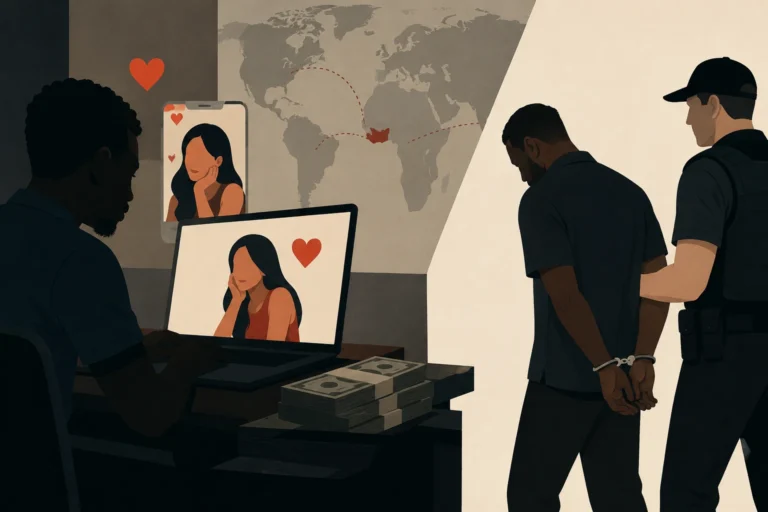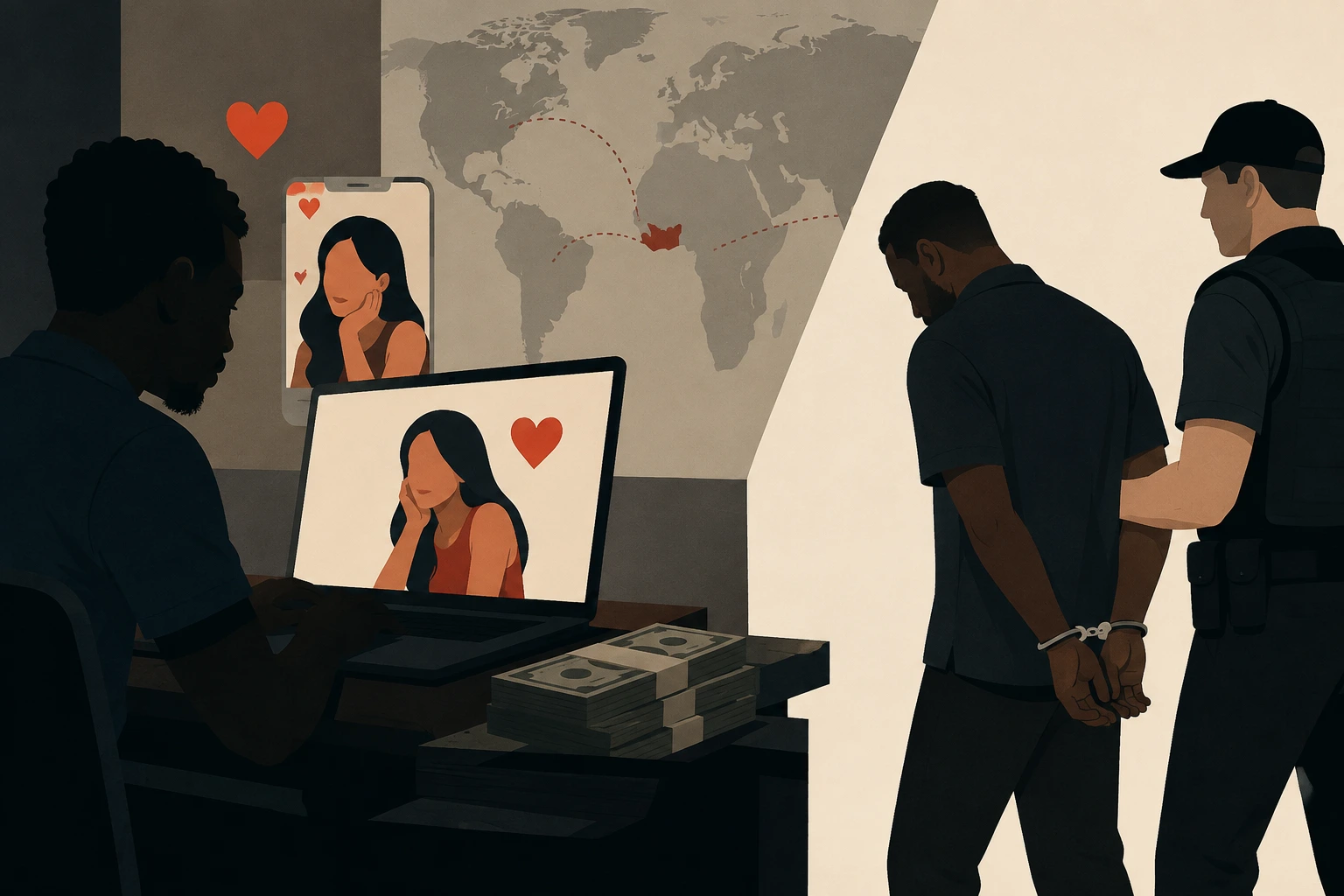
A Ghanaian man has been sentenced to more than seven years in a U.S. federal prison after admitting his role in an international romance fraud operation that prosecutors say extracted more than $10 million from victims by exploiting trust developed through fake online relationships.
The defendant, Derrick Van Yeboah, pleaded guilty earlier this year to conspiracy to commit wire fraud before a federal court in New York imposed an 85-month prison sentence. In addition to imprisonment, the court ordered him to forfeit more than $10 million and serve two years of supervised release after completing his sentence.
A criminal model built on emotional manipulation
According to U.S. prosecutors, Van Yeboah belonged to a wider fraud network operating from Ghana that created fictitious identities on dating websites and social media platforms.
Members of the organisation cultivated long-term online relationships with victims before inventing financial emergencies, business opportunities or inheritance-related claims that persuaded them to transfer money.
Court filings cited by prosecutors describe victims sending millions of dollars after believing they were helping romantic partners or trusted associates. Two American women alone were persuaded to transfer nearly $4.2 million between 2019 and 2020. In another case, a victim sent $123,000 after being told the funds were needed for funeral expenses and to recover gold and diamonds allegedly held in Italy.
The investigation illustrates how cyber-enabled financial crime increasingly depends on cooperation across jurisdictions. U.S. authorities said the FBI worked alongside Ghana’s law enforcement and intelligence agencies, including the Office for the Fight Against Organised Economic and Cyber Crime, the Ghana Police Service, the Cyber Security Authority, the National Intelligence Bureau and Interpol to identify members of the network.
Van Yeboah was arrested in Ghana in 2025 before being extradited to the United States to face prosecution.
Romance fraud remains one of the fastest-growing cybercrimes
Romance scams have become one of the most financially damaging forms of online fraud worldwide because they rely less on sophisticated hacking than on psychological manipulation. Criminal groups often spend weeks or months cultivating relationships before requesting money, making victims less likely to recognise the deception or report it quickly.

Law enforcement agencies in the United States, Europe and West Africa have increasingly targeted organised networks behind such schemes rather than treating individual cases as isolated frauds. Investigators say these groups frequently combine romance scams with business email compromise, investment fraud and money-laundering operations spanning multiple countries.
Former federal prosecutor Jake Layton said the case demonstrated how organised fraudsters exploited loneliness, trust and legitimate business relationships to steal substantial sums from victims, adding that the sentence reflected the seriousness with which U.S. courts now treat transnational cyber-enabled financial crime.