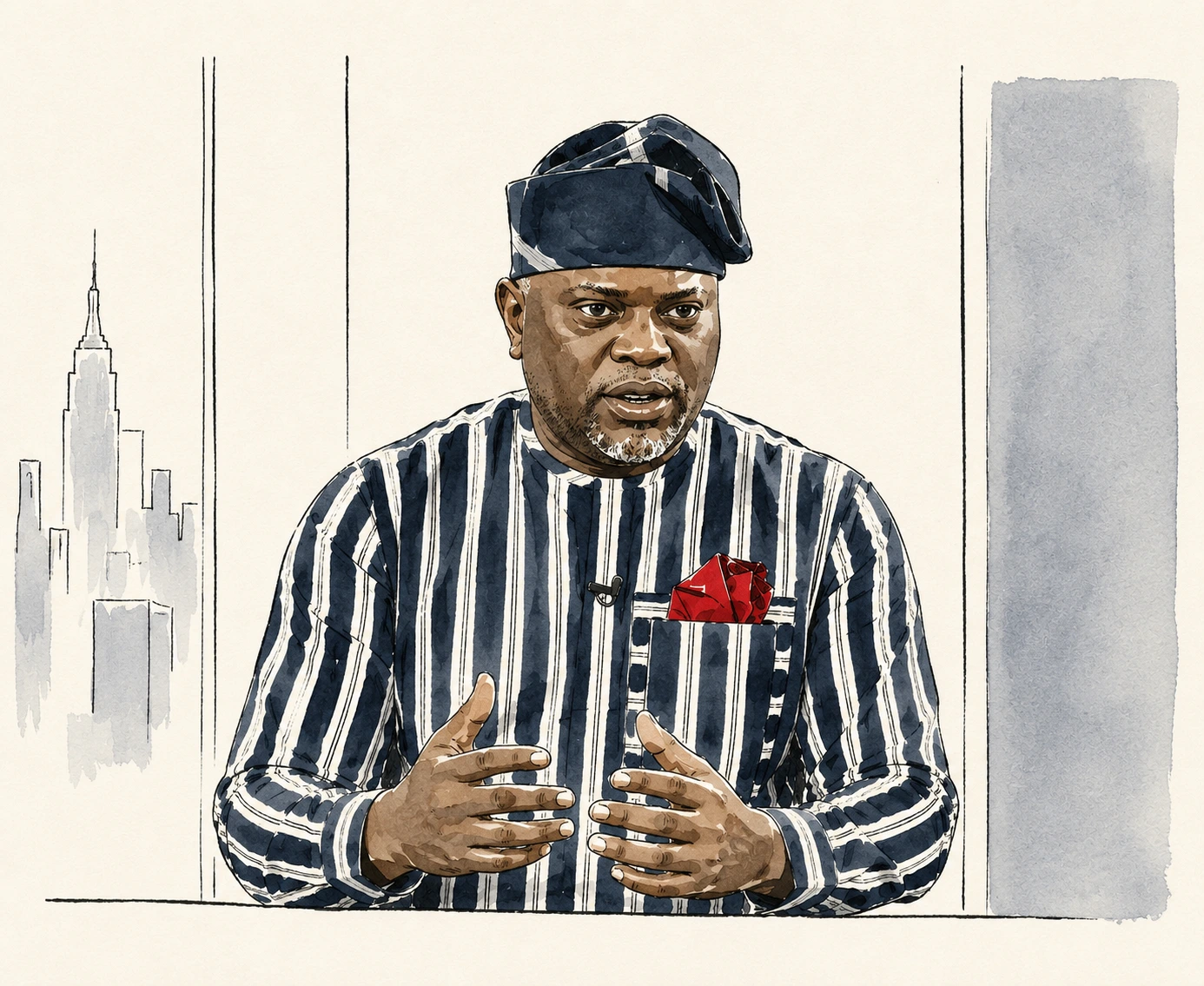
Presidential economic adviser Dr. Tope Fasua has offered an unusual defence of inflation, arguing that the economic debate in Nigeria focuses excessively on those who suffer from rising prices while ignoring farmers, traders, importers and landlords who receive more money when prices increase.
Speaking during an interview on Channels Television, Fasua argued that the sharp increase in prices between 2020 and 2024 generated higher incomes for millions of Nigerians involved in agriculture and commerce.
“When prices went up between 2020 and 2024, farmers made the money, traders made the money, importers made the money. They are Nigerians,” Fasua said.
He made the same argument about rising housing costs.
“When the price of shelter goes up, Nigerian landlords make the money. They pocket the money,” he said.
Fasua described the effects of inflation as “50-50”: consumers pay higher prices, but farmers, traders, importers, landlords and other sellers receive the additional money.
There is an element of established economic thinking in this argument. Inflation does create winners and losers.
But Fasua’s broader argument appears to overlook one of the most fundamental distinctions in economics: the difference between receiving more money and becoming richer.
Higher Prices Are Not the Same as Higher Real Incomes
A farmer who sells a tuber of yam for ₦3,000 instead of ₦1,500 receives twice as much money.
But this does not mean that his income, profit or economic welfare has doubled.
The cost of fertiliser may have increased. Transporting produce to the market may be more expensive. Farm labour may cost more. Seeds, machinery and other inputs may also have risen in price.
And when the farmer spends his higher income, he also confronts higher prices for food, transportation, housing, education and healthcare.
Economists therefore distinguish between nominal income and real income.
Nominal income measures how much money a person receives.
Real income measures what that money can actually buy.
It is the second measure that determines whether the farmer, trader or landlord cited by Fasua has genuinely benefited from inflation.
A farmer whose revenues increase by 50 per cent while production and living costs rise by 70 per cent is poorer, not richer.
Fasua’s argument appears to confuse these two very different economic outcomes.
Traders Do Not Simply ‘Make the Money’ When Prices Rise
The same problem applies to Fasua’s argument about traders.
A trader who bought a product for ₦10,000 and sells it for ₦15,000 may appear to have made more money.
But if replacing the product now costs ₦16,000, the higher selling price has not necessarily increased the trader’s real income or wealth.
This is one of the basic problems businesses face during periods of high inflation.
Companies and traders may report rapidly increasing revenues while simultaneously experiencing pressure on profit margins because wages, energy, transportation, inventory and financing costs are also rising.
Higher turnover is not necessarily higher profit.
And higher nominal profit is not necessarily higher real profit.
Simply observing that traders receive more naira when prices rise therefore tells us very little about whether inflation has made them economically better off.
The Same Problem Applies to Landlords
Fasua also argues that Nigerian landlords benefit when rents increase.
Some undoubtedly do.
A landlord whose rental income rises faster than inflation and whose property appreciates in real terms can genuinely benefit from an inflationary environment.
This is one area where Fasua’s broader point about winners and losers has economic validity.
But even here, the calculation is more complicated than simply observing that rents have increased.
Construction materials, repairs, security, labour and property maintenance costs may also rise.
More importantly, landlords are not merely landlords. They are also consumers.
The additional income earned from higher rents must be measured against the declining purchasing power of that income.
Whether a landlord has benefited from inflation therefore depends on whether rental income and asset values have increased faster than the landlord’s costs and the general price level.
Again, the relevant economic question is about real gains, not nominal price increases.
Inflation Does Create Winners and Losers
There is, however, an important element of mainstream economics in Fasua’s argument.
Inflation does not affect everyone equally.
Unexpected inflation can reduce the real value of fixed-rate debt, benefiting borrowers at the expense of lenders.
Owners of property, commodities and other real assets may be better protected against inflation than people who hold large amounts of cash.
Companies with strong pricing power may increase prices faster than their costs.
Workers whose wages rise faster than inflation can also experience increases in real income.
Nigerian do not experience inflation in exactly the same way.
But acknowledging that inflation creates winners and losers is very different from arguing that its economic effects are “50-50.”
Inflation Is Not a Simple Transfer From Consumers to Producers
The central problem with the “50-50” argument is that inflation is not simply a transfer of money from the person buying a product to the person selling it.
If that were the case, sustained high inflation might indeed be largely neutral for the economy as a whole.
Consumers would lose. Producers would gain. The money would simply move from one group of Nigerians to another.
But this is not how mainstream economics understands inflation.
Persistent high inflation reduces the purchasing power of money.
It makes it harder for businesses to plan and invest.
It creates uncertainty about future costs and revenues.
It can discourage long-term savings in the domestic currency.
It can distort investment decisions.
It forces businesses to devote resources to repeatedly changing prices, renegotiating contracts and managing inflation risk.
It can also make it more difficult for consumers and businesses to distinguish between changes in the relative price of a particular product and increases in the general price level.
These are real economic costs.
They do not disappear simply because some farmers, traders and landlords receive more naira.
Nigeria’s Experience Makes the ‘50-50’ Argument Even Harder to Defend
The distribution of income and assets in Nigeria creates an additional problem for Fasua’s argument.
Poorer households spend a significantly larger proportion of their incomes on essential goods such as food, transportation and housing.
They are therefore particularly vulnerable to high inflation.
Many Nigerians also work in the informal economy or receive wages that are adjusted slowly, if at all, when prices increase.
For these households, inflation can produce a rapid decline in living standards.
Meanwhile, ownership of the assets that may protect against inflation — property, equities and profitable businesses — is concentrated among a much smaller proportion of the population.
The Nigerians who benefit from rapidly rising rents or appreciating property values are not necessarily the same Nigerians struggling to pay for food and transportation.
The existence of inflation winners therefore does not establish that the gains and losses are evenly distributed across the economy.
Indeed, inflation can transfer income and wealth from poorer households with few assets to wealthier households with greater ability to protect themselves against rising prices.
What Happened to Nigerian Farmers Between 2020 and 2024?
Fasua’s reference to farmers raises perhaps the most important empirical question in his argument.
Did Nigerian farmers actually become significantly richer as food prices increased between 2020 and 2024?
It is not enough to establish that the prices of yam, rice, tomatoes and other agricultural products increased.
To demonstrate that farmers benefited from inflation, it would be necessary to examine what happened to their real incomes.
How much did fertiliser prices increase?
What happened to transportation costs?
How much more did farmers pay for labour, seeds, pesticides and machinery?
Did farm profits increase faster than inflation?
And after receiving higher revenues, could farmers actually buy more goods and services than they could before prices increased?
Without answering these questions, the statement that “farmers made the money” tells us very little about whether Nigerian farmers became economically better off.
The Real Question Is Purchasing Power
The fundamental weakness in Fasua’s argument is therefore relatively straightforward.
Higher prices generate higher nominal revenues.
They do not automatically generate higher real incomes.
A worker whose salary increases from ₦200,000 to ₦300,000 has received a 50 per cent pay increase.
But if the cost of maintaining the same standard of living for him and his family has doubled, that worker is poorer.
A farmer whose sales revenue doubles while production costs triple has not benefited from inflation.
A trader whose turnover increases by 70 per cent while inventory replacement costs increase by 100 per cent has not become richer.
A landlord whose rents rise faster than inflation and maintenance costs may genuinely have gained.
The correct economic analysis must therefore examine changes in real wages, real profits, productivity, purchasing power and wealth.
Simply pointing to the Nigerians receiving higher prices does not answer the question.
Why Central Banks Fight Inflation
There is also a larger difficulty with Fasua’s argument.
Central banks across the world devote enormous resources to maintaining price stability.
The Central Bank of Nigeria raises interest rates to control inflation. The US Federal Reserve, European Central Bank and Bank of England all have price stability at the centre of monetary policy.
The reason is not that economists have somehow overlooked the farmers, traders, businesses and landlords who receive higher prices.
It is because decades of economic research and experience have established that sustained high and unpredictable inflation imposes significant costs on economies.
Moderate inflation can accompany economic growth.
Unexpected inflation can benefit particular groups.
Asset owners and borrowers can sometimes gain.
But none of these observations leads mainstream economics to conclude that sustained high inflation is broadly beneficial or that its impact can be described as “50-50.”
Tope Fasua Has Identified a Real Economic Effect — But Drawn the Wrong Conclusion
Fasua is right that Nigerians should not be analysed solely as consumers.
They are also producers, workers, borrowers, lenders, traders and asset owners.
Inflation affects these groups differently.
Some Nigerians unquestionably benefit from inflation.
But Fasua moves from this legitimate economic observation to a much more questionable conclusion.
The fact that farmers sell food at higher prices does not prove that their real incomes have increased.
The fact that traders receive more money does not establish that their real profits have risen.
And the fact that landlords charge higher rents does not demonstrate that inflation is economically neutral because the money paid by tenants has simply gone into the pockets of other Nigerians.
The missing concepts are real income, real profit and purchasing power.
Without examining them, Fasua’s “50-50” description of inflation risks confusing the movement of nominal prices with the creation of real economic gains.

That is not merely a disagreement over President Tinubu’s economic policies.
It is a disagreement about one of the most fundamental distinctions in economics.