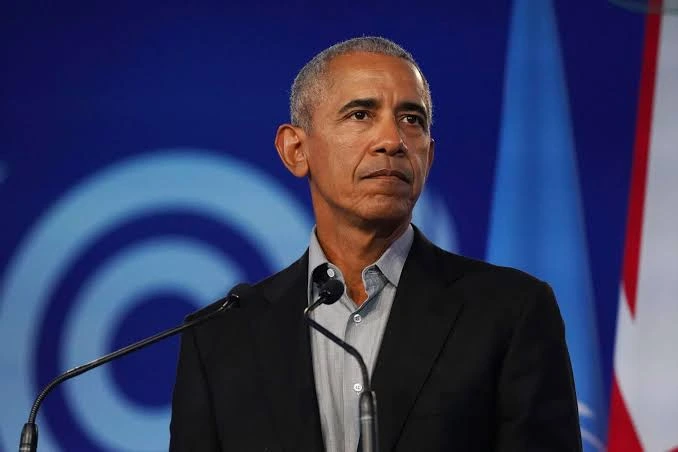
Former U.S. President Barack Obama has cautioned that any new nuclear agreement between Washington and Tehran is unlikely to represent a meaningful upgrade on the landmark 2015 accord he once brokered, arguing instead that diplomacy—however imperfect—remains the only viable path to avoiding another major Middle East war.
In a reflective interview excerpt aired on ABC News’ This Week, Obama revisited one of the most contested foreign policy legacies of his presidency: the Iran nuclear deal, formally known as the Joint Comprehensive Plan of Action.
He suggested that expectations surrounding a potential new agreement under President Donald Trump were being overstated, and that the original framework, despite its critics, had delivered stability for years before the United States withdrew from it.
“No significant improvement is likely”
Obama’s central argument was blunt. It was “doubtful,” he said, that any new arrangement negotiated by the current administration would differ meaningfully from the 2015 deal—or improve upon it in any substantial way.
That agreement, reached after years of diplomacy with Iran and other world powers, placed strict limits on Tehran’s nuclear programme in exchange for sanctions relief.
He pointed out that the deal functioned as intended for a considerable period before it was abandoned by the United States, a move that reshaped regional dynamics and set off years of renewed tension.
Diplomacy versus escalation
Beyond the technical debate over nuclear thresholds and verification mechanisms, Obama used the interview to return to a broader philosophical position that defined much of his foreign policy outlook: the belief that military pressure alone cannot resolve deeply rooted geopolitical disputes.
Referring indirectly to ongoing tensions involving Tehran and Western powers, he warned against the idea that coercion or force could substitute for negotiation.
The former president argued that even a flawed agreement would be preferable to the risk of open conflict, particularly given the fragility of the region.
His comments come at a moment of renewed volatility in the Middle East, where US and Israeli military activity earlier this year escalated tensions with Iran, and diplomatic channels have remained uncertain.
President Trump has continued to promote the possibility of a new deal, describing it as a framework that would permanently prevent Iran from developing nuclear weapons and potentially reopen strategic shipping routes such as the Strait of Hormuz.
Tehran, however, has publicly questioned the value of continued negotiations under current conditions.
A familiar warning
Obama’s remarks also reflected a broader concern about what he sees as cyclical policy mistakes in Washington’s approach to Iran.
In his view, the collapse of the earlier agreement and the return to confrontation underscored a recurring failure to sustain long-term diplomatic commitments.
“You’d think we would have learned that lesson by now,” he said, framing the issue less as a partisan disagreement than as a structural challenge in American foreign policy.
He reiterated that the original agreement had been designed not as a permanent solution, but as a stabilising mechanism—one that reduced the immediate risk of nuclear escalation while keeping space open for future negotiations.
Closing perspective: the stakes of repetition
At its core, Obama’s intervention was less about revisiting past policy than about warning against repeating it under new political branding. He suggested that the illusion of achieving a dramatically “better” deal may be less realistic than accepting incremental compromise as the price of stability.
The debate now unfolding in Washington and Tehran, he implied, is not simply about terms and conditions, but about whether diplomacy itself still holds enough political patience to function.
More than a decade after the original accord was signed in 2015, the same questions persist—how to contain nuclear ambition, how to balance pressure with engagement, and how to avoid turning negotiation failures into military confrontation.