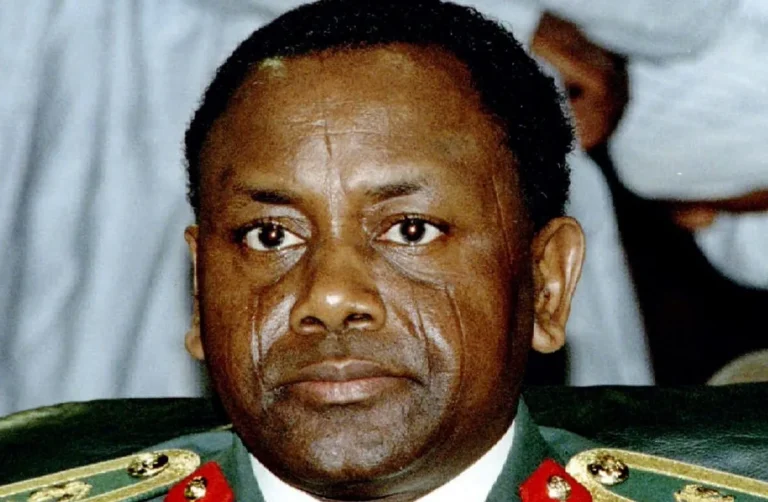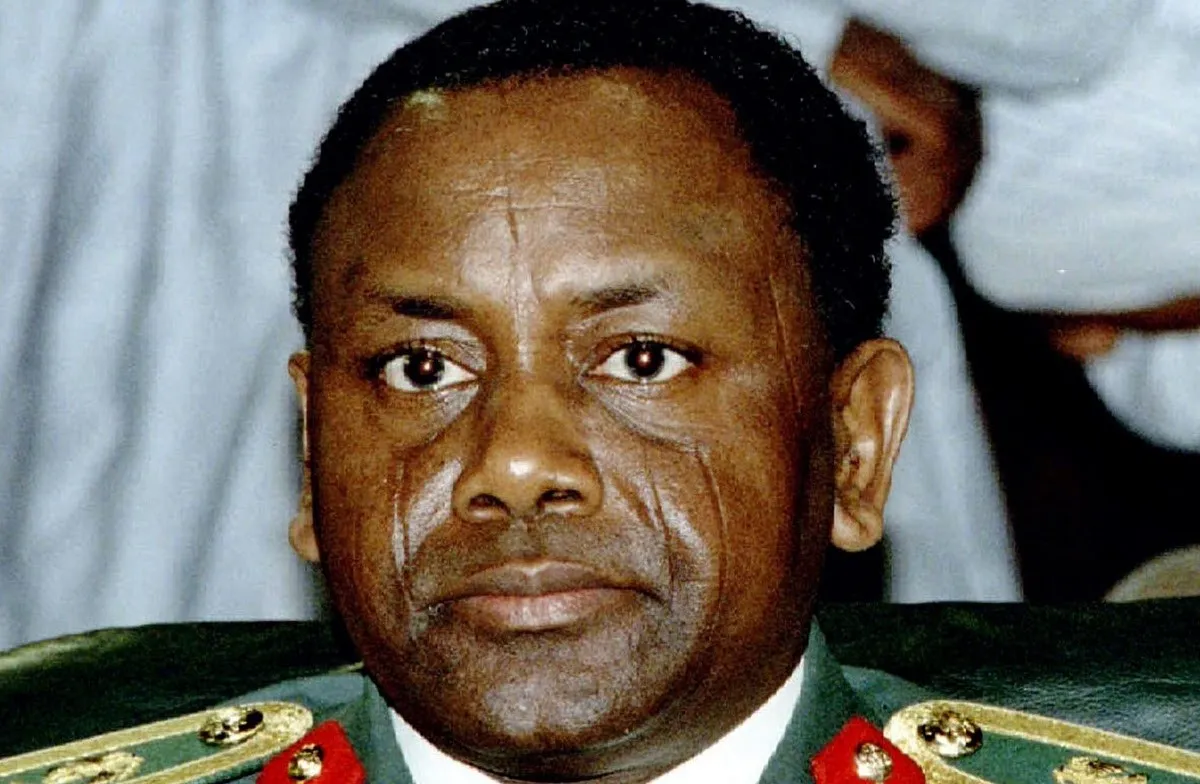
Nearly three decades after Sani Abacha died inside Nigeria’s seat of government, the circumstances of his death have acquired a new version — and the dispute over it says as much about the opacity of military rule as it does about the former ruler himself.
Dennis Amachree, a retired senior intelligence officer who was working for the State Security Service when Abacha died in June 1998, has written that the military ruler suffered a fatal cardiac arrest during an intimate encounter with a woman at the Presidential Villa in Abuja.
The account, published in Amachree’s memoir DSS @40: My Journey Behind the Shield, has since been rejected by two men who were closely associated with Abacha’s government.
Former chief security officer Hamza Al-Mustapha has called it false, while former petroleum minister Dan Etete says Amachree has produced no documentary or medical evidence capable of establishing the claim.
The disagreement matters because there was never a publicly established forensic record that settled the circumstances of Abacha’s death.
Contemporary reporting said the government attributed his death to a heart attack, but Abacha was buried on the day he died and was not subjected to an autopsy, according to contemporaneous reporting.
That left an unusual gap in the historical record: one of the most powerful men in Nigeria died suddenly at the centre of government, yet the evidence available to the public about precisely how he died has never been extensive enough to extinguish competing theories.
What the new account actually claims
Amachree was an Assistant Director of Operations and Intelligence at the Lagos SSS Command when Abacha died.
In his memoir, he places the fatal episode at about 4:05 a.m. on June 8, 1998, at the Presidential Villa. He says Abacha was with a woman and suffered what he describes as a cardiac arrest during the encounter.
According to accounts of the memoir, the woman was connected to another woman who had accompanied her to Abuja and was identified as a pharmacist. Amachree says she realised that Abacha was no longer responding, left the villa and travelled to Lagos.
He says the intelligence service subsequently located and questioned her.
That is the crucial part of Amachree’s account: he is not presenting the story merely as something he heard years later. He says he was involved in the intelligence response that followed Abacha’s death.
But that distinction does not make the account independently proven.
A memoir is a source of testimony. It is not, by itself, a medical record.
The missing document is central to the dispute
Etete’s objection goes directly to that evidentiary problem.
He has demanded the post-mortem report, medical findings and records of the alleged investigation into the woman. He has also questioned whether there are flight records, security logs or interrogation documents that could independently establish the sequence described by Amachree.
The challenge is difficult to dismiss entirely because the original official explanation was itself relatively narrow.
When Abacha died on June 8, 1998, reports said the government attributed his death to a heart attack. Contemporary Washington Post reporting also described the official cause as a heart attack and noted that Abacha was buried without an autopsy.
That absence of an autopsy does not prove that the official explanation was wrong. Nor does it prove Amachree’s version is wrong.
It does, however, explain why the circumstances of the death have remained unusually vulnerable to competing narratives.
Abacha’s death came at a dangerous political moment
The mystery cannot be separated from the political circumstances in which Abacha died.
He had taken power in a November 1993 coup after the collapse of the interim civilian government that followed the annulled 1993 presidential election. His government subsequently became one of Nigeria’s most repressive military administrations.
Human Rights Watch documented the imprisonment of political and pro-democracy activists, restrictions on the press and the weakening of judicial independence under Abacha. In 1995, the regime executed writer and environmental campaigner Ken Saro-Wiwa and eight other Ogoni activists after a military tribunal process that drew international condemnation.
Abacha’s government was also holding Moshood Abiola, the presumed winner of the annulled June 1993 presidential election, in detention.
His death therefore did not occur in an ordinary political environment. It happened while Nigeria was still under military rule, amid intense domestic opposition and international pressure over human rights and the country’s stalled return to democracy.
Human Rights Watch later described Abacha’s death as bringing an abrupt end to a transition programme that had been widely discredited and that appeared designed to allow him to succeed himself as a civilian president. His successor, General Abdulsalami Abubakar, moved quickly towards a new transition process and released political prisoners.
The political consequences were immediate.
Within a year, Nigeria had returned to civilian government.
Why the conspiracy theories survived
The secrecy surrounding Abacha’s final hours became part of the larger mythology surrounding his rule.
For years, different explanations circulated, including allegations that he had been poisoned. The absence of a public autopsy gave such theories room to persist, even though none of them has been established as fact.
The new account does not really resolve that problem. Instead, it replaces one unresolved question with another.
Amachree’s version supplies a highly specific narrative — a precise time, location, a woman, an alleged interrogation and a medical explanation. But specificity is not the same as verification.
Al-Mustapha has attacked the account on another ground: proximity.
The former chief security officer says Amachree was not at the Presidential Villa when Abacha died and claims he possesses CCTV footage contradicting the account. He has not, however, publicly released that material.
That leaves the public with competing assertions from former members of the security establishment, without the underlying records that could settle the disagreement.
The bigger story is Nigeria’s missing institutional memory
The controversy illustrates a recurring difficulty in reconstructing episodes from Nigeria’s military era.
The people who witnessed major events often possessed information that was never fully transferred into publicly accessible institutional records. Decades later, memories become competing evidence.
That is particularly consequential when the event involves the death of a head of state.
A properly documented medical examination could have addressed the question of cause of death. Security and immigration records could potentially establish the movements of people allegedly present. An interrogation record could test whether the account attributed to the woman was actually documented at the time.
Without such material, historians and journalists are left trying to reconstruct an important event through recollections that may differ sharply.
That is why the latest dispute should not be reduced to the sensational question of whether Abacha died during sex.
The more consequential question is why, 28 years later, the public still cannot examine a sufficiently complete evidentiary record of how Nigeria’s military ruler died.
What can be established
There are several points that are not seriously in dispute.
Abacha died at the Presidential Villa on June 8, 1998, aged 54. He had ruled Nigeria since November 1993. The government said he died from a heart attack, and he was buried without an autopsy, according to contemporary reporting.
It is also established that a former senior intelligence officer has now published a substantially different account of the circumstances surrounding the death.
What remains unestablished is whether the woman described by Amachree was actually with Abacha at the time of his death, whether his death occurred in the manner described, and whether a cardiac arrest caused by the encounter was medically established at the time.
Those are different questions from whether Amachree was in a position to hear about or investigate the incident.

Until contemporaneous records emerge, the account remains a claim.
And the fact that it has taken 28 years to produce one more version of the story is itself part of the history of Abacha’s Nigeria: a period when enormous political power was concentrated in the hands of a small security establishment, and when the records needed to reconstruct its most consequential events were often inaccessible to the public.